Australia’s higher education teaching funding system is primarily based on subjects rather than students. Subjects taken are converted into ‘equivalent full-time student load’ (EFTSL), the amount of study a full-time student does in an academic year. The funding rate per EFTSL varies by field of education, assuming that subject characteristics drive costs.
Various supplementary programs calculate funding on headcount equity students, but with trivial resources compared to the subject-driven funding programs, the Commonwealth Grant Scheme and HELP.
Funding on headcount?
One interesting idea in submissions to the Universities Accord review, especially suggested by regional universities, was to base more funding on the student. For part-time study one EFTSL could be two or more individual students. While their combined classroom time matches one full-time student, a student with 50 per cent of an EFTSL could put similar or even greater demands on other university services as a student at 100 per cent of an EFTSL.
In RUN’s submission they report a member university’s finding that, on average, their part-time students utilised eleven services compared to five for full-time students.
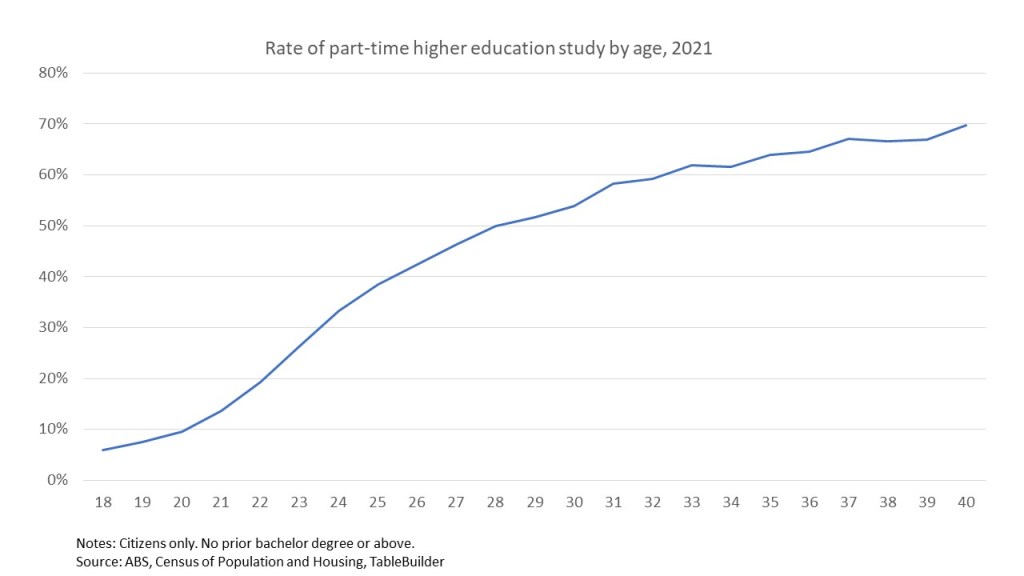
Older students are more likely to enrol part-time (chart below). Given the high rates of upper ATAR students going to university soon after school older first-time students must disproportionately be people with weaker school results. They plausibly have above-average needs for academic support to complete their courses successfully.
 Andrew Norton