Job-ready Graduates – its effects on university Commonwealth supported places decisions

The student contribution increases of Job-ready Graduates get regular media coverage, focusing on the plight of debt-laden arts graduates. Far less attention is given to how JRG affected university decision-making.

For universities JRG had multiple elements. Total overall Commonwealth supported student funding rates by discipline were changed, some increasing but most decreasing. The changes to student contributions altered incentives for over-enrolments. Previous separate allocations of sub-bachelor and postgraduate Commonwealth supported places (CSPs)were ended, merged into a single fund with bachelor degrees.

To explore these effects, Ren-Hao Xu from UWA and I interviewed 15 leaders and officials from five universities in 2024 and 2025. We chose universities with various sizes, locations, missions and rankings to find out how they interpreted the JRG incentives and how these affected decision making. An academic article reporting our methodology and findings was recently published in the Australian Educational Researcher journal.

Over-enrolment

One thing I was especially curious about was to what extent over-enrolment – taking students on the student contribution only – was deliberate and to what extent accidental, reflecting the inherent difficulties in hitting precise full-time equivalent enrolment targets.

For the over-enrolled universities in our study the answer was mostly deliberate.

Two universities in our study had mission-related reasons for over-enrolling. The vice-chancellor of an equity-focused university told us that ‘we’ve also felt that we should over-enrol based on demand due to the university’s mission to serve students from disadvantaged backgrounds.’ The vice-chancellor of a regional university was willing to over-enrol as there was no other local university students could attend.

Other universities took a more strategic approach. One noted the likely Accord system re-set, knowing that during past policy shifts enrolments as of a recent year were used at the basis of the new funding system. This was a chance to lock in a larger base funding amount (an approach that has so far only partly worked, with just $50 million allocated to convert over-enrolments to fully-funded places).

Read More »

The $1 billion spent on undelivered student places

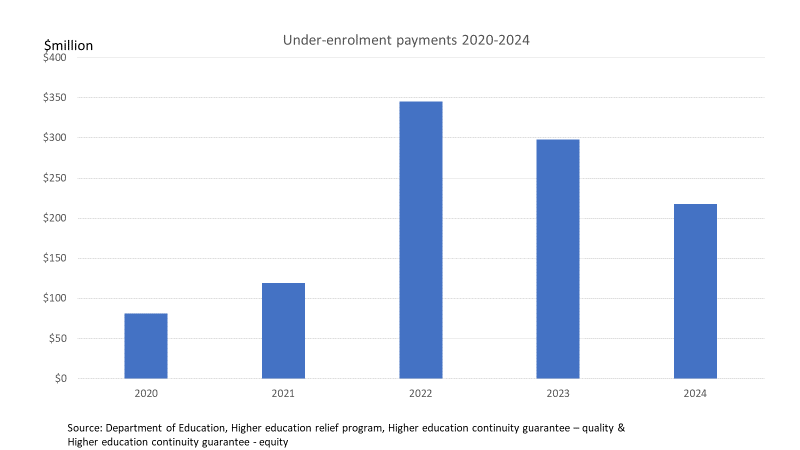
Last year I wrote about payments to universities under the Higher Education Continuity Guarantee, a Morrison-era program to compensate universities for ‘under-enrolment’. I then had data up to 2022. This can now be updated to 2024. Total expenditure on the Guarantee and its 2020 predecessor, the Higher Education Relief Program, now exceeds $1 billion.

How the Higher Education Continuity Guarantee worked

In simplified terms, the Higher Education Continuity Guarantee offset reduced payments to universities from the Commonwealth Grant Scheme.

Under the funding legislation, universities are supposed to receive the lesser of 1) The value of Commonwealth supported places delivered, calculated on a full-time equivalent place multiplied by the relevant Commonwealth contribution amount, or 2) the maximum grant amount that universities were entitled to receive under their funding agreement (how this maximum was calculated varied in the life of the Guarantee).

For universities entitled to receive only the amount calculated in option (1), the Guarantee topped them up to the amount in (2).

This is called ‘under-enrolment’ because universities did not deliver sufficient Commonwealth supported places to receive their maximum grant amount.

The cost of the Higher Education Continuity Guarantee

Guarantee funding peaked in 2022, at $346 million, before dropping to $298 million in 2023 and $218 million in 2024. Total cost since 2020 is $1.056 billion.

Read More »

Political compromise to end the worst of Job-ready Graduates

Late last year the Greens introduced the Higher Education Support Amendment (Reverse Job-Ready Graduates Fee Hikes and End 50k Arts Degrees) Bill  into the Senate. Submissions for the Senate inquiry into this bill close on Friday.

Under the bill, the student contribution for most arts students would go down from $17,399 a year to $8,164, what it would have been if Job-ready Graduates had never happened. For business and law the student contribution would go down from $17,399 to $13,624, similarly what it would have been without Job-ready Graduates. Creative arts students contributions would go down from $9,537 to $8,164.

My submission to the inquiry is here.

Constitutional problems

While I agree with the broad direction of the Reverse Job-ready Graduates bill on student contributions, it cannot fix the JRG problem. Under section 53 of the Australian Constitution, a bill appropriating money cannot originate in the Senate. Offsetting reduced student contributions with higher Commonwealth contributions, as needed to maintain university funding, would require an appropriation. Due to this legal limitation, the bill contains only lower student contributions, without any changes to Commonwealth contributions.

If the bill passed we would be left with JRG Commonwealth contributions and pre-JRG student contributions. Total funding for a full-time arts student would halve, from $18,715 to $9,480.

Ending $50,000 arts degrees by ending arts degrees is too radical a measure.

Read More »

Needs based funding – the low SES and Indigenous component

Directing some university funding based on student, rather than just course, characteristics was one good idea coming from the Universities Accord. Students arrive in higher education with varying academic abilities. Other personal attributes and circumstances present potential obstacles to successful study. In a mass higher education system these are routine issues. But some universities enrol more students needing help to succeed than others, a fact only indirectly recognised to date, through equity group funding.

In 2024 I argued that needs based funding should go beyond equity group membership and use more reliable needs indicators, including admissions information. Policy should stop prioritising niche targeted programs over larger-scale initiatives that would benefit many students but higher-needs students the most. Broader changes to pedagogy or student services, for example.

But the needs based funding system as introduced for 2026, for which we now have additional administrative detail, is for the most part not genuine needs based funding. It is an update of old equity programs. In this post I will examine the ‘equity component’ of the new program. A later post will look at the ‘regional component’.

The legal framework

The current legal basis of needs based funding is intended to be temporary. Like previous equity programs it is authorised under section 41-10 (item 1) of the Higher Education Support Act 2003, under which the minister makes ‘grants to promote equality of opportunity in higher education’. It is one of the ‘other grants’ in the Act, that is other than the Commonwealth Grant Scheme (CGS). All ‘other grants’, and the amounts paid under them, are at the discretion of the minister. The plan, however, is to give needs based funding its own statutory basis in the CGS. We are yet to see the necessary legislation.

While current legal arrangements are temporary they are also unusual and unsatisfactory. The funding amounts and formulas, which I will discuss shortly, are not in the needs based funding legislative instrument. This instrument regulates eligibility for and use of needs based funding, but not how it is calculated. Indeed, it does not require that any money be paid at all.

Section 41-30 of HESA 2003 states that the amount of each ‘other grant’ is based on the guidelines, of which there are none for this matter, or ‘the amount determined in writing by the minister’. So needs based funding depends on this ministerial determination.

Instead of specifying the funding rules in a legislative instrument, the Department of Education has issued a document called Needs-based Funding Guidance v1.0 December 2025. This has no formal legal status, but tells universities how the minister intends to calculate funding per institution under section 41-30.

Funding determined this way without formal guidelines is not unprecedented in higher education policy, for example the national institutes grants. But I can’t think of another example where there is an underlying funding formula but the government has chosen not to put it into legal form. I see this as another example of the decline of the rule of law in higher education, in favour of ministerial or potentially ATEC discretion.

I expect that needs based funding will be paid, but to date there is no public evidence that the necessary funding has been authorised.

Read More »

The Australian Tertiary Education Commission legislation – Part 3, Per student funding and student contributions

Since it came to office, Labor has deferred dealing with Job-ready Graduates student contributions. First it added student contributions to the Universities Accord list of issues. In February 2024 the Accord Final Report suggested basing student contributions on lifetime earnings. Subsequently the minister said the new Australian Tertiary Education Commission would provide advice. Now we have ATEC’s legislation, but how student contributions will be handled is less clear than I expected.

All legislative references, unless otherwise specified, are to the Universities Accord (Australian Tertiary Education Commission) Bill 2025.

The ATEC bill and per student funding

The ATEC bill does not mention student contributions at all. One of ATEC’s functions, however, will be to advise the minister on:

“The efficient cost of higher education across disciplines and student cohorts and in relation to the Commonwealth contribution amounts for places in funding clusters.”: section 11(d)(ii), section labelled “Functions of the ATEC”.

In different words, in a later section on “Advice and recommendations”, a topic of advice is:

“The costs of teaching and learning in higher education and overall higher education funding amounts, including on a per student basis.”: section 41(1)(b).

Read More »

University under-enrolment in the COVID and after years

Recently the Department of Education published 2021-2022 data on payments under the Higher Education Continuity Guarantee, a 2021-23 Coalition program to compensate universities for under-enrolments. It has previously released data on a predecessor program, the 2020 Higher Education Relief Program.

It shows that over the 2020 to 2022 period under-enrolments cost the Commonwealth nearly $550 million. On my estimates the sector under-enrolled by approximately 47,000 places. Eight universities were under-enrolled in each of 2020, 2021 and 2022. Only four universities received nothing under the HECG or HERP, showing that enrolment shortfalls were widespread across the sector.

What is under-enrolment?

Under the Higher Education Support Act 2003 universities get paid their maximum basic grant amount (MBGA) – see my funding agreement posts for more detail on this – or the value of their Commonwealth supported places delivered (on a relevant Commonwealth contribution * EFTSL basis), whichever is lower.

During the COVID period the Coalition decided that it would let universities keep their MBGA even if they had not enrolled enough students to justify it. This was called the Higher Education Relief Program in 2020 and the Higher Education Continuity Guarantee 2021-2023. The purpose was to provide stability for universities during COVID and post-COVID enrolment turbulence.

There is a 2024-2025 program called the HECG, but it is a redirect of money to equity programs and has nothing to do with the original purpose of the HECG.

Read More »

Has funding for Commonwealth supported students been cut?

With universities back job shedding, academics and their unions are looking for someone to blame. University leaders and consultants are being attacked for poor decisions. The government also gets criticised. UTS history professor Anna Clark says that over the last twenty years ‘we have seen gradual, steady decline in government investment across the sector’. In his recent lament Broken Universities, Graeme Turner says that there has been a ‘steady decline in the levels of funding per student’.

Five years ago, early in the COVID crisis, I wrote a post about government ‘cuts’. This post is an update.

Funding for Commonwealth supported students

As my earlier post noted, time series data is not straightforward. The chart below focuses on the major student funding programs, in today’s terms the Commonwealth Grant Scheme (CGS), HECS-HELP, and upfront student contributions. These funding sources have always had a link to the number of full-time equivalent Commonwealth supported students, although historically the money they delivered supported research as well as teaching expenditure.

Around these core funding sources other schemes serve the same purpose (e.g. transition funding) or similar purposes (e.g. NPILF). The chart below includes the Job-ready Graduates (JRG) transition funding and but excludes NPILF. It includes money paid from the Higher Education Continuity Guarantee, a COVID measure still in place for universities that ‘under-enrol’ that would normally face a CGS penalty. From 2021-2024 the time series excludes the enabling course loading that was previously in the CGS but moved to IRLSAF. But this funding is back in the CGS in 2025 due to the FEE-FREE Uni Ready places. The regional loading remains out from 2021 as it is still in IRLSAF and will join needs-based funding next year.

Overall my time series goes for simplicity over a full count of expenditure on student-related programs. In the time series, one big structural change should be noted, which is research student funding moving to a separate program from 2001, which caused a significant but artificial year-on-year decline.

Trends in total funding

Focusing on recent times, in nominal dollar terms total CGS funding dipped between 2021 and 2022, which was mostly short-term COVID places coming out of the system. HECS-HELP lending fell between 2020 and 2021, driven by the strange decision to pass on reduced JRG student contribution rates to all current students but to grandfather increased student contribution rates, so that only 2021 and later commencing students pay them. HECS-HELP lending fell again in 2022, with lower student numbers also affecting revenue from a university perspective.

Read More »

How attractive will the FEE-FREE Uni Ready places be to universities?

Last week the government introduced legislation that would, among other things, create a new funding category for what we now call enabling courses, which will be redesigned and rebadged as FEE-FREE Uni Ready places. These courses help prepare students for higher education study.

The current system

Under the current system, Commonwealth supported enabling places are funded at the Commonwealth contribution rate for the relevant discipline.

Enabling places are not capped but the financial incentives to enrol enabling CSP students are weak because no student contribution can be charged.

An enabling loading is paid in lieu for universities with an allocation of enabling funding, but many universities have no enabling loading or a low amount.

The government does not seem to update the enabling loading in a public place, but indexing a previous rate I think it is $3,886 per EFTSL in 2024.

Job-ready Graduates affected the financing of enabling places in fields with Commonwealth contribution cuts. Nearly 40% of enabling places are in the lowest Commonwealth contribution field, $1,236 for 2024. That plus the enabling loading = $5,122 per place.

Read More »

Job-ready Graduates price effects?: An update with 2022 enrolment data

The official release yesterday of the CPI-indexed Job-ready Graduates student contributions for 2025 has prompted questions about what impact the JRG price increases have had on enrolments.

With arts, business and law student contributions to hit nearly $17,000 a year in 2025 – with our bout of inflation having increased them from $14,500 in 2021 – students would be wise to think about whether this is a sensible investment. That’s $50,000 for a basic 3 year degree or $85,000 for common combinations like arts/law or business/law.

On the other hand, as I have argued, students follow their interests while keeping an eye on which courses within their cluster of interests would have the best employment and salary outcomes.

The most sophisticated work to date, using NSW data to 2021, found small effects in the expected directions.

Using simple trends in subjects taken, this post will look at domestic commencing EFTSL by discipline in the 2010-2022 period, drawing on the annual commencing load spreadsheet produced by the Department of Education. This does not distinguish between CSP and domestic full-fee students, but it is the best I can do with publicly available data.

Because I am comparing fields with very different absolute enrolments, I have converted them to an index, with 2010=1. So an index of 1.1 in a subsequent year would mean 10% more EFTSL, and an index of .9 would mean 10% fewer EFTSL.

Read More »

Accord implementation proposals, part #5: Needs-based funding that is not aimed directly at needs

The Accord implementation consultation paper on need-based funding for equity group members was released late last week, although students with disability will be discussed in a later consultation document. That leaves low SES, Indigenous and students at regional campuses for this paper.

When the Accord interim report came out I rated the principle of needs-based funding as one of its better ideas. But turning it into policy faces significant conceptual, practical and ethical issues. The consultation paper does not resolve these issues.

Funding based on needs versus equity group membership

The basic conceptual problem, in the Accord reports and this consultation paper, is that it remains unclear why needs-based funding should apply only for students designated as equity group members. With the exception of people with disabilities that require adjustments for them to participate in higher education, none of the equity group categories identify personal disadvantage. As the Accord report itself notes, groups other than the equity four are ‘under-represented’ in higher education.

The higher education system should help all its students achieve success, not just those that for historical reasons are included in the equity group list.

Many of the outcome differences we observe are the by-product of mass higher education, which brings a wide range of people into the system. There are more people who were not especially ‘academic’ at school, more people who have trouble financing their education, more people who have major responsibilities other than their studies. In a mass higher education system these students are core business.

Read More »