Yesterday the higher education funding legislation had its biggest revision in many years. I summarised the Senate changes to the original funding bill in this post. But along with these amendments a new provision added two higher education providers to Table B of the Higher Education Support Act 2003. These are Alphacrucis University College and the Australian University of Theology. There are financial advantages to being listed on Table B, as I explain below. But there are also regulatory and governance disadvantages.
Liberal Senator Matt O’Sullivan, who introduced the amendment, told the chamber that ‘they are both reputable, highly effective and respected institutions that have met all the thresholds required to be listed as table B providers. We are asking the government and all those in this parliament to recognise these wonderful institutions and list them in legislation. In doing that, can I take a moment to recognise, as is appropriate,… that [it] wouldn’t happen without the support of the government.’ With Labor indicating agreement with the amendment, it was passed without a division in the Senate.
The trouble is that no official criteria exist for addition to Table B, although there is a precedent that only one of these institutions satisfies. Which institutions are put on Table B should be based on clear rules. There may also be constitutional issues with the way the Parliament handled this this amendment.
Financial benefits of Table B
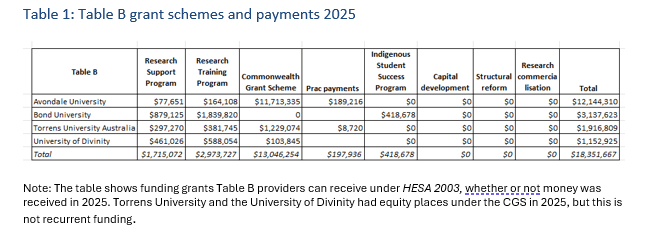
The main institutional benefit of Table B listing is access to the Research Support Program and the Research Training Program. Funding under both schemes is driven by prior performance, which limits how much newer institutions can receive. But as the table below shows, existing Table B institutions shared about $4.7 million in funding from these sources in 2025.
Table B providers are also eligible to collect Prac Payment funds on behalf of their students and to be funded under the Indigenous Student Success Program. The table shows other categories for which Table B institutions are legally eligible, but for which in practice they received no funding in 2025.
All providers registered under HESA 2003, which includes Table B institutions, are technically eligible for CSPs in ‘national priority’ or from 2027 ‘priority’ classes of courses, but under both the old and new funding legislation there are only two CSP categories, Table A and non-Table A. Table B listing does not confer any additional benefit. Of the Table B institutions only Avondale has long-term recurrent CSP funding. Alphacrucis has some CSPs for 2026, but these are equity places that are being phased out.