Points-tested visas and international students – possible changes to the points

In a previous post I described the three points-tested visas that international students use to achieve permanent residence or a clear pathway to it. These are the subclass 189 Skilled Independent visa, the subclass 190 Skilled Nominated visa, with the nomination by state and territory governments, and the subclass 491 Skilled Work Regional (Provisional) visa, which is also state and territory nominated.

The total number of these visas awarded to identifiable former international students peaked in 2022-23 at just under 40,000. It was 31,783 in 2024-25, the latest available full financial year data. The chances of former international students getting points-tested visas dropped more sharply, due to increased demand but fewer places.

This post looks at potential changes to the points available in the points-tested visas and how these might affect international students.

Maximum points for different attributes

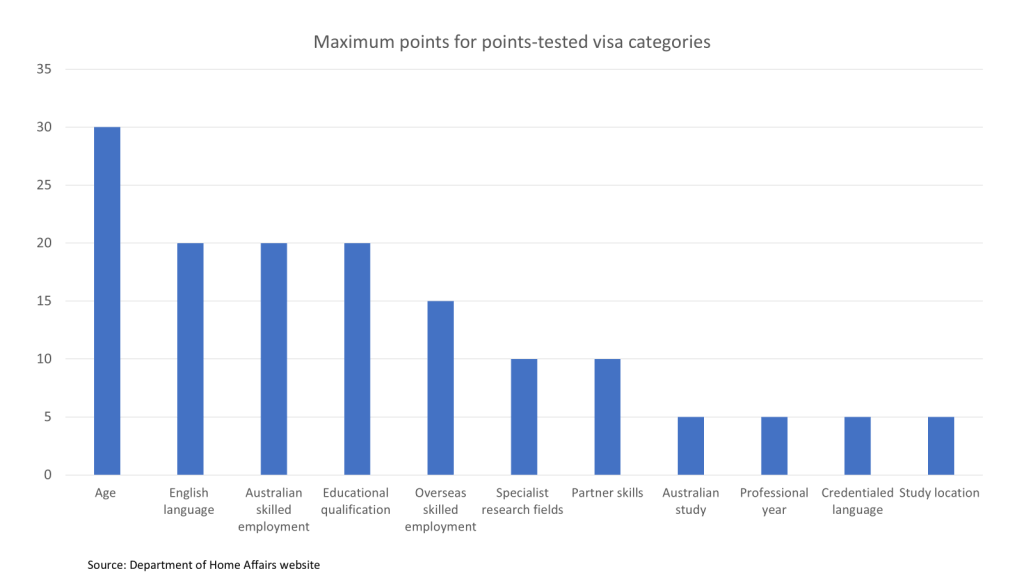
The chart below shows the maximum points available in categories relevant to all three points-tested visas. For study location, credentialed language (interpreting or translating), a professional year (training linked to work experience), Australian study, and a specialist educational qualification (research degree in science, IT or engineering) the points are a flat number. Applicants either meet the criteria or they do not. The other categories offer graded points up to the maximum shown, for example the system favours more over less skilled work experience and ‘superior’ over ‘proficient’ English.

The maximum standard points total 145, although some combinations are unlikely. Somebody with extensive skilled work experience probably does not need a professional year. Combining maximum points for both Australian and overseas skilled work experience would block maximum points for age.

For the subclass 190 visa, applicants receive an extra 5 points for state or territory agency sponsorship and for the subclass 491 visa this sponsorship is worth an extra 15 points.
Read More »

Private higher education provider policy now less coherent

Yesterday the higher education funding legislation had its biggest revision in many years. I summarised the Senate changes to the original funding bill in this post. But along with these amendments a new provision added two higher education providers to Table B of the Higher Education Support Act 2003. These are Alphacrucis University College and the Australian University of Theology. There are financial advantages to being listed on Table B, as I explain below. But there are also regulatory and governance disadvantages.

Liberal Senator Matt O’Sullivan, who introduced the amendment, told the chamber that ‘they are both reputable, highly effective and respected institutions that have met all the thresholds required to be listed as table B providers. We are asking the government and all those in this parliament to recognise these wonderful institutions and list them in legislation. In doing that, can I take a moment to recognise, as is appropriate,… that [it] wouldn’t happen without the support of the government.’ With Labor indicating agreement with the amendment, it was passed without a division in the Senate.

The trouble is that no official criteria exist for addition to Table B, although there is a precedent that only one of these institutions satisfies. Which institutions are put on Table B should be based on clear rules. There may also be constitutional issues with the way the Parliament handled this this amendment.

Financial benefits of Table B

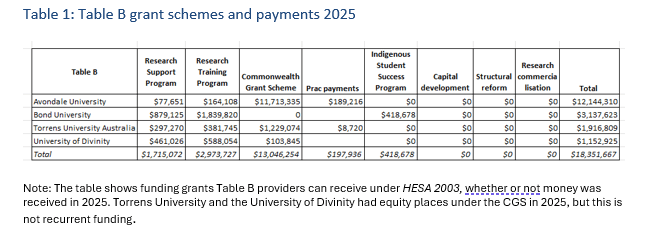
The main institutional benefit of Table B listing is access to the Research Support Program and the Research Training Program. Funding under both schemes is driven by prior performance, which limits how much newer institutions can receive. But as the table below shows, existing Table B institutions shared about $4.7 million in funding from these sources in 2025.

Table B providers are also eligible to collect Prac Payment funds on behalf of their students and to be funded under the Indigenous Student Success Program. The table shows other categories for which Table B institutions are legally eligible, but for which in practice they received no funding in 2025.

All providers registered under HESA 2003, which includes Table B institutions, are technically eligible for CSPs in ‘national priority’ or from 2027 ‘priority’ classes of courses, but under both the old and new funding legislation there are only two CSP categories, Table A and non-Table A. Table B listing does not confer any additional benefit. Of the Table B institutions only Avondale has long-term recurrent CSP funding. Alphacrucis has some CSPs for 2026, but these are equity places that are being phased out.

Read More »

The student places capping and needs based funding bill has passed – with amendments

The government’s capping student places and needs-based funding bill – with considerable spin officially called the Universities Accord (Opening the Doors of Opportunity) Bill 2026 – won Senate approval on Monday. A total of 43 amendments were made, 32 from the Australian Greens, 6 from the government, and 5 from the Coalition. In some cases, a bundle of related amendments was needed to make a single substantive change.

The amended bill then returned to the House of Representatives for approval. The House made a purely technical change, replacing a Senate equity grant expenditure provision with its own identical amendment. This was due to section 53 of the Constitution, concerning the Senate’s power to amend financially-related provisions. So the amended-but-not-amended bill went back to the Senate and secured final approval today.

This post outlines the major changes to the original bill. It revises an earlier post on proposed amendments. The key changes are: a more secure sector-level floor number of Commonwealth supported places; a higher over-enrolment limit for larger universities; removal of a power to designate courses, which would have let ATEC allocate and cap places for specific courses; a better definition of equity student; and limits on the minister’s power to add conditions.

The Senate also inserted an amendment unrelated to the original bill, moved by the Coalition, to add two new institutions to Table B of the Higher Education Support Act 2003. This achieves more favourable public funding for them and their students. I suspect this amendment also has section 53 issues and will need to be revisited. In the interests of not further lengthening this post, I discuss this issue in a separate post.

A sector-level floor number of places

On the bill’s introduction the explanatory memorandum indicated a floor number of Commonwealth supported places was intended, but this was not reflected in the bill itself.

In the House of Representatives a government amendment created a ‘core student load’ minimum number of places for public universities, although the amendment does not preclude year-on-year reductions in places.

But there was no corresponding requirement that the minister set a ‘total allocation pool’ of Commonwealth supported places sufficient to cover all the minimum ‘core student load’ allocations.

A government amendment in the Senate ensures that a year’s total allocation pool will be at least the previous year’s level: new section 30-5(1A).

That could still leave continuing student enrolment growth without sufficient places in the total allocation pool, which would force a reduction in commencing places. But overall this amendment improves the bill’s internal coherence.

Read More »

Restrictions on secondary student visa holders – the legal detail

After Tony Burke gave his National Press Club address on migration I wrote a blog post on new limits on secondary visa holders, the partners and children of the primary visa holders. Not much detail was available at the time. This post draws on the since enacted legislative instruments to provide this detail.

The new rules on student secondary visa holders interact with new restrictions on onshore student visa applications. So it is not just who can apply for a secondary visa, it is where they can be when they do so.

The main categories of students who can bring partners and children are: students from the Pacific region or ASEAN countries, doctoral students, students sponsored by the Department of Foreign Affairs and Trade or the Department of Defence, and students with fully-funded scholarships from a foreign government. Data on foreign scholarships is not available, but based on recent history the other categories would support about 10,000 secondary visa holders per year.

In addition to this 10,000, transitional categories of current secondary student visa holders already in Australia can remain while their primary visa holder gets another visa for a higher AQF course or due to delays in completing their course.

New restrictions on secondary student visa holders

The default position is now that secondary applicants are not permitted unless they fall into an exempt category.

DFAT and Defence sponsored students

Primary applicants sponsored by the Department of Defence or Department of Foreign Affairs and Trade can bring their partner and/or children: new paragraph 1222(3)(da)(i) of the Migration Regulations 1994.

In 2025-26 3,397 primary student visas were granted to Defence and Foreign Affairs students, accompanied by 1,066 secondary visa applicants.

Exempt countries

Students from Pacific-regional countries can bring partners and children as secondary applicants: new paragraph 1222(3)(da)(i) of the Migration Regulations 1994.

Read More »

New restrictions on onshore applications for student visas

As foreshadowed in Tony Burke’s September 2026 National Press Club speech, the government has now implemented a range of policy changes for onshore student visa applications. There is a new general rule against onshore student visa applications, from which there are exceptions, the most significant of which is letting current students apply for a new student visa if it is at a higher qualification level. The Department of Home Affairs summary of the changes is here.

Why is policy changing?

The reason for this change is to limit the number of current visa holders applying for a student visa to prolong their stay in Australia.

Onshore applicants for a student visa get a bridging visa while their application is processed. As of December 2025 the median processing time for an onshore student visa application was 134 days, delivering another 4 to 5 months living and working in Australia even if the visa application is unsuccessful.

Rejected onshore student visa applicants can appeal the decision in the Administrative Review Tribunal. As of 31 August 2026 the ART had a backlog of 53,347 student visa appeals. Applicants receive a bridging visa while waiting for their case to be decided. The official indication of median processing time to decide a student visa refusal is 17 months, but that might be too low. For the first two months of 2026-27 the ART resolved only 1,500 applications per month, although ending in-person hearings in most cases may speed things up.

As of 31 December 2025, 107,449 people were on bridging visas while waiting for a student visa application to be resolved.

Onshore applications – key statistics

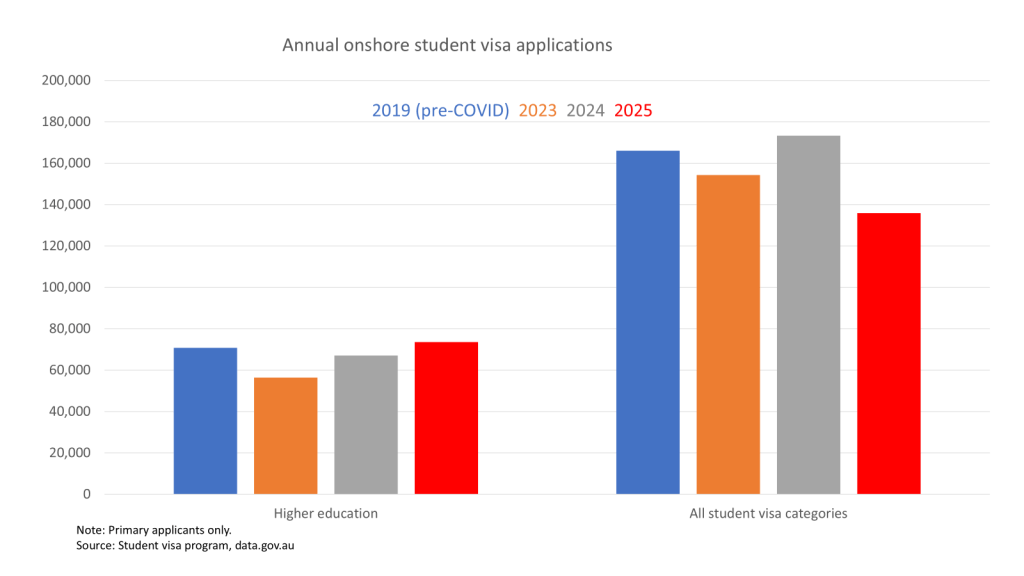
Due to other policy changes, onshore student visa applications were already trending down prior to this announcement. In 2025, 135,979 onshore student visa applications were made, 30,000 below 2019 pre-COVID levels. In 2025, 54% of onshore student visa applications were for higher education, with the absolute number still above 2019 levels. Policy change has hit VET and ELICOS harder than higher education.

For 2026 up to August, 95,936 onshore applications have been made, 4.7% fewer than by August 2025. For higher education as of August 2026 56,898 applications have been made, down 1.3% on the same time last year. The higher education share of the total is 59%. Note that in the Department of Home Affairs statistics ‘higher education’ does not include postgraduate research or DFAT or Department of Defence sponsored students taking higher education courses.

Read More »