As foreshadowed in Tony Burke’s September 2026 National Press Club speech, the government has now implemented a range of policy changes for onshore student visa applications. There is a new general rule against onshore student visa applications, from which there are exceptions, the most significant of which is letting current students apply for a new student visa if it is at a higher qualification level. The Department of Home Affairs summary of the changes is here.
Why is policy changing?
The reason for this change is to limit the number of current visa holders applying for a student visa to prolong their stay in Australia.
Onshore applicants for a student visa get a bridging visa while their application is processed. As of December 2025 the median processing time for an onshore student visa application was 134 days, delivering another 4 to 5 months living and working in Australia even if the visa application is unsuccessful.
Rejected onshore student visa applicants can appeal the decision in the Administrative Review Tribunal. As of 31 August 2026 the ART had a backlog of 53,347 student visa appeals. Applicants receive a bridging visa while waiting for their case to be decided. The official indication of median processing time to decide a student visa refusal is 17 months, but that might be too low. For the first two months of 2026-27 the ART resolved only 1,500 applications per month, although ending in-person hearings in most cases may speed things up.
As of 31 December 2025, 107,449 people were on bridging visas while waiting for a student visa application to be resolved.
Onshore applications – key statistics
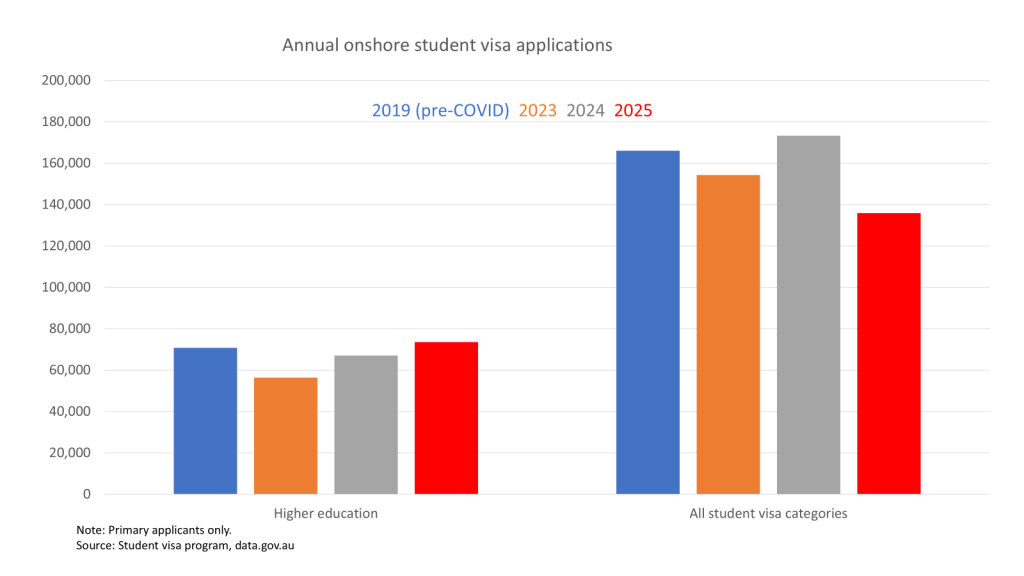
Due to other policy changes, onshore student visa applications were already trending down prior to this announcement. In 2025, 135,979 onshore student visa applications were made, 30,000 below 2019 pre-COVID levels. In 2025, 54% of onshore student visa applications were for higher education, with the absolute number still above 2019 levels. Policy change has hit VET and ELICOS harder than higher education.
For 2026 up to August, 95,936 onshore applications have been made, 4.7% fewer than by August 2025. For higher education as of August 2026 56,898 applications have been made, down 1.3% on the same time last year. The higher education share of the total is 59%. Note that in the Department of Home Affairs statistics ‘higher education’ does not include postgraduate research or DFAT or Department of Defence sponsored students taking higher education courses.
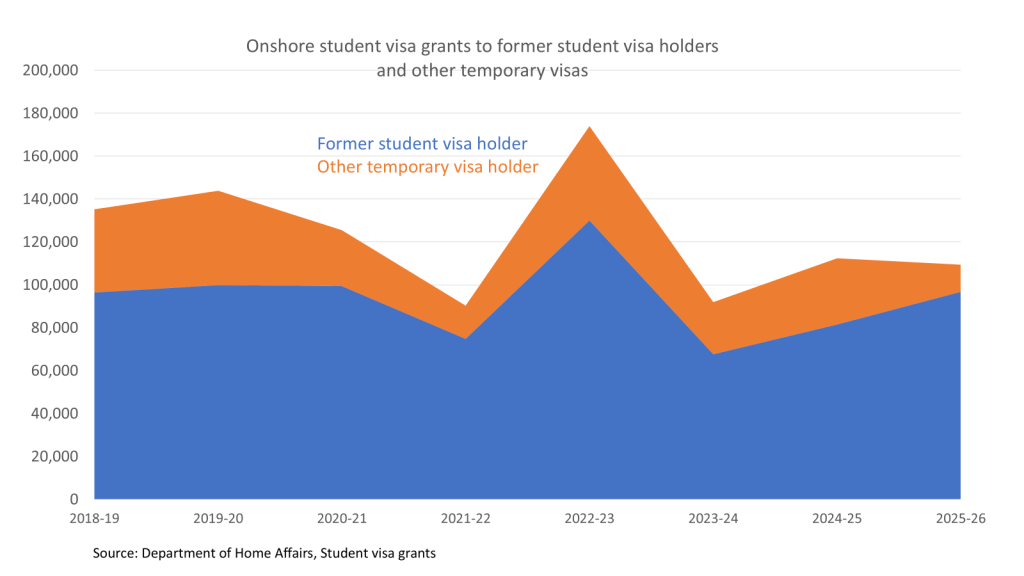
I don’t have onshore student visa grants by calendar year (requires work to convert financial year monthly reports), but with fewer applications these are unsurprisingly also down on pre-COVID times. In 2025-26, 109,364 onshore student visas were granted, compared to 135,205 in 2018-19 and 112,350 in 2024-25.
Despite the overall trend, higher education has been resilient. The 67,740 onshore higher education visa grants in 2025-26 is the second-highest financial year total after 2022-23 (69,358) in a time series that goes back to 2005-06. In 2025-26, 35% of total higher education visa grants were to onshore applicants. The main reduction is onshore vocational education visa grants, in 2025-26 sitting at only a third of a 2022-23 peak.
Onshore student visa grants have always been mostly to students converting to another student visa, but the former student visa percentage has gone up and was 84% in 2025-26. The July 2024 ban on onshore applications from visitor or temporary graduate visa holders helped bring the ‘other’ category in 2025-26 down to its lowest absolute level in this time series.
New complete blocks on applying onshore for a student visa
With last week’s changes a range of additional temporary visa holders cannot apply for a student visa onshore. Of the additional categories, only working holiday visa holders are significant, with 8,718 onshore student visas granted in 2025-26, 61% of them in the vocational education sector (2,201 in higher education – a minority but trending up).
The subclass 482 Skills in Demand visa is also on the newly-banned list. Skills in Demand visa holders are unlikely to have been a major source of onshore student visa applicants anytime soon, but this visa has strong demand from former international students. The government is removing this route to another temporary visa now, before it becomes a problem.
A ban on onshore student visa applications with exceptions
There is a new general rule requiring offshore student visa applications from current student visa holders, with exceptions I outline below.
Exception – students moving to a higher AQF level
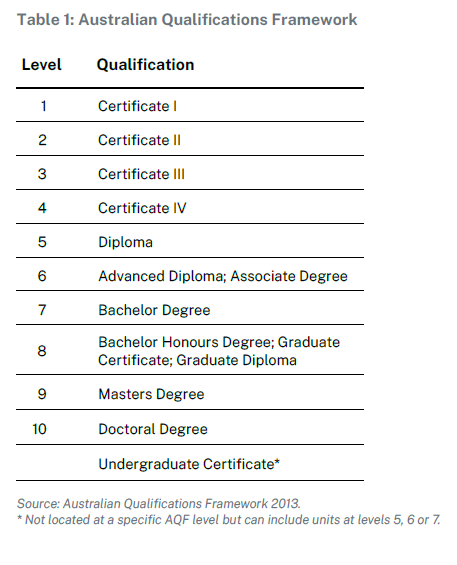
An onshore student visa holder wanting another visa now needs to apply for a course at a higher level in the Australian Qualifications Framework. The AQF website is discreet about ranking but the list is below. Generally, levels 1-6 are vocational education and levels 7-10 are higher education, although higher education courses are offered at levels 5 & 6 and vocational courses at level 8.
The data on non-upward movements has limitations. The Department of Home Affairs publishes data for onshore student visa grants where the student changes sector, which will not capture lateral or downward movements within a sector. At the sector level, the chart below shows that ‘downward’ movements have already been significantly reduced. The March 2024 ‘genuine student test’ included a requirement for ‘logical course progression’, which made it harder to move sideways or ‘down’ a sector or a qualification level. The vast majority of downward movements were/are higher education to vocational education.
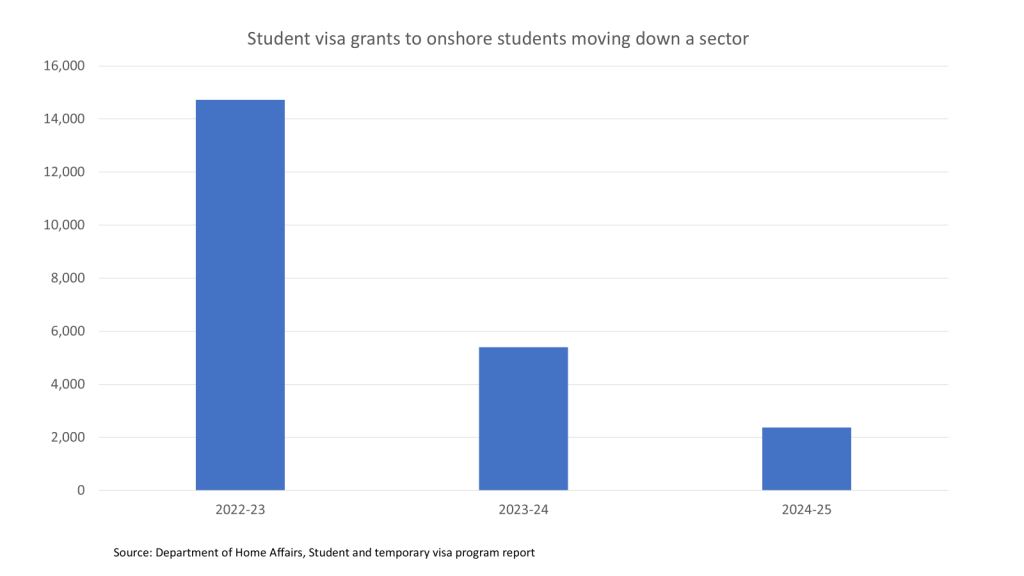
The remaining downward sector movements in 2024-25 may reflect legacy applications being decided (due to slow visa processing or successful ART appeals) or the occasional VET to higher education move classed as ‘logical course progression’. The new rule may block some legitimate career development transitions but, given apparently arbitrary decision making in visa applications, a rule that is clear may be better overall, even if it produces sub-optimal outcomes in some specific cases. With this type of visa application blocked, prospective students won’t waste the $2500 application fee on courses lower in the AQF than their current enrolment.
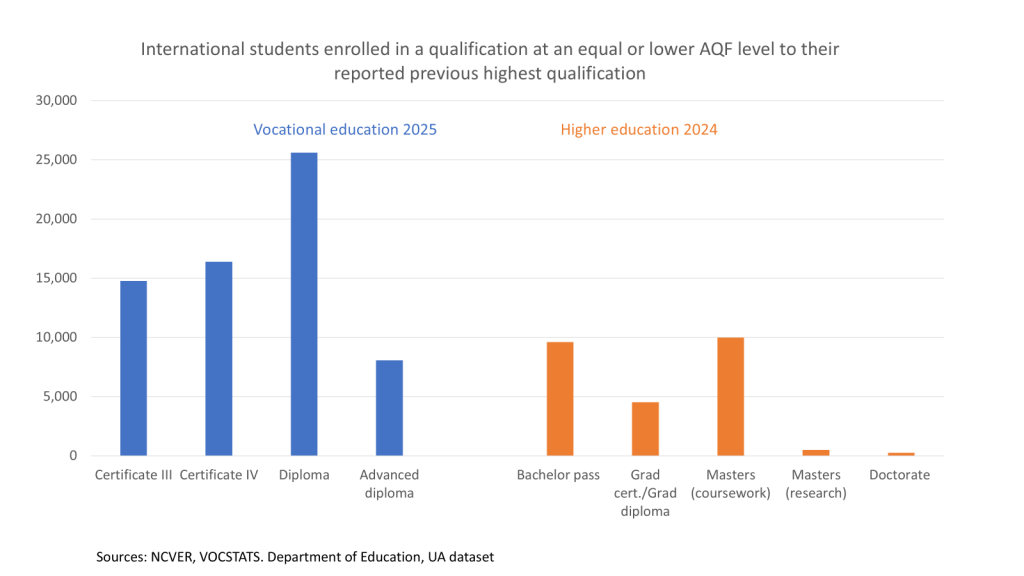
Enrolment data in vocational and higher education asks about highest previous qualification. The difficulty with this in assessing the impact of the up-the-AQF requirement is that these qualifications may be from other countries. The new rule refers to the AQF level of the preceding student visa, not the previous highest qualification. With this caveat, in 2025 68,444 VET students already had a qualification on an AQF level equal to or above their current enrolment. In higher education in 2024 the equivalent statistic was 24,285 students.
Changes to former students applying onshore – vocational AQF level 8
A requirement not in last month’s NPC speech, but in the new regulations, is that if the current student visa is for a higher education course the next one must be for a higher education course taught by a higher education provider.
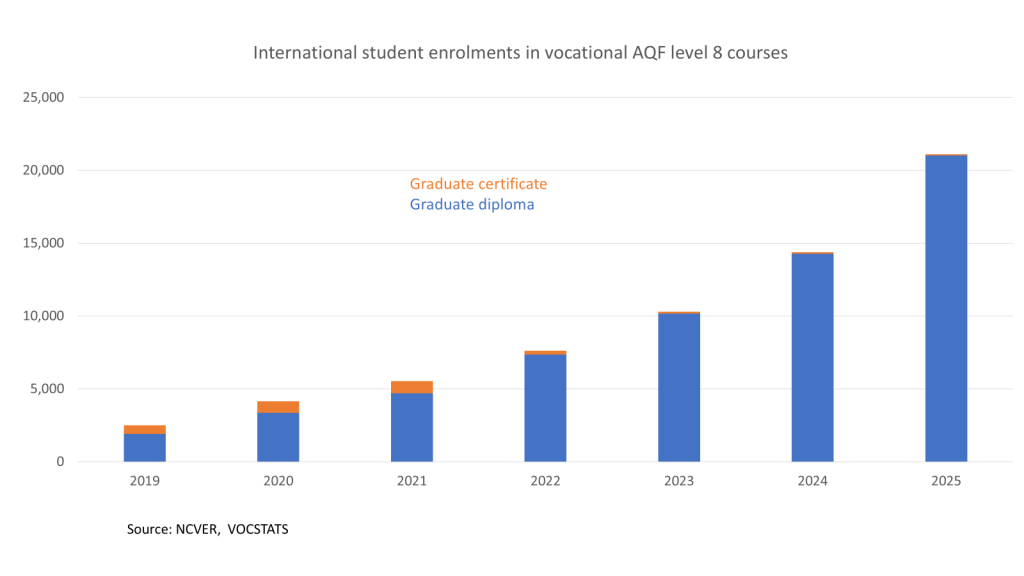
This higher education restriction stops AQF level 7 bachelor degree students moving to AQF 8 level vocational graduate certificates and graduate diplomas. As the chart below shows, international student enrolments have significantly increased in these qualifications in recent years. Most graduate diploma enrolments were in the Graduate Diploma of Management (Learning) that the government cancelled for new enrolments in September, but this new rule will help it keep one step ahead of the migration agents seeking new ways to prolong client stays in Australia.
Exception – doctoral students
Doctorates are at level 10 in the AQF, the highest level, so any onshore student visa applicant is going to move up the AQF unless the degree they are completing or they have completed is also a doctorate.
There is also a specific exemption from the restriction on onshore applications for students seeking a visa for a doctorate. The legislative instrument does not specify doctorate by research. In the enrolment data, 239 international students enrolled in a doctorate reported another doctorate as their highest qualification. This may be from a university overseas and so not covered by the student visa rules, but if an Australian degree this specific exemption from the higher AQF level rule will allow a second Australian doctorate.
In earlier commentary on secondary student visa issues, I wondered if masters by research students would also get an exemption, on the assumption that some students start in a masters degree and then convert to a PhD. On further examination of the enrolment statistics I can see why the government has not exempted all research students.
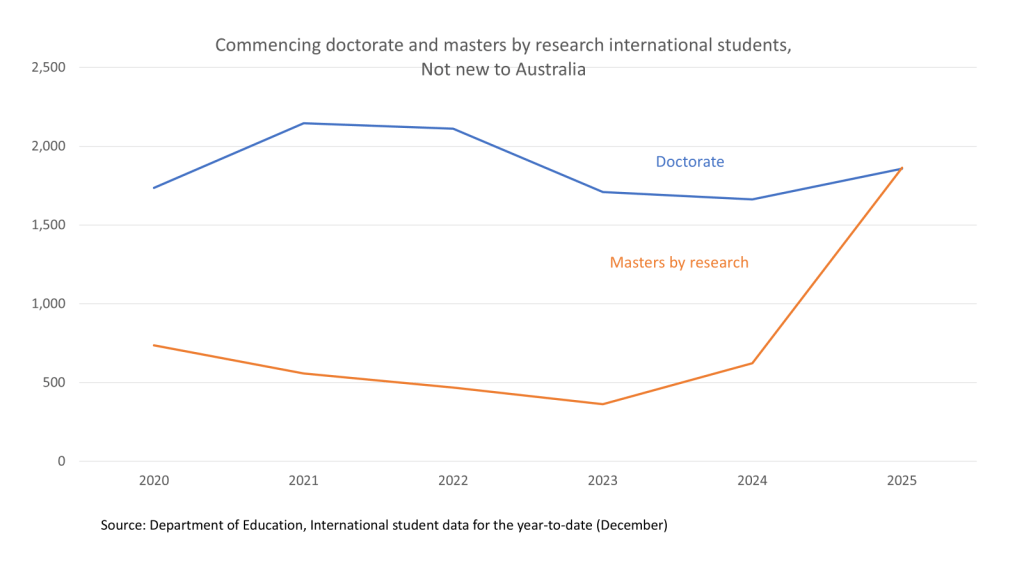
The Department of Education’s international enrolment data classifies students as new or not new to Australia, I take the ‘not new’ category as primarily onshore applicants. The chart below shows a sharp 2025 spike in onshore masters by research international commencing enrolments, for the first time outnumbering onshore applicant doctoral commencing students.
The government may have identified masters by research as an emerging area of ‘visa hopping’ and decided to omit it from the exceptions. The source countries where masters by research increased at an extreme rate between 2024 and 2025 include Nepal, Bhutan and Bangladesh, three migration-focused markets.
Despite this, I am not sure whether the rule is watertight. Masters by research is level 9 in the AQF, so moving to that from a bachelor honours level 8 would both be up the AQF and (depending on the fields of education being consistent) a ‘logical course progression’. Satisfactory performance in masters by research could lead to a permitted onshore doctoral visa application.
Exception – school and foundation studies students
School students have a general exemption from the ban on onshore student visa applications. As of June 2026, 15,910 international students were enrolled in schools.
Foundation program students (8,204 enrolments in June 2026) can apply for another student visa onshore but it must have an AQF level. I think that the same rule applies to onshore students with an ELICOS visa, although the explanatory statement does not directly say this.
Exception – course disruption
Students who need another 12 months to complete due to delays during their courses can apply onshore.
Students whose providers have not delivered or have stopped delivering their course can also apply for another visa onshore. More than a dozen providers have collapsed this year, with many more likely to follow as the international education regulatory onslaught shrinks the industry. Somewhat surprisingly no higher education providers have so far drawn on the Tuition Protection Service, although the vocational arm of one NUHEP had liquidators appointed in August 2026.
Exception – Defence and Foreign Affairs students
Students sponsored by the Department of Defence or the Department of Foreign Affairs and Trade can apply onshore. Only 140 did so in 2025-26.
No exempt countries
While nationals of certain countries are exempt from the ban on bringing families under a student visa, there are no exempt countries for the ban on onshore student visa applications.
ENDS

