ATEC’s interim statement of strategic priorities

Yesterday the Australian Tertiary Education Commission issued an interim statement of strategic priorities. This statement will guide university mission based compacts for 2027. This post covers the legal status of the statement, its apparent approach to management of the sector via compacts, and what it proposes in the areas of skills, First Nations, equity, teaching quality, VET-higher education relations, and research.

Decision-making under the ATEC system

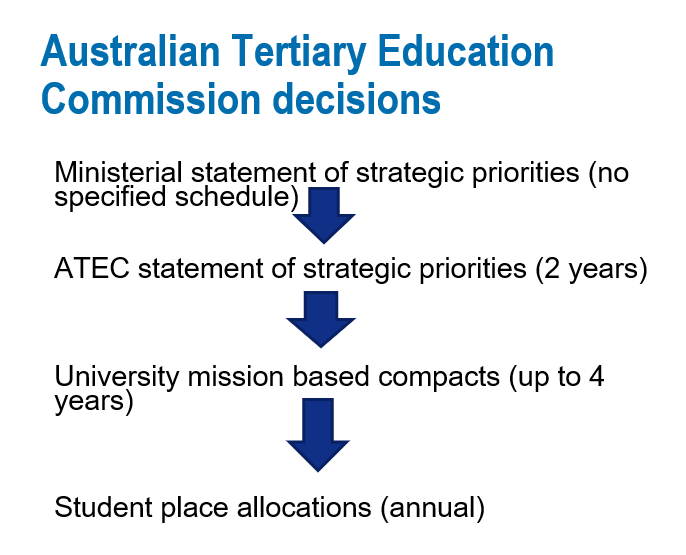
When fully operational the ATEC decision-making process will operate in the sequence shown in the chart below.

Despite the ATEC Act 2026 officially coming into force on 29 April 2026, ATEC’s interim statement seems to be operating in the legal limbo the organisation has been in since being established as the ‘interim ATEC’ in July 2025.

Read More »

Needs based funding winners and losers

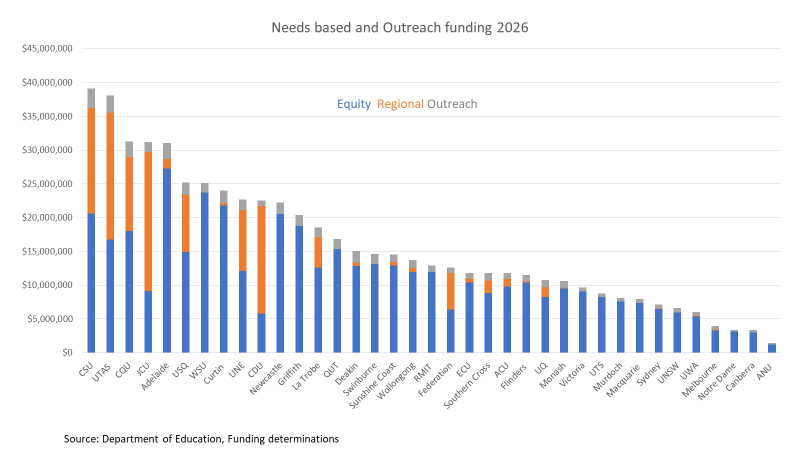
Last month I wrote about the new equity and regional needs based funding programs. Back then I had the funding formulas but not total funding amounts. The Department’s funding determinations now show that $425.7 million has been allocated for equity needs based funding and $118.6 million for regional needs based funding. There is also $43.7 million for outreach programs. The total is $588.1 million, including $1.3 million in equity needs based funding going to NUHEPs and private universities.

These new programs were principally funded from abolishing the old HEPPP equity program, the old regional loading, and the NPILF program, which supported internships and other engagement with industry. The predecessor programs were allocated $515.9 million, so the increase is more than indexation. Real cuts to the Commonwealth Grant Scheme may have funded the gap.

Funding by university

The chart below shows funding by university. Charles Sturt University and the University of Tasmania get the most money while the two Canberra universities get the least funding. They suffer from a lack of official ‘low SES’ areas in the ACT; as I noted earlier this month the low SES definition is not fit for funding purposes.

A spreadsheet of public university funding levels is available here.

Read More »

What is going on with low SES higher education numbers?

In his speech to the Universities Australia conference last month Jason Clare complained that the low SES share of enrolments ‘hasn’t changed that much in the last 30 years.’ He is overly pessimistic about long run trends in low SES higher education participation. But after 2017 key indicators went backwards, until a recent stabilisation with signs of partial recovery. This post explores trends and speculates on causes.

School leaver participation

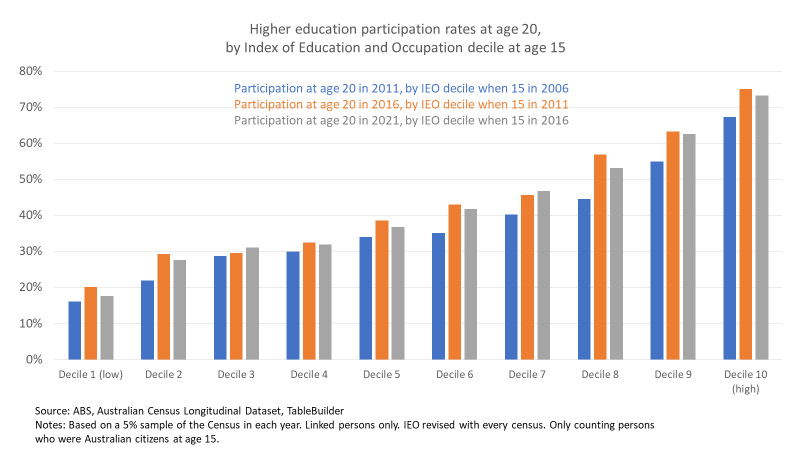
One issue with measuring trends in low SES enrolments is correctly identifying low SES students. In higher education statistics a person is low SES if from an area in the lowest 25% by the ABS Index of Education and Occupation. As charts below will show, this IEO geographic proxy shows a distinctive lowest 10% for higher education participation. Above that, however, we see modest participation and attainment increments between deciles 2-6, with differences then speeding up to a distinctive top 20%.

The participation rate similarity between deciles 2-6 makes the current low SES definition unsuitable for funding purposes, but a reasonable rough guide to overall trends. Because deciles 2-6 are sociologically similar, they probably respond in similar ways to economic, educational and policy trends affecting higher education enrolments.

In his speech, the minister referred to an enrolment share metric, low SES students/all domestic students. That’s administratively convenient but analytically weak, as low SES results depend as much on movements in middle and high SES as low SES enrolments. Participation rates are better measures, low SES higher education students/low SES population.

The chart below uses census longitudinal data for school leavers, taking as their SES the IEO ranking of where they lived when they were 15 years old, to better capture the social context of their secondary school years. The orange bars show that in 2016 all deciles had increased their participation rates since 2011, facilitated by the demand driven funding system. But in 2021, shown in grey bars, the participation rate in most deciles was lower than in 2016. There may be some statistical noise. This dataset takes a 5% sample of the census and my results omit unlinked census records – meaning the ABS could not track the same person from census to census or the necessary data was missing. But other data reported in this post confirms that the overall trend is real, even if some decile results are not 100% accurate.

Read More »

Needs based funding – the regional campus component

This post examines the regional campus component of needs based funding, which starts this year. I looked at the low SES and Indigenous component last week.

The regional component funds students at regional campuses rather than regional students. It assumes higher average costs at regional campuses. A longstanding ‘regional loading’ served a similar purpose. Just under $90 million was spent on the regional loading in 2025. Universities have been notified of their needs based funding amounts, but as of 23 February 2026 I cannot find a public record of them.

The research on cost by campus

The Deloitte Access Economics costing work used by the Morrison government to reset funding rates found that regional universities had higher costs per EFTSL after controlling for other factors affecting costs, such as discipline.

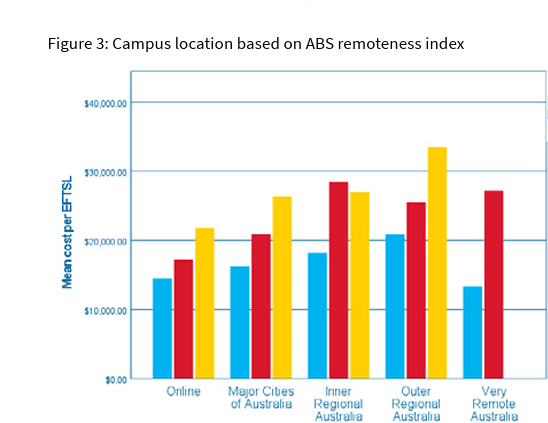
Later work by the U of M’s Centre for the Study of Higher Education, using Pilbara Group data, also found that regional campuses had higher average costs per EFTSL (chart below). This partly reflects a general feature of university costs – higher education is an economies of scale enterprise, but regional campuses on average have lower enrolments than major city campuses. However, higher regional costs were found to be still present after controlling for subject size.

Assuming that higher education should, ideally, be taken to where the students are – a proposition I agree with – the basic policy idea behind the regional loading/regional component of needs based funding is sound.

Read More »

Needs based funding – the low SES and Indigenous component

Directing some university funding based on student, rather than just course, characteristics was one good idea coming from the Universities Accord. Students arrive in higher education with varying academic abilities. Other personal attributes and circumstances present potential obstacles to successful study. In a mass higher education system these are routine issues. But some universities enrol more students needing help to succeed than others, a fact only indirectly recognised to date, through equity group funding.

In 2024 I argued that needs based funding should go beyond equity group membership and use more reliable needs indicators, including admissions information. Policy should stop prioritising niche targeted programs over larger-scale initiatives that would benefit many students but higher-needs students the most. Broader changes to pedagogy or student services, for example.

But the needs based funding system as introduced for 2026, for which we now have additional administrative detail, is for the most part not genuine needs based funding. It is an update of old equity programs. In this post I will examine the ‘equity component’ of the new program. A later post will look at the ‘regional component’.

The legal framework

The current legal basis of needs based funding is intended to be temporary. Like previous equity programs it is authorised under section 41-10 (item 1) of the Higher Education Support Act 2003, under which the minister makes ‘grants to promote equality of opportunity in higher education’. It is one of the ‘other grants’ in the Act, that is other than the Commonwealth Grant Scheme (CGS). All ‘other grants’, and the amounts paid under them, are at the discretion of the minister. The plan, however, is to give needs based funding its own statutory basis in the CGS. We are yet to see the necessary legislation.

While current legal arrangements are temporary they are also unusual and unsatisfactory. The funding amounts and formulas, which I will discuss shortly, are not in the needs based funding legislative instrument. This instrument regulates eligibility for and use of needs based funding, but not how it is calculated. Indeed, it does not require that any money be paid at all.

Section 41-30 of HESA 2003 states that the amount of each ‘other grant’ is based on the guidelines, of which there are none for this matter, or ‘the amount determined in writing by the minister’. So needs based funding depends on this ministerial determination.

Instead of specifying the funding rules in a legislative instrument, the Department of Education has issued a document called Needs-based Funding Guidance v1.0 December 2025. This has no formal legal status, but tells universities how the minister intends to calculate funding per institution under section 41-30.

Funding determined this way without formal guidelines is not unprecedented in higher education policy, for example the national institutes grants. But I can’t think of another example where there is an underlying funding formula but the government has chosen not to put it into legal form. I see this as another example of the decline of the rule of law in higher education, in favour of ministerial or potentially ATEC discretion.

I expect that needs based funding will be paid, but to date there is no public evidence that the necessary funding has been authorised.

Read More »

The 2026 funding agreements, Part 2: Sorting out the medical student policy mess

Last year the Parliament passed legislation making Commonwealth supported places demand driven for Indigenous students enrolled in medical courses. It sounded good, we need more Indigenous doctors. But as I pointed out, the policy as legislated risked reducing non-Indigenous medical student enrolments without increasing Indigenous medical students enrolments.

The 2026 funding agreements reveal that the Department of Education has been quite inventive in finding a workaround to prevent this perverse outcome. The price, however, is yet more complexity in higher education policy.

The problem

A demand driven funding policy for Indigenous medical students assumes that fixed total funding holds Indigenous enrolments down. Student places are indeed unusually restricted in medicine. Medicine is the only ‘designated’ course, meaning that the government sets a specific number of student places. While designation does not prohibit over-enrolments (i.e. student contribution only places), medicine also has a completions cap. A standard funding agreement clause specifies that a university must not change its medical enrolments in ways that will change annual completions from the capped level.

While medical student numbers are restricted it is not clear that this prevents increased Indigenous enrolments. As I argued in my original post, universities already try hard to recruit Indigenous medical students, with special entry schemes and quotas in some cases. On the available data (below) these schemes are delivering Indigenous enrolments, a source of pride for the medical deans association. 3% of domestic medical students are Indigenous, compared to 2.3% of the overall domestic student population.

The main obstacle to further enrolment increases is unlikely to be funding. It is finding potential students who are not being set up to fail.

Read More »

Demand driven funding for Indigenous medical students – is it a good idea?

In line with a 2025-26 Budget commitment, the government has introduced legislation for demand driven funding of Indigenous medical students from 2026.

While well-intentioned, this policy is unlikely to make any significant difference to Indigenous medical student numbers and could accidentally reduce the number of non-Indigenous medical students.

Is there a problem that demand driven funding can solve?

In his second reading speech, the minister noted the current low number of Indigenous doctors and the benefits for Indigenous patients of Indigenous health care workers.

As with the earlier demand driven system for Indigenous bachelor degree students, however, it’s not clear that a shortfall in Indigenous doctor numbers is a problem that demand driven funding will solve.

Universities already try hard to recruit Indigenous medical students, with special entry schemes and quotas in some cases. On the available data (below) they are having some success, a source of pride for the medical deans association. 3% of domestic medical students are Indigenous, compared to 2.3% of the overall domestic student population.

The main obstacle to further enrolment increases is unlikely to be funding rather than the difficulties in finding potential students who meet the entry requirements and are not being set up to fail.

Read More »

Update on Accord student funding policies

With a break between jobs and other things going on I did not comment in December on the Accord-related MYEFO student funding announcements. Compared to last year’s consultation papers, the announcements included a policy change on over-enrolments, more detail on how under-enrolments will be handled, and funding amounts.

Over-enrolments

One of the worst ideas in the June 2024 managed growth consultation paper was a hard cap on Commonwealth supported places. Currently the main CSP category has a soft cap – once a university enrols CSPs valued at its maximum basic grant amount it gets only the student contribution for additional students. These student contribution-only places are known as ‘over-enrolments’. Under a hard capped system over-enrolments would receive zero funding. I explained why hard caps are a bad idea in this post.

In its MYEFO summary the government backed off a little from the hard cap idea. Now universities ‘will continue to receive student contribution amounts for a small proportion of additional students’. The reason given was the practical difficulty of hitting a precise enrolment target. [Update: At a Senate estimates hearing on 27/2/25 the Department said that ‘the overenrolment buffer will be between two per cent and five per cent’.]

Read More »

Accord implementation proposals, part #5: Needs-based funding that is not aimed directly at needs

The Accord implementation consultation paper on need-based funding for equity group members was released late last week, although students with disability will be discussed in a later consultation document. That leaves low SES, Indigenous and students at regional campuses for this paper.

When the Accord interim report came out I rated the principle of needs-based funding as one of its better ideas. But turning it into policy faces significant conceptual, practical and ethical issues. The consultation paper does not resolve these issues.

Funding based on needs versus equity group membership

The basic conceptual problem, in the Accord reports and this consultation paper, is that it remains unclear why needs-based funding should apply only for students designated as equity group members. With the exception of people with disabilities that require adjustments for them to participate in higher education, none of the equity group categories identify personal disadvantage. As the Accord report itself notes, groups other than the equity four are ‘under-represented’ in higher education.

The higher education system should help all its students achieve success, not just those that for historical reasons are included in the equity group list.

Many of the outcome differences we observe are the by-product of mass higher education, which brings a wide range of people into the system. There are more people who were not especially ‘academic’ at school, more people who have trouble financing their education, more people who have major responsibilities other than their studies. In a mass higher education system these students are core business.

Read More »

Accord implementation proposals, part #4: Managed demand driven funding for equity students

When the Accord final report was published one recommendation that confused me was a policy to increase equity student enrolments that was “effectively ‘demand driven for equity’ but with planned allocation of places to universities”.

A demand driven system, under which universities can enrol unlimited numbers of students meeting set criteria, can sit alongside a system of allocated student places or funding. Current Indigenous bachelor degree demand driven funding, which would be retained in the Accord model, sits alongside a soft capped block grant for most other students. But for the same courses, or student categories, demand driven and allocated student place systems are mutually exclusive.

Any hope of clarity has been dashed by the Accord implementation paper on managed growth. It proposes “managed demand driven funding for equity students”.

Read More »