This post is about unlegislated higher education policies. The story starts last year with reports that the government was imposing caps on commencing Commonwealth supported places, which reached the media in November 2025. This sparked my interest, as the current funding legislation does not specifically authorise it.
By the end of the Universities Australia conference in February 2026 I was also hearing that governance conditions were being imposed on universities getting additional funds to reduce over-enrolment (taking students on the student contribution only). The policies were implemented via emails to vice-chancellors.
I decided to file a Freedom of Information request on the emails. I paid a $150 processing charge. This week the request was granted.
The minister’s letter
The FoI release shows that this process started with a letter from Jason Clare to the ‘interim ATEC’ dated 28 August 2025.
The letter reiterates the minister’s views on the impact of over-enrolments for the universities left with too few students. Its solution is to get over-enrolled universities to do three things:
- ‘Agree’ to a plan to reduce or not further grow commencing Commonwealth supported students
- Report on plans to support staff and students during this transition period (an implicit acknowledgement that fewer CSPs = fewer staff)
- Early adoption of agreed actions from the Education Ministers’ consideration of recommendations from the Expert Council on University Governance
To do these things, universities were to be given two incentives and one threat.
- A share of a $50 million over-enrolment fund for 2026, which would convert some over-enrolled places to fully-funded places (i.e. Commonwealth + student contribution)
- A more attractive transition phase to a capped system, under which they could keep student contributions for over-enrolments while trending down to the caps (the ‘glidepath’)
- And the threat that ‘actions they take now will be considered by ATEC when allocating growth places through mission based compacts for 2027’.
Emails to vice-chancellors of over-enrolled universities, dated 11 December 2025, mentioned that they had already agreed to ‘pursue a more modest growth strategy in 2026’ and told them that they had until 14 January 2026 to confirm student and staff support plans and agreement to governance actions.
Read More »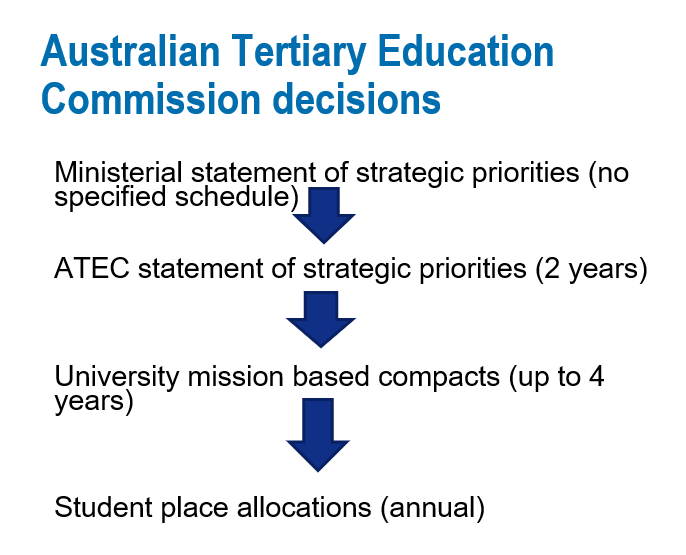
 Andrew Norton