ATEC’s interim statement of strategic priorities

Yesterday the Australian Tertiary Education Commission issued an interim statement of strategic priorities. This statement will guide university mission based compacts for 2027. This post covers the legal status of the statement, its apparent approach to management of the sector via compacts, and what it proposes in the areas of skills, First Nations, equity, teaching quality, VET-higher education relations, and research.

Decision-making under the ATEC system

When fully operational the ATEC decision-making process will operate in the sequence shown in the chart below.

Despite the ATEC Act 2026 officially coming into force on 29 April 2026, ATEC’s interim statement seems to be operating in the legal limbo the organisation has been in since being established as the ‘interim ATEC’ in July 2025.

Read More »

ATEC legislation amended in the Senate

The ATEC legislation passed the Senate yesterday, after the government accepted amendments from the Greens and David Pocock. It now needs to be rubber-stamped by the House of Representatives [update 9pm 31/3 – done] and the Governor-General [update 3/4 -done]. Once that is done, it will become law after 28 days [update – 29 April].

The amendments improve the legislation while still in my view leaving major flaws.

This previous post of mine links to my ATEC Senate inquiry submission and earlier posts on aspects of the legislation.

Objects of the Act

One of my criticisms was the entirely utilitarian and philistine set of ‘objects’ in the Act. While arguably no government since the 1970s has genuinely cared much about the broader functions of universities, they at least nodded to them in legislative objects. Not this government.

But the Senate amendment improves things:

Research

The ATEC bill read like a rushed committee job with nobody in enough control to ensure internal coherence. One example of this was research appearing in the objects of the bill but then disappearing from ATEC’s functions and matters on which it can give advice.

This is now fixed.

Read More »

The 2026 funding agreements, Part 1: Public university block grants

The 2026 higher education funding agreements, the legal basis of Commonwealth Grant Scheme funding, were published recently. This post examines public university funding for ‘higher education courses’.

‘Higher education courses’ has a specific legal meaning. It includes FEE-FREE Uni Ready (enabling) courses and coursework programs other than medicine, except for Indigenous students in bachelor degree courses, who are funded separately. Each public university receives a maximum basic grant amount (MBGA) for higher education courses. This funding is intended to be a flexible block grant. Universities can move money between qualification levels and disciplines, except for medicine.

Policy change

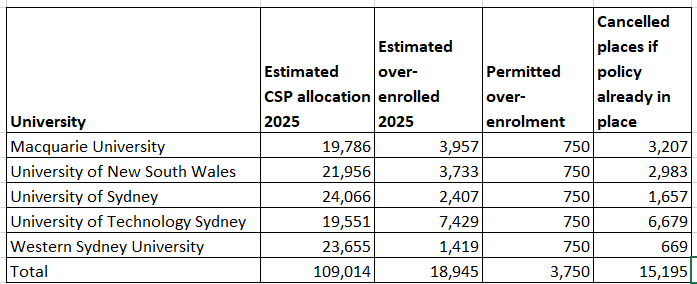
For 2026 the government has changed its policy on setting university MBGAs, as part of a transition to a new funding system under the proposed Australian Tertiary Education Commission. For 2023-2025 Labor retained the Coalition policy of indexing MBGAs to inflation and adding regional-campus-biased increments for population change. This policy led to many universities not using all their MBGA, known as ‘under-enrolment’. Coalition policies to compensate higher education providers for under-enrolment cost taxpayers $844 million between 2020 and 2023.

The government has, sensibly enough, decided not to keep increasing MBGAs for universities that cannot utilise the funds. The new policy, as summarised in the funding agreements, is:

  • For universities that significantly under-enrolled in 2024, the last year with ‘verified’ data, the provider will receive no increase in higher education courses MBGA between 2025 and 2026. Section 30-27(3) of the Higher Education Support Act 2003 prevents the government from lowering a MBGA between years.
  • Universities with enrolments valued at or near their MBGA will receive inflation indexation.
  • Universities with significant over-enrolment ‘may’ also receive a share of an over-enrolment fund.

In a document distributed to universities in 2025, significant over-enrolment was defined as delivering places valued at 5% or more above their MBGA.

Read More »

My ATEC Senate inquiry submission/legislation analysis

Submissions for the ATEC bills Senate inquiry are appearing on the inquiry’s website.

My submission turned into a detailed analysis of the two bills, the main one setting up ATEC and another with consequential amendments to the Higher Education Support Act 2003 and the TEQSA Act 2011.

It draws from my seven posts to date on the ATEC bills: on its objectives, on mission based compacts, on student contributions and funding rates, on ATEC’s independence from the government, on the setting of the Threshold Standards, on international student caps, and on ATEC commissioners and their qualifications.

The bills should be rejected

The short version of my view is that neither bill should pass.

Although the full scope of ATEC’s powers won’t be seen without further legislation, the mission based compacts alone, as drafted, give the government/ATEC unprecedented power over universities.

This power is inconsistent with university autonomy and with proper parliamentary control over government officials.

On the available evidence, this power would be used to pursue a narrow instrumentalist view of higher education. Even modest acknowledgements that education has purposes other than economic or equity goals, such as the references to ‘cultural and intellectual life’ in HESA 2003, are conspicuously absent from these bills.

Read More »

The Australian Tertiary Education Commission legislation, Part 7, The number of ATEC commissioners and their qualifications

Under the bill to create the Australian Tertiary Education Commission there will be three ATEC commissioners: a Chief Commissioner, a First Nations Commissioner, and a Commissioner.

The commissioners will have significant administrative and advisory functions requiring expertise on a wide range of topics. I have covered two of these topics in detail in this series on the ATEC legislation, ATEC’s advice on the Threshold Standards that govern all higher education providers and on per student funding rates. Other subjects on which expertise will be needed include the equity groups, education demand, higher education administration, and research.

It’s not clear, however, that the three commissioners envisaged under the ATEC legislation will have expertise across the full range of fields.

Mapping ATEC functions and advisory roles against statutory selection criteria

In the Universities Accord (Australian Tertiary Education Commission) Bill 2025 sections 56 to 59 set out the qualifications for being a commissioner. All three commissioner roles have a general requirement for appropriate skills, knowledge and experience. Section 59 sets out specific required domains of knowledge and experience that they must collectively have. The table below maps these against the responsibilities of ATEC, as indicated across section 3 of the bill (Objects), section 11 (Functions) and section 41 (Advice and recommendations). 

Read More »

The Australian Tertiary Education Commission legislation, Part 6, International student caps

Under legislation to establish the Australian Tertiary Education Commission, introduced into Parliament in November 2025, a function of ATEC is to ‘allocate a maximum number of international student commencements to ESOS registered providers at the direction of the Minister’. This appears as section 11(h) of the Universities Accord (Australian Tertiary Education Commission) Bill 2025.

Does this create a power to cap international student numbers?

The ATEC bill’s explanatory memorandum states that further legislation will set out a framework for how international student commencements will be allocated (p. 8). But does section 11(h) on its own create a power to cap international students independently of this framework?

On its plain meaning I think it does. Section 33(1) of the Acts Interpretation Act 1901 says that: ‘When an Act confers a function or imposes a duty, then the power may be exercised and the functions or duty must be performed from time to time as the occasion requires.’

The minister can, by legislative instrument, create rules ‘necessary or convenient for carrying out or giving effect to this Act’, adding more detail to how the caps would work: section 75(1)(b), Universities Accord (Australian Tertiary Education Commission) Bill 2025.

Read More »

The Australian Tertiary Education Commission legislation, Part 5, ATEC, TEQSA and the Threshold Standards

Under the legislation to establish the Australian Tertiary Education Commission, introduced into Parliament late last month, ATEC would advise the minister on the Higher Education Threshold Standards. All higher education providers must meet these standards as a condition of registration. The enforcement agency is the Tertiary Education Quality and Standards Agency.

This post compares the current system for setting the Threshold Standards with how this would happen if the ATEC legislation passes unamended.

Current process for setting the Threshold Standards

The Threshold Standards are a legislative instrument – and so disallowable by either the Senate or the House of Representatives – made by the education minister: section 58 of the Tertiary Education Quality and Standards Agency Act 2011. Under the same provision the minister can make other quality-related standards, as part of a Higher Education Standards Framework.

The minister must not make a standard unless a draft has been developed by the Higher Education Standards Panel (discussed shortly): section 58(3)(a) TEQSA Act 2011.

The minister must consult with the state and territory education ministers: section 58(3(b)(i) TEQSA Act 2011.

The minister must consult with the research minister if that is a separate role (not currently): section 58(3(b)(ii) TEQSA Act 2011.

The minister must consult with TEQSA: section 58(3(b)(iii) TEQSA Act 2011.

The minister must have regard to any advice or recommendations given by the Panel or the consultation parties: section 58(4) TEQSA Act 2011.

Read More »

The Australian Tertiary Education Commission legislation, Part 4, ATEC’s independence from the government

The Universities Accord Final Report recommended that ATEC be an ‘independent statutory authority … to enable it to provide robust advice and support evidence-based decision making and planning’ (p. 234). This post explores the relationship between ATEC and the government, as set out in the ATEC bill introduced into Parliament last week.

I should say at the start that unelected bodies with significant powers (‘independent’) are not necessarily good things. Government agencies should work within clear goals and rules established by democratic processes.

But independence can be beneficial in ensuring that government (and the broader public) get honest data – the ABS is a model here. Independent bodies can also help governments avoid the temptation to do things that are politically beneficial in the short run but detrimental in the long run – the RBA is a model here. Both the ABS and the RBA make mistakes, but their overall approach is better than letting the government decide whether or not to release vital data or to set interest rates with public opinion in mind.

All legislative references, unless otherwise specified, are to the Universities Accord (Australian Tertiary Education Commission) Bill 2025.

Administration of mission based compacts

The most important ATEC function will be to administer mission based compacts. As noted in a previous post, the content of mission based compacts will be driven by a ministerial statement of short-term and long-term strategic priorities: section 15. However this is not a legislative instrument: section 15(6). This means that neither the Senate nor the House of Representatives can disallow it. I take this as a democratic negative compared to the current system, under which key spending programs, such as equity and research block grants, have their own legislative instruments.

ATEC must prepare its own statement of strategic priorities: section 43. ATEC must take the minister’s priorities into account when performing its functions: section 15(4). Within the limitations of the new framework, this is appropriate in putting ATEC’s direction under the broad control of a person who can be subject to parliamentary questions, even if the ministerial statement of priorities cannot itself be vetoed. ATEC itself will appear before Senate Estimates.

Importantly, the minister will not give directions to ATEC in relation to decisions ATEC makes or in relation to ‘a higher education provider or a class or classes of higher education providers’: section 71(2)(b) & (c). This compares favourably to the current funding agreement system, under which the minister can effectively determine the content: section 30-25 of the Higher Education Support Act 2003. It is also better than the wide power to cancel course registration for international students, including on the basis of the ‘kind of provider’, which was approved by Parliament with modest improvements the same week the ATEC bill was introduced.

Section 71(2) reduces the risk of ministerial discretion being misused to penalise a university or universities in an arbitratry way.

The strongest guard against the misuse of power, however, is having rule-driven programs. On that the ATEC model would be worse than what we have now.

Read More »

The Australian Tertiary Education Commission legislation – Part 3, Per student funding and student contributions

Since it came to office, Labor has deferred dealing with Job-ready Graduates student contributions. First it added student contributions to the Universities Accord list of issues. In February 2024 the Accord Final Report suggested basing student contributions on lifetime earnings. Subsequently the minister said the new Australian Tertiary Education Commission would provide advice. Now we have ATEC’s legislation, but how student contributions will be handled is less clear than I expected.

All legislative references, unless otherwise specified, are to the Universities Accord (Australian Tertiary Education Commission) Bill 2025.

The ATEC bill and per student funding

The ATEC bill does not mention student contributions at all. One of ATEC’s functions, however, will be to advise the minister on:

“The efficient cost of higher education across disciplines and student cohorts and in relation to the Commonwealth contribution amounts for places in funding clusters.”: section 11(d)(ii), section labelled “Functions of the ATEC”.

In different words, in a later section on “Advice and recommendations”, a topic of advice is:

“The costs of teaching and learning in higher education and overall higher education funding amounts, including on a per student basis.”: section 41(1)(b).

Read More »

The Australian Tertiary Education Commission legislation – Part 2, Mission based compacts

An earlier post looked at the objectives of ATEC, as set out in legislation introduced yesterday. This post looks at mission based compacts, the key instrument of ATEC control over universities.

All legislative references, unless otherwise specified, are to the Universities Accord (Australian Tertiary Education Commission) Bill 2025.

Entering into mission based compacts is a function of ATEC: section 11(b).

Purpose of mission based compacts

Since the Universities Accord Final Report the term ‘mission based compact’ has been ambiguous. Whose mission will the compacts implement, the government’s mission or the university’s mission?

The ATEC bill tries to have it both ways. Section 28 describes the purpose of compacts as giving the ‘provider flexibility to pursue their goals and mission’ while also contributing to an ATEC statement of priorities for the sector, diversity in the system, and meeting the needs of the provider’s students and community.

The bill’s explanatory memorandum offers this passage of doublethink:

“Compacts will enable providers to demonstrate how their unique mission – the institution’s core purpose, values, and goals – aligns with national, state and local priorities, planning, and strategy, as well as industry engagement and innovations in learning and teaching. Informed by strategic priorities identified in the Statement of Strategic Priorities…”

How is a mission unique if it aligns with national priorities? All section 28 means, I think, is that universities can still pursue objectives not specified by ATEC, provided that these do not conflict with any requirements ATEC imposes. The extensiveness of those requirements will determine how much scope for independent action remains.

Read More »