Tony Burke’s changes to student visa policy – first draft on secondary visa holders

As foreshadowed in recent weeks, Tony Burke has today announced changes to student visa policy. Unfortunately at the moment – about 5.30pm on 17 September – there is little detail other than what has been given to journalists and Burke’s National Press Club address. I will update this post as necessary when more information is available.

The key changes are restrictions on secondary visa holders, for both students and temporary graduate visa holders, and additional limits on changing courses.

It appears that the secondary visa holder changes are prospective and won’t apply to students already in Australia, but this needs cross-checking against more policy detail. In the first draft of this post I will focus on secondary visa holder restrictions.

Summary of secondary student-related visa numbers

I analysed secondary student visa holder numbers earlier this month. Some key points from this analysis:

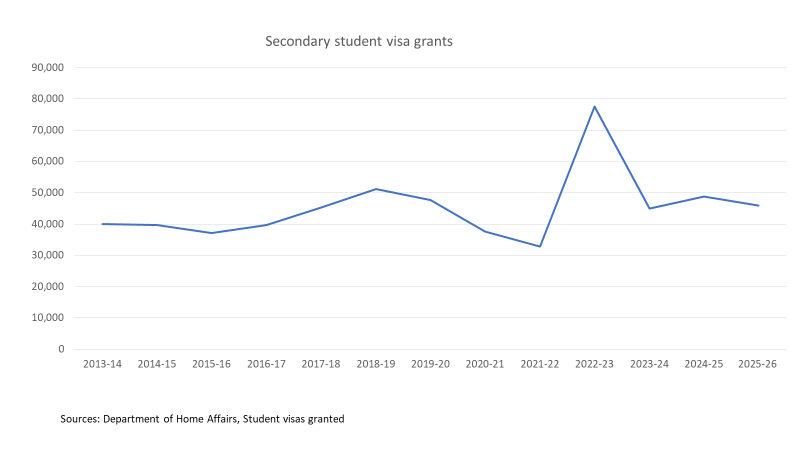
  • In recent years, annual secondary student visa holder grants have been in the 45,000-49,000 range.
  • Based on age group analysis, 27-28% of them are the children of students (proxy of age 19 years or less).
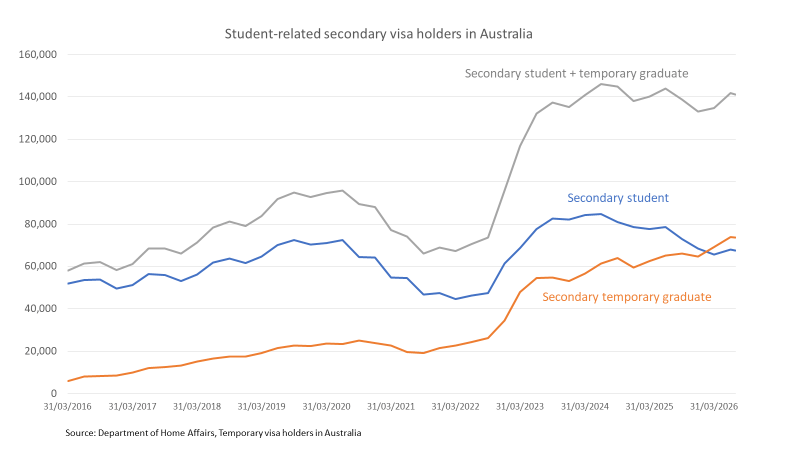
  • The ‘stock’ of secondary student visa holders present in Australia on a given day is already well off its peak of 84,846 in mid-2024, and was 67,549 on 31 July.
  • The flows and stocks of secondary student visa holders look anomalous. I think this is largely explained by a surge in secondary student visa grants in 2022-23 (77,599). Their primary visa holders have now mostly completed their courses and moved to temporary graduate visas or left the country, so outflows from secondary student visas have exceeded inflows.
  • As a result, as of 31 July secondary temporary graduate visa holders outnumber secondary student visa holders, 73,704 to 67,549.
  • Adult secondary student visa holders are likely to be an important aspect of the economics of coming to Australia for some students, with declared earnings of $1.3 billion in 2022-23. Secondary temporary graduate visa holders earned a similar amount.

New restrictions on secondary student visa holders

In line with recent policymaking preferences, the following groups will be exempt from restrictions on secondary student visa holders: research students, foreign affairs and defence sponsored students, students from the Pacific Islands, Timor-Leste and ASEAN countries. We can track their numbers through the student visa grants data. Over the last decade these visa categories have typically led to 10-11,000 annual secondary student visa grants. There was a spike in 2022-23, which included pent-up demand from the COVID border closure years.

Read More »
Pathways to permanent residence for former international students

The Australian government is trying, without much success to date, to reduce the number of long-term temporary migrants. For student-related visa holders – people with student visas, temporary graduate visas, or former international students on bridging visas – this is primarily about reducing inflows of new visa holders and increasing outflows of existing visa holders. Another important element, however, is moving former students to permanent visas.

This post looks at recent trends in former international students achieving permanent residence. It concludes with a discussion of the subclass 482 Skills in Demand visa, which offes a new route to PR.

Permanent visas

My main data source is the Department of Home Affairs Student visa and Temporary Graduate visa program report. It only reports former students transitioning from these visas, and not those with another temporary visa prior to PR. An ABS analysis up to the 2021 Census found that over half the 587,000 former student visa holders with PR had first held three or more temporary visas. This total includes secondary applicants, who made up about a quarter of the total.

The Home Affairs data includes former students moving to visas that are probable sources of PR, which I discuss below. There is no primary/secondary visa holder split. As I showed in an earlier post, secondary visa holders are a significant share of the potential PR population, especially for temporary graduate visa holders.

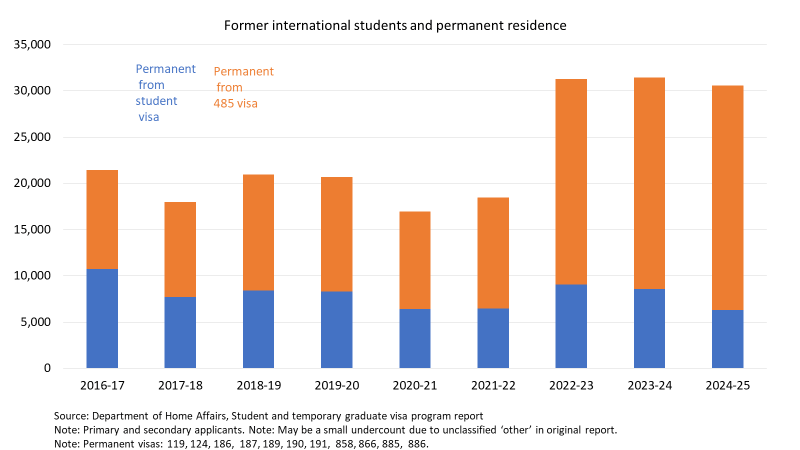
Since 2022-23 the annual number of former international student visa holders getting PR has increased significantly. Before COVID it was around 20,000 a year, after COVID it was around 31,000 a year. These are primarily work-related visas, with the subclass 190 state or territory Skilled Nominated visa the largest category.

One-step moves from a student visa have become less common. Their share of the total halved from 40% of the total in 2019-20 to 20% in 2024-25. The two-step track – student, temporary graduate visa – to PR has become more common.

Read More »

The coming cuts to student-related secondary temporary visa holders

Last week The Australian reported on apparent forthcoming limits on student secondary visa holders, the partners and children of the primary visa holder students. This has been rumoured for months. Along with long-foreshadowed changes to points-tested permanent visas, restricting secondary visa holders is a major yet-to-be-deployed policy weapon against temporary migration.

This post looks at the characteristics of and trends in student-related secondary visa holders.

Student-related secondary visa population trends

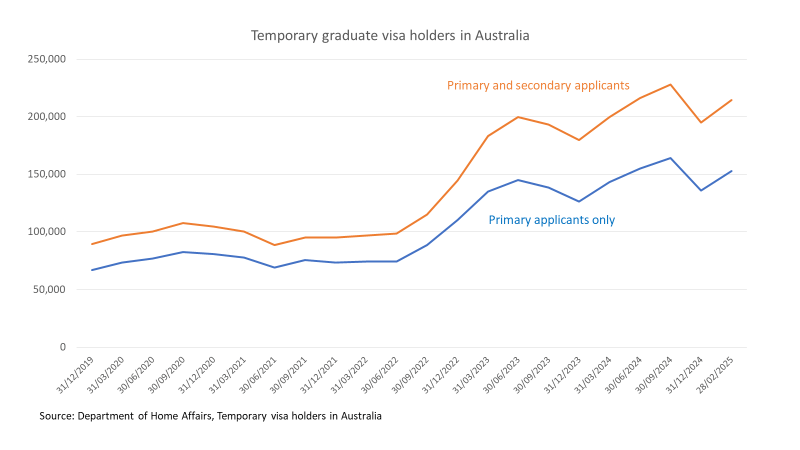
While students rather than temporary graduate visa holders seem to be the main policy target, as the chart below shows the secondary student visa holder population is already trending down, while temporary graduate secondary visa holders are increasing. The overall totals have fluctuated in a narrow range around 140,000 since late 2023.

Student secondary visa grants

As the chart above suggests, the relationship between student and temporary graduate secondary visas has changed over time. The recent temporary graduate takeover partly reflects a prior spike in secondary student visa grants, shown in the chart below. This was part of a high general increase in student-related visa numbers due to pent-up demand and policy incentives I described in an earlier post.

Read More »

Higher education participation rates at age 19 – a migration data update

For many years I have published estimates of the domestic higher education participation rate at age 19. That age was chosen as it is the modal age of domestic higher education students.

To calculate a participation rate we need a count of domestic higher education students (Australian or NZ citizen, permanent resident) and a count of the ‘domestic’ population, that is all Australian or NZ citizens and permanent residents. There are significant issues with calculating both numbers – explained in this post from last year.

One of these issues is that the ABS population figures are inflated by temporary migrants. They need to be removed from the count to get a ‘domestic’ population figure. The ABS does not provide a temporary visa/domestic breakdown. As a workaround, my participation time series deducts international 19 year old higher education students from the ABS 19 year old population estimate.

A new methodology

This onshore higher education international students aged 19 correction, however, has several problems: a) the higher education enrolment data does not cover all higher education providers; b) vocational education students are not included; and c) other temporary visa holders in Australia are not included.

These omissions should lead to an under-estimate of the temporary visa population and, after their deduction, an over-estimate of the ‘domestic’ population.

To get a more accurate temporary population figure, I asked the Department of Home Affairs for data on 19 year old temporary visa holders in Australia on 30/06/2024, the date of the ABS population estimate. Some of these visa holders may not satisfy the population count rule – that the person is or will be in Australia for at least 12 months in a 16 month period. However, people with temporary visas who satisfy the 12/16 rule but who were temporarily absent from Australia on 30/06/2024 are omitted from the count.

Read More »

Senate inquiry submission on mass cancelling courses for international students, banning new higher education providers, and Indigenous demand driven funding for medical courses

Update 28/11/2025: The Senate passed some amendments to this bill. These are noted in the original posts.

————————————————————————————————-

Senate inquiry submissions are due on Friday for the Education Legislation Amendment (Integrity and Other Measures) Bill 2025.

I am releasing my late draft submission in case it helps people finalising their own submissions and to identify any errors or omissions on my part.

Update 17/11/25: Final submission on the Senate committee website.

It builds on my three prior blog posts on the subject – on mass cancelling courses for international students, on a de facto ban on new higher education providers, and on extending Indigenous demand driven funding to medical courses.

Mass cancelling CRICOS course registrations

The main new content in the submission is description of existing legislative powers that can achieve the same claimed policy goals as the course cancellation proposal.

The practical effect of the bill, if it passes, would be to enable the suspension of the rule of law. It would allow the minister to make decisions according to vague criteria, without consulting anyone or considering other relevant laws. Due process would be abolished; providers could be penalised with course cancellation even if they have followed the law and acted ethically at all times.

It shocks me that this Trump-style bid to rule by executive order has even been introduced into Parliament. It’s staggering that, given nearly a year to think again since its original defeat last year, the government has brought back a bill that is, in some places, even more defective than their first attempt. I am referring here to removing the requirement to consult TEQSA or ASQA before cancelling a course on ‘standard of delivery’ grounds.

Read More »

The education minister should not have the power to cancel ‘classes of courses’ for international students

Update 28/11/2025: Last night the Senate passed the ESOS amendment bill with Coalition amendments. While I still believe this provision counts as very poor public policy – for reasons exanded up in my Senate inquiry submission – the Coalition changes do improve things somewhat. These are noted in the text below.

—————————————————————————————————-

The government is having another go at its 2024 Education Services for Overseas Students (ESOS) legislation, reintroducing it earlier this month minus the enrolment caps that saw it blocked in the Senate last November.

This post draws on and adds to things I wrote last year about proposed ministerial powers to suspend and cancel ‘classes of courses’.

The amendments discussed in this post were partly why I regarded the 2024 ESOS amendment bill as the single worst piece of higher education related legislation to come before the Parliament in my career.

What took it beyond standard bad policy was its use of broad ministerial discretion with minimal constraints on how it is exercised. That creates rule of law problems, making it hard to know in advance what the rules are. If passed, the amendments could lead to some education providers being arbitrarily punished for the actions of others.

Legislative references are to the section numbers of the ESOS Act 2000, as they are or as they would be if the bill passes unamended.

A mass course cancellation power

The bill gives the education minister power to simultaneously suspend or cancel multiple ESOS course registrations at multiple providers: division 1AB. It does this by making the unit of regulation a ‘class of courses’ – the definition of which is discussed below.

This mass cancellation power differs from existing laws that give the ‘ESOS agency’ (TEQSA in higher ed, ASQA in VET) power to suspend or cancel the registration of specific courses or specific providers: sections 83 to 92. It also differs from the current power of the immigration minister to issue a ‘suspension certificate’ to a provider. This can be done in specified circumstances such as fraud in visa applications, students breaching visa conditions, and other visa issues: sections 97 to 103.

Read More »

International students and the rental market

The housing section of the RBA’s report last week on international students and the economy had higher education media dismissing the contribution of students to rent increases as a ‘furphy’. I agree that international students are at most one factor amongst many in post-COVID accommodation market problems. That said, the RBA may understate the scale of international education’s contribution to rental demand.

Student Experience Survey results

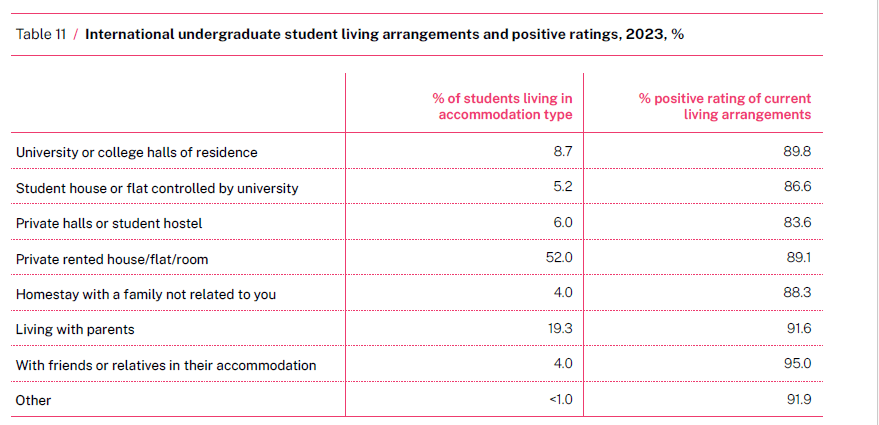
The RBA used the Student Experience Survey to try to work out the proportion of students in the private rental market where they compete with others for accommodation. The question the SES asks is below.

The RBA’s conclusion that about half of international students are in the private rental market is based on the result below, which is for undergraduates. Taking a broad definition of undergraduate that was about 40% of international students in 2023. But assuming it is broadly representative, there is still one number that I have persistently struggled to understand in this survey, which is the high percentage of international students who say they live with their parents – 19% in 2023. Can that be right?

Read More »

What do Australian governments owe international students?

Gaby Ramia, a University of Sydney academic, has long written about international student issues, including their security and well-being. His latest book, International student policy in Australia: The welfare dimension, accuses successive governments of ‘policy inaction’ on international student welfare.

The book opens with what became an infamous statement by then Prime Minister Scott Morrison. When asked, in the early stages of the COVID-19 pandemic, about the plight of JobKeeper-ineligible international students, Morrison responded that ‘these [student] visas and those who are in Australia under various visa arrangements, they’re obviously not held here compulsorily. If they’re not in a position to be able to support themselves, then there is the alternative for them to return to their home countries.’

A transactional relationship between Australia and international students

As Ramia’s book shows, in itself the prime minister’s statement was unsurprising. While Australia has longstanding consumer protection policies for international students, it has not offered general welfare-state type benefits. International students self-insure against the adversities that welfare states cover. As a visa condition they are supposed to arrive with savings. They are required to take out private health insurance. Education providers must provide information about welfare and other services, but are not obliged to deliver them.

Over the last quarter century the government has, to extents that vary over time, also encouraged international students to meet Australia’s labour market needs. But there was never any intention that the government fund international student related services. The government offered an Australian education and access to Australia’s labour market, not Australian welfare state support.

Ramia, by contrast, thinks that the government should take more responsibility for the welfare of international students. This should start with public transport concessions where these are not already offered and access to Medicare.

Ramia’s book was completed before the government changed its mind on international students, and started trying to cut their numbers. That policy turn creates new issues about the relationship between the government and international students.

Read More »

Temporary graduate visas – trends in applications, grants and populations

As part of its international student policy announcement, the Coalition promised a ‘rapid review into the Temporary Graduate Visas (subclass 485)’. The review would ‘address the misuse of post-study work arrangements as a way to gain access to the Australian labour market and as a pathway to permanent migration.’

While recent polls suggest the Coalition will not form government, net overseas migration will remain an important political issue. It is worth understanding trends in major migration categories such as the 485 visa.

This post summarises the available 485 visa data. A key point is that although applications for new 485 visas in 2024-25 to date are lower than in previous years, in the coming years there is the potential for significant increases in total 485 visa holder numbers.

Purpose of the 485 temporary graduate visa

Today’s temporary graduate visa is descended from an early 2010s policy that was designed to make Australia more competitive in the international education market. It does this by letting former international students access the labour market, so doing this is not ‘misuse’ according to the policy’s intent. The pathway element is more contentious. The 485 visa can be a pathway to permanent residence but it offers no guarantees. Government and student expectations proably differ on this matter.

In any case, as the numbers reported below show, there is no way all 485 visa holders in Australia in early 2025 could transition to a permanent migration program of 185,000 people for 2024-25.

Trends in the number of temporary graduate visa holders

The Department of Home Affairs does not publish how many people hold a 485 visa. The closest we get to a stock figure is a monthly count of temporary migrants in Australia. As at 28 February 2025, 214,714 people were in Australia on 485 visas. This was about 14,000 down on the 30 September 2024 peak. The monthly in-country totals undercount visa holders as some are temporarily overseas.

Since 2022 the primary visa holder share of the total – that is, the former student with the relevant qualification – has decreased from 75-80% of the total to 70-72%. There has been greater growth in secondary visa holders, the partners and children of primary visa holders.

Country of origin of 485 visa holders

Read More »

The Coalition’s plan to reduce international student numbers – some first thoughts

As rumoured in recent months, the Coalition has decided, if it wins office on 3 May, to cap commencing international student enrolments at a percentage of all commencing enrolments. The precise number is yet to be settled, but is expected to be around 25% and will only apply to public universities.

Student experience as well as migration concerns

A key conceptual difference with the government’s policy is that the Coalition wants to improve the domestic student experience as well as take pressure off accommodation markets. That’s why they chose a % of enrolments rather than, as under Labor, formulas driven by past enrolment patterns – although Labor did include a penalty for institutions with high concentrations of international students.

So far as I know, no careful research examines whether high concentrations of international students adversely affect domestic students in measurable ways. There are many anecdotal complaints, especially around group assignments. Is it a coincidence that computing, engineering and business courses, which have high concentrations of international students, have relatively low student satisfaction (chart below)?

Perhaps international students have nothing to do with it. Long ago, looking at the old CEQ results, I observed that students in vocational courses seem less satisfied than other students. Speculatively they have more instrumental motivations, and so enjoy study less. They study in fields where universities compete with industry and the professions for staff. Academic salaries might not attract the best possible teachers.

Questions about the domestic student experience are at least worth asking and answering as best we can. Universities are too conflicted to do it or release the results if they do. It’s another argument for making higher education data available to researchers inside and outside the academy (e61 is doing a great job on this kind of research).

Read More »