The proposed new funding system, part 2: ATEC allocations of Commonwealth supported places to public universities

In the previous post, I outlined how the minister would set total numbers of Commonwealth supported student places if the Universities Accord (Opening the Doors of Opportunity) Bill 2026 is passed. This post looks at how the Australian Tertiary Education Commission (ATEC) will allocate CSPs to public universities. ATEC will also allocate places to other higher education providers, discussed in a later post.

To recap on the previous post, ATEC will allocate places from a ‘total allocation pool’ (TAP) determined by the minister. ATEC will not allocate medical places, which the minister will do. ATEC will also not allocate demand driven places, currently Indigenous students in bachelor degrees or medicine.

All legislative references in the following text are to the Higher Education Support Act 2003 unless otherwise specified, ‘current’ signalling the legislation now in force, ‘new’ signalling the amending bill.

Feedback is welcome via the comments or direct communication. This is complex legislation and I may misunderstand things. Three revisions to my first post so far.

Total number of Commonwealth supported places per university

The total number of CSPs allocated to a university will be known as their ‘domestic student profile’: new section 30-15(2).

The domestic student profile will have up to two components, the ‘core student load’ and an ‘additional growth allocation’: new section 30-25.

Read More »

The proposed new funding system, part 1: Setting the number of fully-funded Commonwealth supported places

This post is the first in a series of explainers on how the new Commonwealth supported student funding system will operate if the Universities Accord (Opening the Doors of Opportunity) Bill 2026 is passed.

The series is primarily aimed at policy advisers and people working in university planning offices. I covered the most important issue for the general public and prospective university students in this Conversation article.

This post looks at how the total number of fully-funded Commonwealth supported places will be determined. A fully-funded place is one for which both a Commonwealth and a student contribution is paid. Student contribution only places will be discussed in a later post.

The current system

As a refresher, the current CSP allocation system has three components:

  • Designated courses, where the minister allocates, via university funding agreements, specific number of CSPs. Currently only medicine for non-Indigenous students is designated. The funding formula is the Commonwealth contribution rate * the number of student places delivered or the allocated number of places, whichever is the lower.
  • Demand driven courses, currently only Indigenous students in bachelor degrees or medical courses. The funding formula is the Commonwealth contribution rate * the number of student places delivered. Effectively, universities and students decide on the allocation.
  • A ‘higher education courses’ grant in which each university gets a maximum basic grant amount (MBGA) to cover CSPs not in the previous two categories. The value of CSPs delivered in this category is calculated as the Commonwealth contribution rate * the number of student places delivered. If the value of these places exceeds the MBGA the university gets the MBGA. If the value is below the MBGA in theory the university receives that amount. In practice, in recent years, universities have received the full value of their MBGA via other programs despite not delivering CSPs of the required value.

The proposed reforms

All three of these components will change if the bill passes.

The overall higher education courses category will be allocated in CSPs instead of dollars, with no maximum basic grant amount. Total places will be determined by the minister, allocations to specific providers will be determined by ATEC.

Designated places will become a sub-category of higher education courses, used to allocate/restrict places in specific kinds of courses. While the minister decides which courses are designated, ATEC allocates designated places to providers.

Medicine will move into a new, separate category, still functionally equivalent to designation but allocated by the minister (as now) instead of ATEC.

The existing demand driven categories will be maintained and include a ministerial discretion to add new categories of courses. There will be a new mechanism to cap demand driven places if needed.

Read More »
Trends in domestic postgraduate coursework education

I have a paper coming out soon, co-authored with Ren-Hao Xu, on the rise of Commonwealth supported places in postgraduate coursework degrees. It is another in our series on university decision-making under Job-ready Graduates. This post provides more general background on domestic postgraduate coursework trends.

Key points:

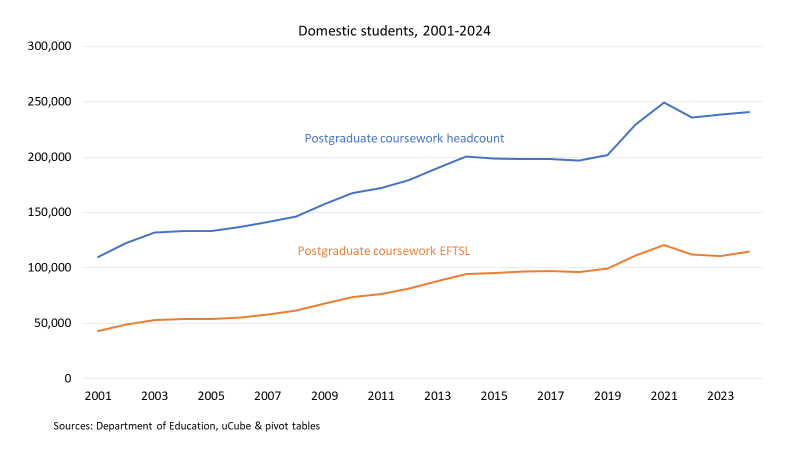
  • Despite a return to headcount growth following a mid-to-late 2010s stall, domestic PG coursework enrolments are declining as a % of the main potential market, the bachelor-degree holding population.
  • On a full-time equivalent student basis the largest domestic PG coursework enrolments by field are in education, business and health. Growth over the last decade is concentrated in health, social work and IT.
  • PG coursework had a 63.6% female enrolment share in 2024. The large health and education fields are highly feminised. The female enrolment share is increasing in most other broad fields of education.
  • Two-step bachelor/masters entry to professional occupations is making the PG coursework population younger.
  • More PG coursework is being delivered online, a likely cause of increased rates of part-time study.
  • In line with 2020s enrolment trends, course completions are increasing. Many migrants also have postgraduate qualifications. As a result the postgraduate share of the workforce is increasing.

Why do students enrol in postgraduate coursework degrees?

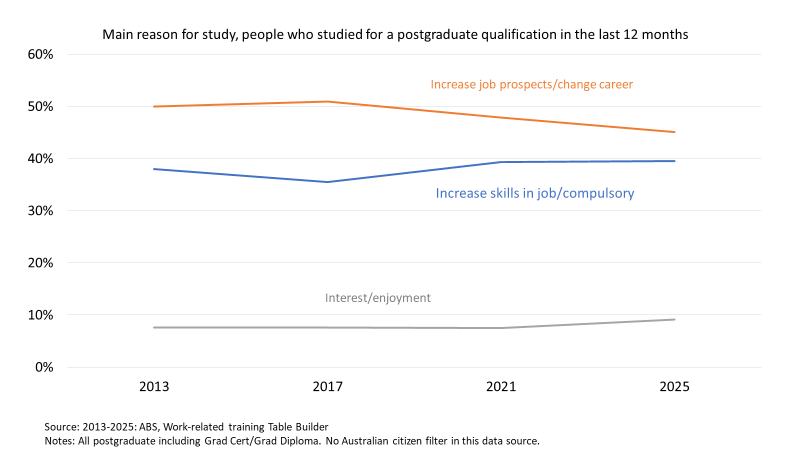
In the ABS work-related training survey students mainly give job-related reasons for taking a postgraduate coursework degree. Since 2017 more students take degrees for reasons relating to their current job, compared to seeking a career change or a better job.

Trends in overall domestic postgraduate enrolments

In the mid-to-late 2010s we saw a multi-year plateau in postgraduate coursework enrolments, at around 200,000. Then, in a likely example of higher education’s counter-cyclical relationship with the labour market, enrolments increased significantly in 2020 and 2021. As jobs returned enrolments eased off, but remained above 2019 levels.

Read More »

Job-ready Graduates – its effects on university Commonwealth supported places decisions

The student contribution increases of Job-ready Graduates get regular media coverage, focusing on the plight of debt-laden arts graduates. Far less attention is given to how JRG affected university decision-making.

For universities JRG had multiple elements. Total overall Commonwealth supported student funding rates by discipline were changed, some increasing but most decreasing. The changes to student contributions altered incentives for over-enrolments. Previous separate allocations of sub-bachelor and postgraduate Commonwealth supported places (CSPs)were ended, merged into a single fund with bachelor degrees.

To explore these effects, Ren-Hao Xu from UWA and I interviewed 15 leaders and officials from five universities in 2024 and 2025. We chose universities with various sizes, locations, missions and rankings to find out how they interpreted the JRG incentives and how these affected decision making. An academic article reporting our methodology and findings was recently published in the Australian Educational Researcher journal.

Over-enrolment

One thing I was especially curious about was to what extent over-enrolment – taking students on the student contribution only – was deliberate and to what extent accidental, reflecting the inherent difficulties in hitting precise full-time equivalent enrolment targets.

For the over-enrolled universities in our study the answer was mostly deliberate.

Two universities in our study had mission-related reasons for over-enrolling. The vice-chancellor of an equity-focused university told us that ‘we’ve also felt that we should over-enrol based on demand due to the university’s mission to serve students from disadvantaged backgrounds.’ The vice-chancellor of a regional university was willing to over-enrol as there was no other local university students could attend.

Other universities took a more strategic approach. One noted the likely Accord system re-set, knowing that during past policy shifts enrolments as of a recent year were used at the basis of the new funding system. This was a chance to lock in a larger base funding amount (an approach that has so far only partly worked, with just $50 million allocated to convert over-enrolments to fully-funded places).

Read More »

Self-reported status by educational attainment, an update

It’s common to hear concern about the ‘status’ of vocational education. An article yesterday in The Conversation reported a ‘stigma’ associated with school leavers choosing vocational education. ATEC’s recent discussion paper on a more joined-up tertiary system noted ‘a lack of parity of esteem’ between vocational and higher education. There was a parliamentary inquiry on status of vocational education a few years ago.

For the university-educated academics and bureaucrats who devise measures of status, such as the index of education and occupation used to determine higher education low SES, it seems self-evident that higher education ‘ranks’ above vocational education. In higher education policy the problem is not that educational hierarchy exists, but that access to its upper echelons correlates with family background.

But in a late 2010s blog post I argued that, outside this top-of-the-AQF bubble, educational status is present but seems less significant. The post reported on young people rating the ‘prestige’ of different qualifications and general social survey results of self-reported status by educational level. Although status-focused individuals seek the top educational brands, this does not fully transfer through to general status.

Self-reported status by education

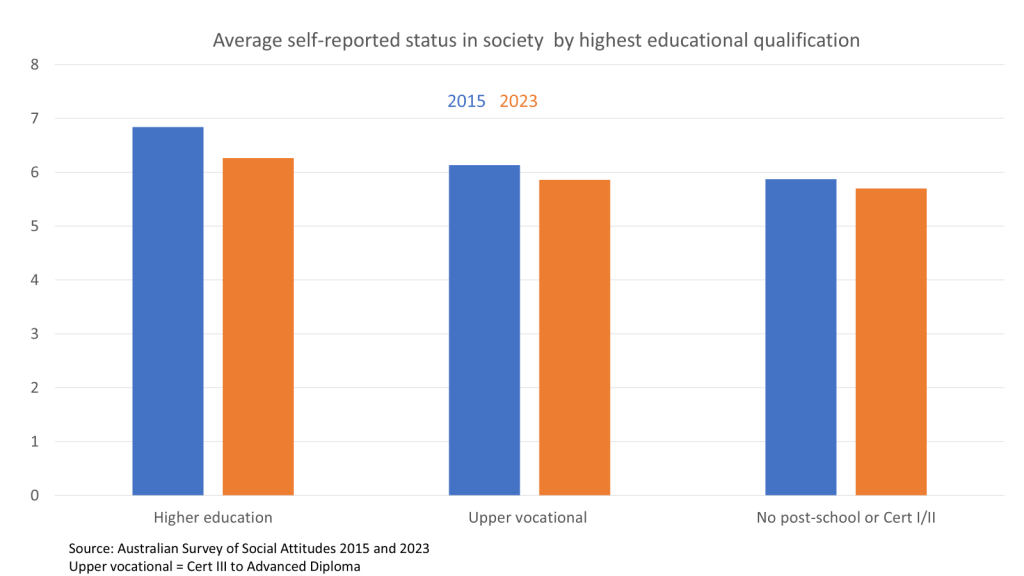
The self-reported status measure asks survey respondents to rate themselves on a 1 (labelled ‘bottom’) to 10 (labelled ‘top’) scale. The chart below reports average results, comparing 2015 from the original post to the 2023 Australian Survey of Social Attitudes.

While survey sample problems may affect the results – with 1010 responses to this question in 2015 and 883 in 2023 – self-reported status declined across all broad qualification groups. Perhaps falling living standards are perceived as a loss of status.

Self-reported status fell by the most for people with a bachelor degree or above. A consequence of this is that the average degree holder status was in 2023 only 0.4 points higher than the average upper vocational qualification holder, down from 0.7 in 2015.

Read More »