It’s common to hear concern about the ‘status’ of vocational education. An article yesterday in The Conversation reported a ‘stigma’ associated with school leavers choosing vocational education. ATEC’s recent discussion paper on a more joined-up tertiary system noted ‘a lack of parity of esteem’ between vocational and higher education. There was a parliamentary inquiry on status of vocational education a few years ago.
For the university-educated academics and bureaucrats who devise measures of status, such as the index of education and occupation used to determine higher education low SES, it seems self-evident that higher education ‘ranks’ above vocational education. In higher education policy the problem is not that educational hierarchy exists, but that access to its upper echelons correlates with family background.
But in a late 2010s blog post I argued that, outside this top-of-the-AQF bubble, educational status is present but seems less significant. The post reported on young people rating the ‘prestige’ of different qualifications and general social survey results of self-reported status by educational level. Although status-focused individuals seek the top educational brands, this does not fully transfer through to general status.
Self-reported status by education
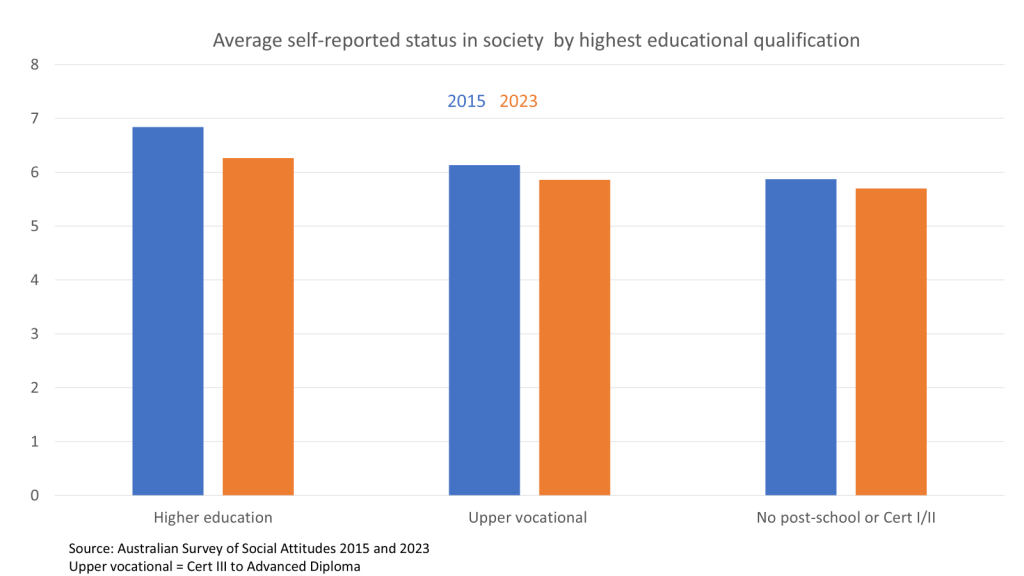
The self-reported status measure asks survey respondents to rate themselves on a 1 (labelled ‘bottom’) to 10 (labelled ‘top’) scale. The chart below reports average results, comparing 2015 from the original post to the 2023 Australian Survey of Social Attitudes.
While survey sample problems may affect the results – with 1010 responses to this question in 2015 and 883 in 2023 – self-reported status declined across all broad qualification groups. Perhaps falling living standards are perceived as a loss of status.
Self-reported status fell by the most for people with a bachelor degree or above. A consequence of this is that the average degree holder status was in 2023 only 0.4 points higher than the average upper vocational qualification holder, down from 0.7 in 2015.
Middle bias
The ABS measures of socioeconomic status use the full range of potential ranks. So on their decile measures similar numbers of people are in each decile from 1st to 10th. But as the distribution of self-reported status results below shows, that is not how people perceive their own position. Self-reported status clusters around ranks 5 to 8, with relatively few people rating themselves as 1 to 4 or as a 9 or 10.
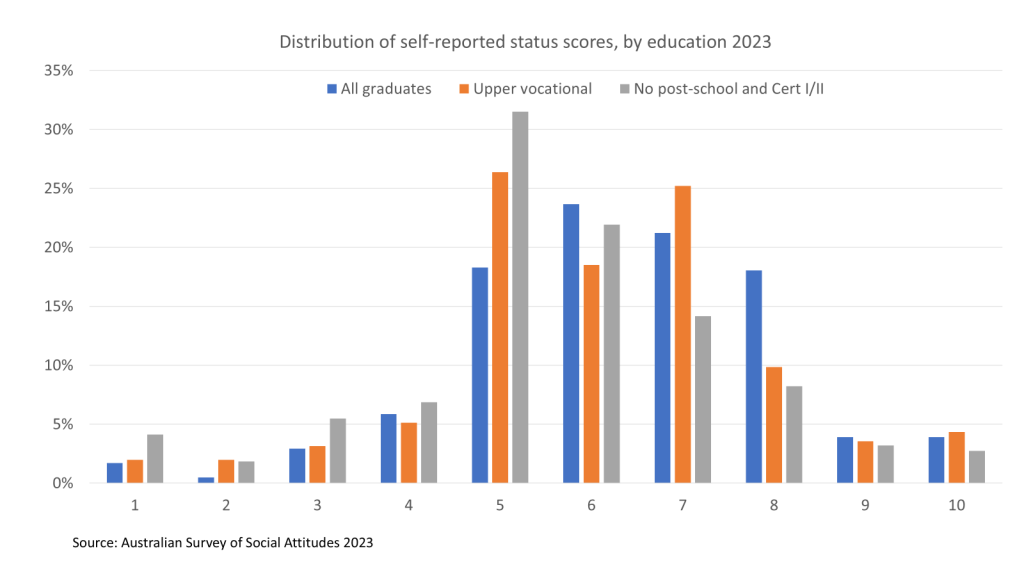
A tendency to avoid negative self-assessment may partly explain the low share of people rating themselves as a status of 1 to 4, with some egalitarian modesty perhaps keeping 9 and 10 ratings down. But I think this chart more accurately captures the Australian status system than ABS measures dividing the population into equal-sized percentiles, deciles or quartiles.
Status is more like a bell curve, with many people in the middle ranks and smaller numbers in the tails, than a 1 to 10 hierarchy. Tick a few boxes around broadly constructive activity and mostly good behaviour and you are at least a 5, and probably a bit higher. Only small numbers of people are exceptional enough to warrant a 9 or 10, a far smaller group than the top 20% in ABS measures. Having a university degree has long ceased being special, and on its own adds little to personal status.


Yes, I read the Conversation article with interest. The perspective from a dual-sector university in Central Queensland is very different. A school leaver choosing a vocational pathway over a higher education course is an extremely rational economic decision: no need to leave home to study at a capital city uni, very possibly a shorter course, no HECS debt and more often than not a higher starting salary working as a tradie than a graduate commencer. This is perhaps why we have a significant cohort of students who actually move onto a TAFE award AFTER completing an undergraduate degree, not as a stepping stone in the other direction. It’s possible that the ‘parity of esteem’ issue may be more of capital city perception than a regional one.
LikeLike