This post is about unlegislated higher education policies. The story starts last year with reports that the government was imposing caps on commencing Commonwealth supported places, which reached the media in November 2025. This sparked my interest, as the current funding legislation does not specifically authorise it.
By the end of the Universities Australia conference in February 2026 I was also hearing that governance conditions were being imposed on universities getting additional funds to reduce over-enrolment (taking students on the student contribution only). The policies were implemented via emails to vice-chancellors.
I decided to file a Freedom of Information request on the emails. I paid a $150 processing charge. This week the request was granted.
The minister’s letter
The FoI release shows that this process started with a letter from Jason Clare to the ‘interim ATEC’ dated 28 August 2025.
The letter reiterates the minister’s views on the impact of over-enrolments for the universities left with too few students. Its solution is to get over-enrolled universities to do three things:
- ‘Agree’ to a plan to reduce or not further grow commencing Commonwealth supported students
- Report on plans to support staff and students during this transition period (an implicit acknowledgement that fewer CSPs = fewer staff)
- Early adoption of agreed actions from the Education Ministers’ consideration of recommendations from the Expert Council on University Governance
To do these things, universities were to be given two incentives and one threat.
- A share of a $50 million over-enrolment fund for 2026, which would convert some over-enrolled places to fully-funded places (i.e. Commonwealth + student contribution)
- A more attractive transition phase to a capped system, under which they could keep student contributions for over-enrolments while trending down to the caps (the ‘glidepath’)
- And the threat that ‘actions they take now will be considered by ATEC when allocating growth places through mission based compacts for 2027’.
Emails to vice-chancellors of over-enrolled universities, dated 11 December 2025, mentioned that they had already agreed to ‘pursue a more modest growth strategy in 2026’ and told them that they had until 14 January 2026 to confirm student and staff support plans and agreement to governance actions.
University funding agreements
For the $50 million to be paid it will have to appear in university funding agreements. As of the morning of 20 May 2026 the public funding agreements include the foreshadowing statement that ‘a provider that was significantly over-enrolled may also be eligible to receive a share of the over-enrolment fund.’ I assume that the $50 million is not in the current funding totals. The government will want to first see that over-enrolled universities held their 2026 commencing students down.
The Higher Education Support Act 2003 allows conditions to be attached to grants: section 30-25(2). It is not clear whether the government proposes putting the email conditions into the funding agreements, or whether this will be an entirely extra-legal use of power.
Unfortunately section 30-25(2) has never been litigated and so there are no court rulings on its scope.
I think the $50 million total in payments in exchange for commencing student constraint has the strongest, although not certain, claim to being valid. While controls on places are not envisaged by HESA 2003 except in ‘designated’ courses (only medicine at this time), the commencing student condition is closely connected to the subject matter of the funding agreement, Commonwealth supported places. If such a condition appears and a university breaches it a reduction of grant penalty could be imposed under division 54 of HESA 2003.
The staff and student support plans are related to changes in CSPs. The email to vice-chancellors says that it expects the additional funding will reduce the need for restructures, redundancies, or course closures. But would such a condition breach section 30-25(2B) of HESA 2003, which expressly forbids conditions relating to industrial relations?
The governance changes clearly don’t belong in funding agreements. Governance is not a topic covered by HESA 2003 at all.
While the government could refuse to put the $50 million into the funding agreements, it cannot stop universities being paid student contributions for all the students they have enrolled. Section 96-1 of HESA 2003 leaves the government with no discretion on that matter.
The process
Whether or not the government tries to formalise conditions in the funding agreements this is a case of the higher education policymaking process falling far below the minimum acceptable standard.
If Jason Clare thinks over-enrolments are bad he should convince the Parliament of this and change the law before implementing an anti-over-enrolment policy.
If Jason Clare thinks university governance needs changing he should use the Threshold Standards amendment process – which he has made easier via ATEC – and persuade his state and territory colleagues to amend the relevant university legislation.
He is in fact planning to do both these things but decided to jump ahead anyway, with the Department of Education in the guise of the ‘interim ATEC’ using the dubious method of emails to vice-chancellors. The rule of law is being replaced with rule by email.
Ironically, the method chosen to improve university governance reflects poor public policy governance. This is not leadership by example.
And if the government implements new higher education policies it should announce them, not wait for someone to pay $150 to get them via Freedom of Information requests instead.
Putting aside legal and process issues, I now turn to the detail of the policies.
The over-enrolment policy
‘Over-enrolment’ in this context refers to enrolments in ‘higher education courses’, which is Commonwealth supported places for all students other than those in medicine or funded by the Indigenous bachelor degree demand driven program. For higher education courses each university gets a ‘maximum basic grant amount’ (MBGA) in their funding agreement. The value of CSPs delivered in the ‘higher education courses’ program is calculated as full-time equivalent places delivered multiplied by the relevant Commonwealth contribution amount.
If that value is less than the MBGA – as it has been for many universities in recent years – it is called under-enrolment. If the value is more than the MBGA it is known as over-enrolment.
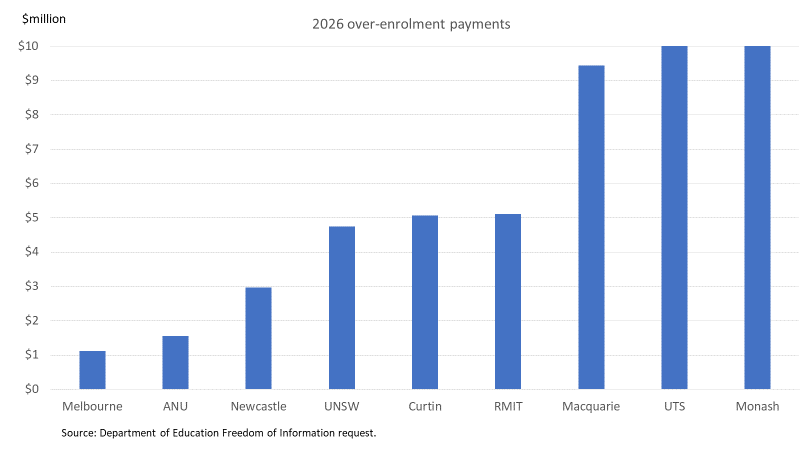
Universities were eligible for a share of the $50 million if over-enrolled by more than 5% of their MBGA, based on 2024 data. If they meet the conditions, the money will be added to their higher education courses MBGA. Effectively, that will reduce the number of student contribution only Commonwealth supported places. Over-enrolment payments per university were capped at $10 million.
We can see from the conditional payment amounts released under FoI that Monash and UTS were the most over-enrolled universities, with Macquarie also getting a relatively large payment. Over-enrolment was largely, although not entirely, a big-city phenomenon with six of the nine universities located in Melbourne or Sydney, which between them received 80% of the available funding.
The governance changes
The governance conditions require universities to commit to new publishing requirements covering:
- Outcomes of meetings and decisions taken
- Consultancy spending, its purpose, value and justification
- Vice-chancellor external roles
- Annual remuneration reports in line with requirements for public companies
- The composition of governing bodies
The membership of governing bodies is already public. The last point may be a reference to the skills matrix proposed in the expert report on university governance.
In addition, universities are expected to explain, in no more than 750 words, how they have begun to give effect to the principles in the governance report and give an estimated timeframe for completion.
Conclusion
FWIW I am against the over-enrolment policy but accept that governance changes are desirable without holding strong views on the details.
This post is, however, about following proper processes – so that policies are announced and debated before they are enacted, enacted before they are implemented, that governments stay within their express legal authority, and that all policies are available to the public.


This is very helpful, thanks Prof Norton. I fear universities will never be the same under this new system (I know that’s the point). Ironically, institutional autonomy is something we value under our Foreign Arrangements Scheme, yet we are becoming more centrally controlled by the day.
LikeLike