Last year I wrote about payments to universities under the Higher Education Continuity Guarantee, a Morrison-era program to compensate universities for ‘under-enrolment’. I then had data up to 2022. This can now be updated to 2024. Total expenditure on the Guarantee and its 2020 predecessor, the Higher Education Relief Program, now exceeds $1 billion.
How the Higher Education Continuity Guarantee worked
In simplified terms, the Higher Education Continuity Guarantee offset reduced payments to universities from the Commonwealth Grant Scheme.
Under the funding legislation, universities are supposed to receive the lesser of 1) The value of Commonwealth supported places delivered, calculated on a full-time equivalent place multiplied by the relevant Commonwealth contribution amount, or 2) the maximum grant amount that universities were entitled to receive under their funding agreement (how this maximum was calculated varied in the life of the Guarantee).
For universities entitled to receive only the amount calculated in option (1), the Guarantee topped them up to the amount in (2).
This is called ‘under-enrolment’ because universities did not deliver sufficient Commonwealth supported places to receive their maximum grant amount.
The cost of the Higher Education Continuity Guarantee
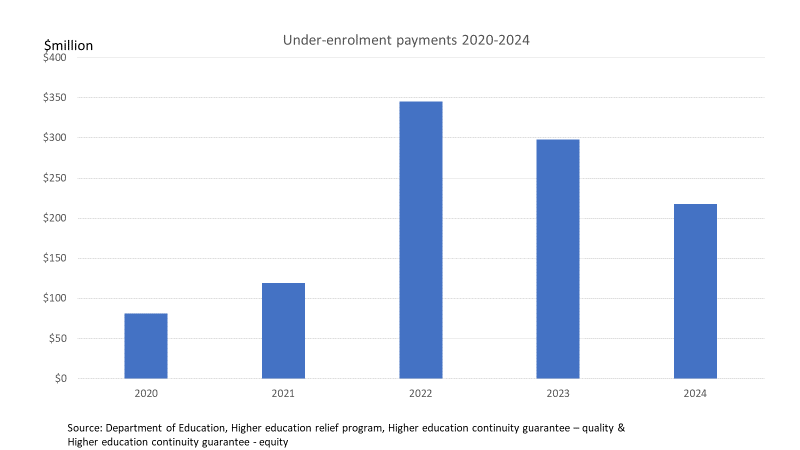
Guarantee funding peaked in 2022, at $346 million, before dropping to $298 million in 2023 and $218 million in 2024. Total cost since 2020 is $1.056 billion.
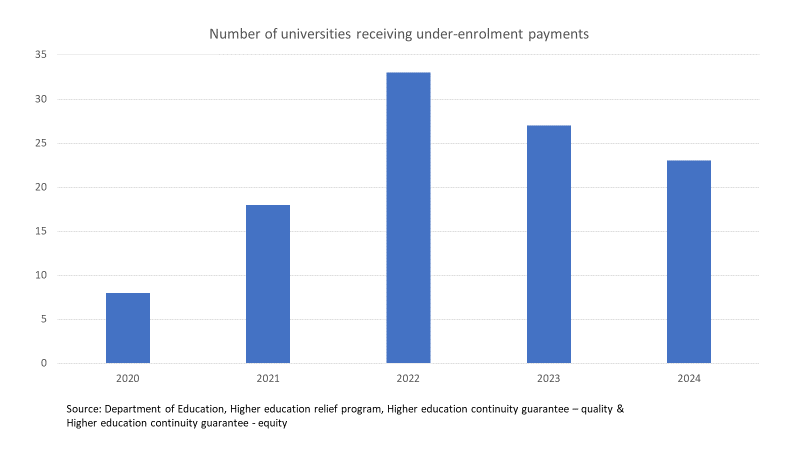
The number of universities receiving payments also fell, but remained at over half the sector in 2024. In that year three universities received less than $50,000 from the Guarantee, so with very slightly different EFTSL outcomes the number of recipients would have been lower.
Results by university
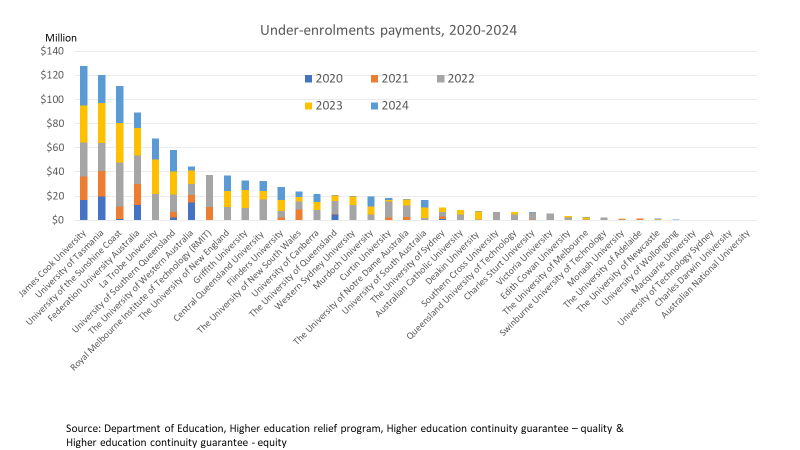
Four universities received nothing under Guarantee programs, while another five were responsible for half of total expenditure. Four of the top five are regional universities and the fifth (La Trobe) has significant regional campuses. A spreadsheet of university-level payments is here.
What was going on?
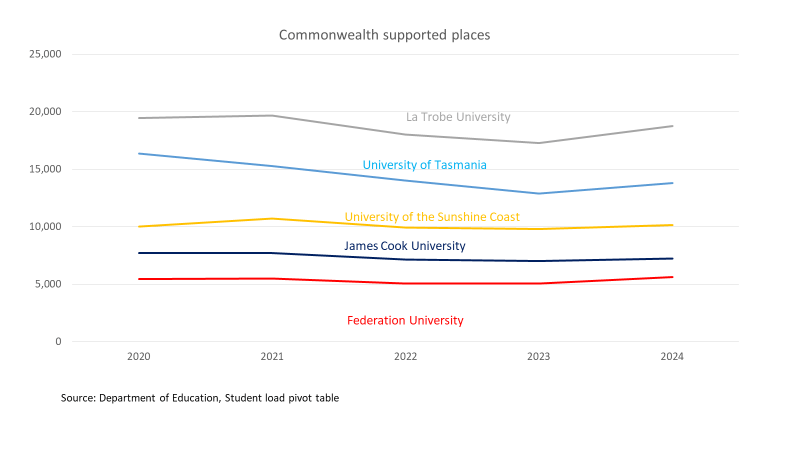
The post-COVID years saw a significant drop in domestic demand, with low SES and mature-age demand hardest hit. That broadly aligns with the enrolment profiles of the five most-affected universities.
While all five universities suffered from declining Commonwealth supported places, in only two of the cases was this a dramatic drop.
While soft demand is the major reason for under-enrolment, the Job-ready Graduates policy exacerbated it.
On the grant amount side, JRG annually increased each university’s maximum grants by CPI, regardless of whether demand justified an increase. It also gave additional increases to campuses in regional areas, also regardless of whether demand justified this. So universities with falling EFTSL were given higher maximum grants, aggravating their under-enrolment situation. These policies have sensibly been abandoned for 2026. Unfortunately what hasn’t gone is the idea that politicians and bureaucrats should decide where student places are located; that is a central assumption of the ATEC era that officially starts this week.
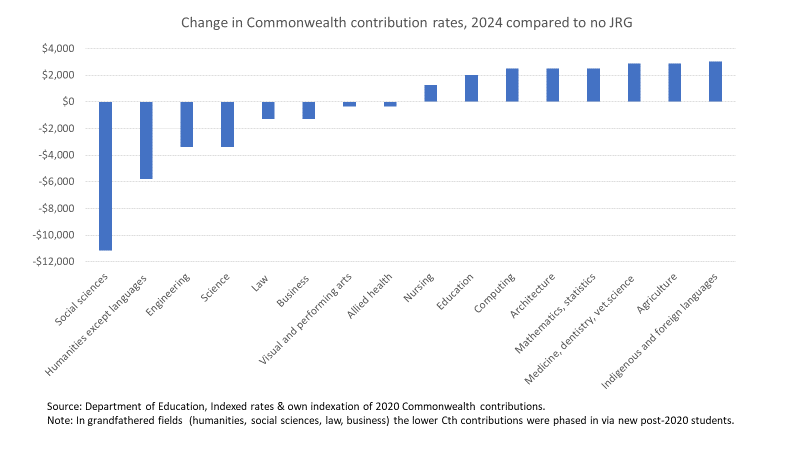
JRG also cut Commonwealth contributions in many fields, as seen in the chart below. This was part of a strategy to increase the number of student places at minimum cost to the Commonwealth, effectively requiring universities to deliver more places than previously to get their full grant amount. But when demand for those places wasn’t there these cuts to Commonwealth contributions also made it harder for universities to reach their allocated CGS amount.
I haven’t looked into the disciplinary mix at the more seriously under-enrolled universities, but even with stable EFTSL it was possible to go backwards on the EFTSL * relevant Commonwealth contribution calculation if enrolments were skewing to the fields with cuts to their Commonwealth contributions. Conversely, other universities may have had stable EFTSL but higher results on the EFTSL * relevant Commonwealth contribution calculation if enrolments were skewing to fields with increased Commonwealth contributions.
The future
The under-enrolment problem was starting to self-correct by 2024, as can been seen in the Guarantee payouts and the EFTSL of the most under-enrolled universities. Applications in 2025 trended up overall and for the most-affected universities, with positive early indicators for 2026. Unwarranted growth in CGS funding has stopped.
For this year, under-enrolled universities are protected by the Transition Funding Floor Guarantee, which I described in an earlier post. The simplified funding formula is Transition Funding Floor Guarantee = (2025 actual CGS + continuity guarantee) – value of 2026 Commonwealth supported places.
Arrangements for 2027 are yet to be enacted, but previous statements indicate that there will be a funding floor of 97.5% of the previous year’s funding amount. So for seriously under-enrolled universities this is less generous than the 2026 system, which guarantees 100% of the previous year’s funding amount.
I support a less generous system. There is a case for a ‘continuity’ program that limits the scale of financial shocks from temporary downturns in student demand. But one of the key risks of ATEC’s bureaucratic allocation of places is that resources are locked to institutions, courses or types of students and then cannot be used in full due to insufficient demand. Combined with restrictions on over-enrolment, the danger is that the system will end up with fewer students than it could theoretically support. The capacity to move student places from under-enrolling universities to areas of greater demand will help reduce that risk.

