The proposed new funding system, part 6: Private universities and non-university higher education providers

The funding system I have described parts 1 to 5 of this series of posts applies in full to the higher education providers listed on ‘Table A’ of the Higher Education Support Act 2003. The public universities and the Batchelor Institute of Indigenous Tertiary Education appear on Table A.

This post looks at the situation of other higher education providers. This includes 5 private universities, 8 university colleges and 166 other higher education providers.

Provider registration by TEQSA does not confer any funding entitlements. It is necessary but not sufficient for funding.

No non-Table A provider has any statutory right to Commonwealth supported places. Four of the five private universities are, however, listed on Table B of HESA 2003. This entitles them to research funding and some other government funding but not CSPs. This post describes how non-Table A providers can get CSPs under the new system.

All legislative references in what follows are to the Higher Education Support Act 2003 unless otherwise specified, ‘current’ signalling the legislation now in force, ‘new’ signalling the amending bill, the  Universities Accord (Opening the Doors of Opportunity) Bill 2026.

Eligibility for Commonwealth supported places

In the new funding system, as now, eligibility for Commonwealth supported places is based on history and politics, not any objective criteria.

The minister, rather than ATEC, will decide whether a provider should be eligible for CSPs. This is done by putting providers on a list in the Commonwealth Grant Scheme Guidelines: new section 30-1(10(a)(ii).

We can see the current policy on adding providers from the 2026 funding agreements. They make reference to CSPs for TAFEs and ‘other high-quality not-for-profit specialist providers’. Five TAFEs have been added since last year. NIDA is also new to the list. The only new not-for-profit is Excelsia University College, although I would not call it a specialist provider, as CSP allocations to teaching, early childhood, social work and counselling courses suggest.

There is no specific power for ATEC to advise on provider additions, but possibly it could do so as incidental to advisory subjects in section 41 of the ATEC Act 2026 including (a) policy settings for higher education and (e) the ‘diversity of the higher education system’.

While eligibility is conferred by the minister ATEC will decide whether or not to allocate CSPs.

Read More »

Rewards and penalties under ATEC and the new funding system

This post in an overview of rewards and penalties available to ATEC as it enforces mission based compact terms and student places allocations.

By the standards of recent higher education regulation the ATEC compliance regime seems relatively weak. This may reflect a trade-off between maximising administrative discretion and creating clear laws to which fines could be attached.

The only automatic penalty universities face under the new system is for enrolling more students than the bureaucrats think they should have.

Rewards – the strange absence of mission funding

Despite the word ‘mission’ in the compact title and reference to university missions in the ATEC Act 2026 nothing in the original ATEC legislation, or the Universities Accord (Opening the Doors of Opportunity) Bill 2026 introduced late last month, gives ATEC any power to support universities in achieving their mission other than by allocating additional Commonwealth supported places.

A mission fund could have provided a balance to homogenising compact targets. But no such fund is planned and no legal provision under which it could be paid is in the current or amending legislation. With no mission funding the compacts are just another compliance exercise.

Read More »

ATEC’s allocation of international student commencements

In presentations earlier this year I told audiences that the government will try again to impose provider-level caps on international students. Its 2024 attempt failed due to a surprise Coalition-Green alliance in the Senate. The basis of my statement was ATEC ‘s legislation, which said that it would ‘allocate a maximum number of international student commencements to ESOS registered providers’ (emphasis added).

But for unexplained reasons the government is backing away from tough provider-level international student enrolment limits. The Universities Accord (Opening the Doors of Opportunity) Bill 2026 gives ATEC a role in allocating commencements to higher education providers, but it is something closer to current national planning level allocations for new overseas student commencement (NOSC) than a hard capped system.

The basic process will be that the minister sets a total allocation pool of international student commencements, and ATEC then decides on the distribution between universities and other higher education providers.

As described in detail below, this process has very high levels of ministerial and ATEC discretion, to the point of both being able to reduce allocations after the students have started their courses.

While there should be much better processes than those set in the bill, at least for non-public university providers it is not obviously significantly worse than what we have now.

Legislative references are to the Universities Accord (Australian Tertiary Education Commission) Act 2026 unless otherwise specified, ‘current’ signalling the legislation now in force, ‘new’ signalling the amending bill.

International student allocation pool

As for domestic students in Commonwealth supported places, the minister for education will start by setting a total pool of ‘overseas students that may commence a course of education with ESOS registered higher education providers during a specified period’: new section 46B(1).

What does the minister take into account when setting the international student allocation pool?

Read More »

ATEC’s interim statement of strategic priorities

Yesterday the Australian Tertiary Education Commission issued an interim statement of strategic priorities. This statement will guide university mission based compacts for 2027. This post covers the legal status of the statement, its apparent approach to management of the sector via compacts, and what it proposes in the areas of skills, First Nations, equity, teaching quality, VET-higher education relations, and research.

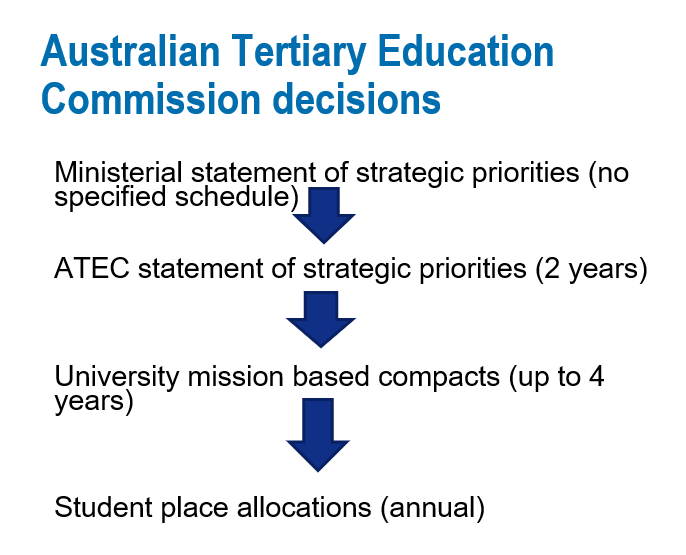
Decision-making under the ATEC system

When fully operational the ATEC decision-making process will operate in the sequence shown in the chart below.

Despite the ATEC Act 2026 officially coming into force on 29 April 2026, ATEC’s interim statement seems to be operating in the legal limbo the organisation has been in since being established as the ‘interim ATEC’ in July 2025.

Read More »

Higher education participation rates at age 19 – a migration data update

For many years I have published estimates of the domestic higher education participation rate at age 19. That age was chosen as it is the modal age of domestic higher education students.

To calculate a participation rate we need a count of domestic higher education students (Australian or NZ citizen, permanent resident) and a count of the ‘domestic’ population, that is all Australian or NZ citizens and permanent residents. There are significant issues with calculating both numbers – explained in this post from last year.

One of these issues is that the ABS population figures are inflated by temporary migrants. They need to be removed from the count to get a ‘domestic’ population figure. The ABS does not provide a temporary visa/domestic breakdown. As a workaround, my participation time series deducts international 19 year old higher education students from the ABS 19 year old population estimate.

A new methodology

This onshore higher education international students aged 19 correction, however, has several problems: a) the higher education enrolment data does not cover all higher education providers; b) vocational education students are not included; and c) other temporary visa holders in Australia are not included.

These omissions should lead to an under-estimate of the temporary visa population and, after their deduction, an over-estimate of the ‘domestic’ population.

To get a more accurate temporary population figure, I asked the Department of Home Affairs for data on 19 year old temporary visa holders in Australia on 30/06/2024, the date of the ABS population estimate. Some of these visa holders may not satisfy the population count rule – that the person is or will be in Australia for at least 12 months in a 16 month period. However, people with temporary visas who satisfy the 12/16 rule but who were temporarily absent from Australia on 30/06/2024 are omitted from the count.

Read More »

The Australian Tertiary Education Commission legislation, Part 6, International student caps

Under legislation to establish the Australian Tertiary Education Commission, introduced into Parliament in November 2025, a function of ATEC is to ‘allocate a maximum number of international student commencements to ESOS registered providers at the direction of the Minister’. This appears as section 11(h) of the Universities Accord (Australian Tertiary Education Commission) Bill 2025.

Does this create a power to cap international student numbers?

The ATEC bill’s explanatory memorandum states that further legislation will set out a framework for how international student commencements will be allocated (p. 8). But does section 11(h) on its own create a power to cap international students independently of this framework?

On its plain meaning I think it does. Section 33(1) of the Acts Interpretation Act 1901 says that: ‘When an Act confers a function or imposes a duty, then the power may be exercised and the functions or duty must be performed from time to time as the occasion requires.’

The minister can, by legislative instrument, create rules ‘necessary or convenient for carrying out or giving effect to this Act’, adding more detail to how the caps would work: section 75(1)(b), Universities Accord (Australian Tertiary Education Commission) Bill 2025.

Read More »

Senate inquiry submission on mass cancelling courses for international students, banning new higher education providers, and Indigenous demand driven funding for medical courses

Update 28/11/2025: The Senate passed some amendments to this bill. These are noted in the original posts.

————————————————————————————————-

Senate inquiry submissions are due on Friday for the Education Legislation Amendment (Integrity and Other Measures) Bill 2025.

I am releasing my late draft submission in case it helps people finalising their own submissions and to identify any errors or omissions on my part.

Update 17/11/25: Final submission on the Senate committee website.

It builds on my three prior blog posts on the subject – on mass cancelling courses for international students, on a de facto ban on new higher education providers, and on extending Indigenous demand driven funding to medical courses.

Mass cancelling CRICOS course registrations

The main new content in the submission is description of existing legislative powers that can achieve the same claimed policy goals as the course cancellation proposal.

The practical effect of the bill, if it passes, would be to enable the suspension of the rule of law. It would allow the minister to make decisions according to vague criteria, without consulting anyone or considering other relevant laws. Due process would be abolished; providers could be penalised with course cancellation even if they have followed the law and acted ethically at all times.

It shocks me that this Trump-style bid to rule by executive order has even been introduced into Parliament. It’s staggering that, given nearly a year to think again since its original defeat last year, the government has brought back a bill that is, in some places, even more defective than their first attempt. I am referring here to removing the requirement to consult TEQSA or ASQA before cancelling a course on ‘standard of delivery’ grounds.

Read More »

Is the government introducing a de facto ban on new higher education providers?

Update 28/11/2025: Last night the Senate accepted Coalition amendments that exempt higher education providers and TAFEs from the requirement to offer courses to domestic students for two years before being eligible to offer courses to international students. So effectively the provision discussed in this post applies only to non-TAFE registered training organisations. As I noted in the original post, offering courses to domestic students for two years is much easier for RTOs than higher education providers. Large numbers of RTOs have already met the requirement and could move into international education.

While this is good news, enrolment caps the government will try again to legislate next year could prove another insurmountable obstacle to education providers of any kind entering the international market.

————————————————————————————————-

Last week Claire Field published an interesting overview of 15 new higher education providers since January 2024. But growth of this kind would become very difficult if the government’s ESOS amendment bill passes unamended. It would limit registration of new providers offering courses to international students. This post examines whether the proposed restriction would, in practice, be a de facto ban on new higher education providers.

Under the ESOS amendment bill providers could not offer courses to international students without first delivering courses to domestic students, but providers are generally not competitive in the domestic market without offering FEE-HELP loans. But to get access to FEE-HELP, providers must demonstrate experience in delivering higher education – in practice usually by teaching the international students the ESOS bill would stop them recruiting.

Legislative references are to ESOS Act 2000 section numbers, as they are or would be if the amendment bill passes unchanged.

The proposed changes

The ESOS amendment bill would give the minister the power to suspend, for up to 12 months, applications and processing of applications for course and provider registration: sections 14C to 14F.

To be registered on CRICOS to offer courses to international students the provider must have delivered courses for consecutive study periods over at least two years to domestic students in Australia: section 11(2).

This post focuses on the section 11(2) change by looking at how providers have entered the international and domestic markets in recent years.

Read More »

The education minister should not have the power to cancel ‘classes of courses’ for international students

Update 28/11/2025: Last night the Senate passed the ESOS amendment bill with Coalition amendments. While I still believe this provision counts as very poor public policy – for reasons exanded up in my Senate inquiry submission – the Coalition changes do improve things somewhat. These are noted in the text below.

—————————————————————————————————-

The government is having another go at its 2024 Education Services for Overseas Students (ESOS) legislation, reintroducing it earlier this month minus the enrolment caps that saw it blocked in the Senate last November.

This post draws on and adds to things I wrote last year about proposed ministerial powers to suspend and cancel ‘classes of courses’.

The amendments discussed in this post were partly why I regarded the 2024 ESOS amendment bill as the single worst piece of higher education related legislation to come before the Parliament in my career.

What took it beyond standard bad policy was its use of broad ministerial discretion with minimal constraints on how it is exercised. That creates rule of law problems, making it hard to know in advance what the rules are. If passed, the amendments could lead to some education providers being arbitrarily punished for the actions of others.

Legislative references are to the section numbers of the ESOS Act 2000, as they are or as they would be if the bill passes unamended.

A mass course cancellation power

The bill gives the education minister power to simultaneously suspend or cancel multiple ESOS course registrations at multiple providers: division 1AB. It does this by making the unit of regulation a ‘class of courses’ – the definition of which is discussed below.

This mass cancellation power differs from existing laws that give the ‘ESOS agency’ (TEQSA in higher ed, ASQA in VET) power to suspend or cancel the registration of specific courses or specific providers: sections 83 to 92. It also differs from the current power of the immigration minister to issue a ‘suspension certificate’ to a provider. This can be done in specified circumstances such as fraud in visa applications, students breaching visa conditions, and other visa issues: sections 97 to 103.

Read More »

International students and the rental market

The housing section of the RBA’s report last week on international students and the economy had higher education media dismissing the contribution of students to rent increases as a ‘furphy’. I agree that international students are at most one factor amongst many in post-COVID accommodation market problems. That said, the RBA may understate the scale of international education’s contribution to rental demand.

Student Experience Survey results

The RBA used the Student Experience Survey to try to work out the proportion of students in the private rental market where they compete with others for accommodation. The question the SES asks is below.

The RBA’s conclusion that about half of international students are in the private rental market is based on the result below, which is for undergraduates. Taking a broad definition of undergraduate that was about 40% of international students in 2023. But assuming it is broadly representative, there is still one number that I have persistently struggled to understand in this survey, which is the high percentage of international students who say they live with their parents – 19% in 2023. Can that be right?

Read More »