Points-tested visas and international students – demand and supply

As explained in a previous post, former international students have a new possible employer-sponsored route to permanent residence via the Skills in Demand visa. But their options for points-tested visas are likely to decline.

In this post, I outline the points-tested visas, report on international student success in obtaining these visas, and describe the level of demand for them. I conclude with migration planning levels for 2026-27, which allocate fewer total places to points-tested visas.

In a following post, I will look at long-foreshadowed changes to points-tested visas and how these may affect international students.

What are points-tested visas?

The key idea behind points-tested visas is that applicants get ‘points’ for various attributes. The more points applicants accrue the more likely they are to get a visa. The theoretical maximum number of points from standard attributes across all three visas is 145. The minimum points to be eligible for a points-tested visa is 65.

But a specific number of points does not equal a visa. People who want points-tested visas submit expressions of interest. An EoI lasts for up to two years. Periodically the Department of Home Affairs invites people from the EoI pool to apply for a visa linked to listed occupations.

Three points-tested visas are currently available: the subclass 189 Skilled Independent visa, the subclass 190 Skilled Nominated visa, with the nomination by state and territory governments, and the subclass 491 Work Regional (Provisional) visa, also state and territory nominated. Some older visas are included in the data below: the subclass 489 Skilled Regional (Provisional) visa, which was replaced by the subclass 491 visa from November 2019, and the subclass 188 Business Innovation and Investment visa, which closed to new applicants on 31 July 2024.

International students and points-tested visas

As noted in my earlier post on international students and permanent residence, only former students moving directly from a student visa or a temporary graduate visa can be tracked using my main data source. This misses people who previously held a student-related visa but hold a different visa when seeking or receiving a points-tested visa. The figures presented are therefore at the lowest end of a range.

The subclass 190 Skilled Nominated visa is the most significant points-tested visa for international students. It has been the largest single category since 2019-20, on several occasions making up more than half the total. It was 48% of former international student visa grants in 2024-25.
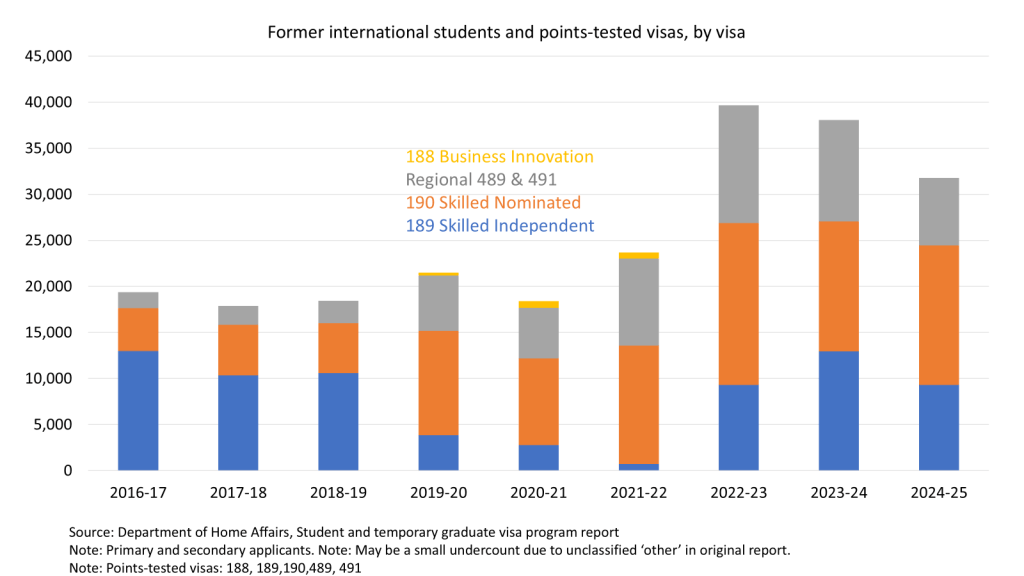
Bar graph showing the number of former international students and points-tested visas by various visa types from 2016-2025, including 188 Business Innovation, Regional 489 & 491, 190 Skilled Nominated, and 189 Skilled Independent.
Read More »

Proposed amendments to the student places capping and needs based funding bill

Jason Clare’s student places capping bill appeared in the Senate several times last week, but there were no votes on substantive amendments. Parliament does not sit again until 12 October.

It is clear, however, that agreement has been reached on amendments that will secure its passage through the Senate. Greens Senator Mehreen Faruqi said in the Senate on Wednesday 16 September that the Greens had ‘secured’ twelve amendments. There are twelve Greens amendments on the bill’s home page, so I will assume that this is the same twelve, although I could be mistaken.

This post summarises the proposed amendments, focusing on the Greens and the Liberals, as both have the numbers to get an amendment through if Labor agrees. The Greens, the Coalition and cross-benchers combined could also pass amendments Labor does not support.

I mostly do not discuss Senator David Pocock’s proposed amendments, because on his own he cannot sway a Senate decision. But he had a high level of intellectual engagement with the bill and proposed sensible changes. He is particularly good on something that the government is particularly bad at – putting rules scrutinised by parliament over ministerial and administrative discretion.

A floor number of places

On the bill’s introduction the explanatory memorandum indicated a floor number of Commonwealth supported places was intended, but this was not reflected in the bill itself.

In the House of Representatives a government amendment created a ‘core student load’ minimum number of places for public universities, although the amendment does not preclude year-on-year reductions in places.

But there was no corresponding requirement that the minister set a ‘total allocation pool’ of Commonwealth supported places sufficient to cover all the minimum ‘core student load’ allocations.

Read More »

Tony Burke’s changes to student visa policy – first draft on secondary visa holders

As foreshadowed in recent weeks, Tony Burke has today announced changes to student visa policy. Unfortunately at the moment – about 5.30pm on 17 September – there is little detail other than what has been given to journalists and Burke’s National Press Club address. I will update this post as necessary when more information is available.

The key changes are restrictions on secondary visa holders, for both students and temporary graduate visa holders, and additional limits on changing courses.

It appears that the secondary visa holder changes are prospective and won’t apply to students already in Australia, but this needs cross-checking against more policy detail. In the first draft of this post I will focus on secondary visa holder restrictions.

Summary of secondary student-related visa numbers

I analysed secondary student visa holder numbers earlier this month. Some key points from this analysis:

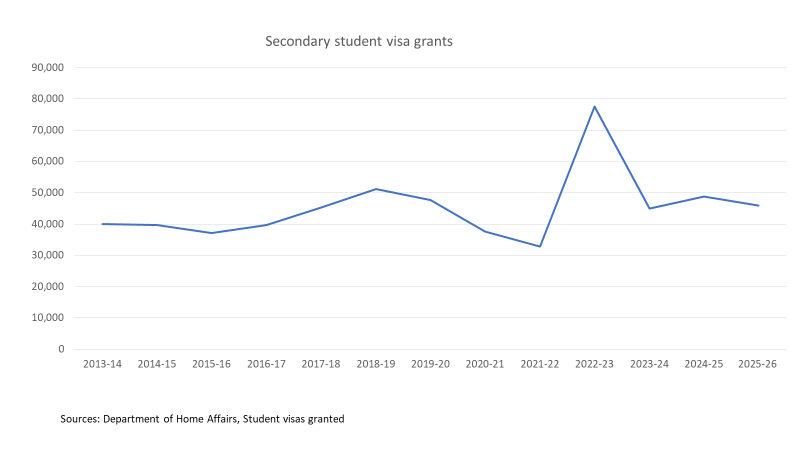
  • In recent years, annual secondary student visa holder grants have been in the 45,000-49,000 range.
  • Based on age group analysis, 27-28% of them are the children of students (proxy of age 19 years or less).
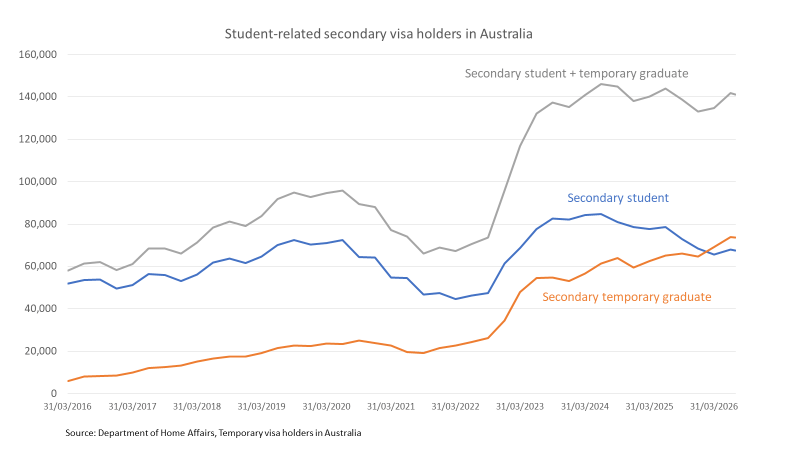
  • The ‘stock’ of secondary student visa holders present in Australia on a given day is already well off its peak of 84,846 in mid-2024, and was 67,549 on 31 July.
  • The flows and stocks of secondary student visa holders look anomalous. I think this is largely explained by a surge in secondary student visa grants in 2022-23 (77,599). Their primary visa holders have now mostly completed their courses and moved to temporary graduate visas or left the country, so outflows from secondary student visas have exceeded inflows.
  • As a result, as of 31 July secondary temporary graduate visa holders outnumber secondary student visa holders, 73,704 to 67,549.
  • Adult secondary student visa holders are likely to be an important aspect of the economics of coming to Australia for some students, with declared earnings of $1.3 billion in 2022-23. Secondary temporary graduate visa holders earned a similar amount.

New restrictions on secondary student visa holders

In line with recent policymaking preferences, the following groups will be exempt from restrictions on secondary student visa holders: research students, foreign affairs and defence sponsored students, students from the Pacific Islands, Timor-Leste and ASEAN countries. We can track their numbers through the student visa grants data. Over the last decade these visa categories have typically led to 10-11,000 annual secondary student visa grants. There was a spike in 2022-23, which included pent-up demand from the COVID border closure years.

Read More »

Pathways to permanent residence for former international students

The Australian government is trying, without much success to date, to reduce the number of long-term temporary migrants. For student-related visa holders – people with student visas, temporary graduate visas, or former international students on bridging visas – this is primarily about reducing inflows of new visa holders and increasing outflows of existing visa holders. Another important element, however, is moving former students to permanent visas.

This post looks at recent trends in former international students achieving permanent residence. It concludes with a discussion of the subclass 482 Skills in Demand visa, which offes a new route to PR.

Permanent visas

My main data source is the Department of Home Affairs Student visa and Temporary Graduate visa program report. It only reports former students transitioning from these visas, and not those with another temporary visa prior to PR. An ABS analysis up to the 2021 Census found that over half the 587,000 former student visa holders with PR had first held three or more temporary visas. This total includes secondary applicants, who made up about a quarter of the total.

The Home Affairs data includes former students moving to visas that are probable sources of PR, which I discuss below. There is no primary/secondary visa holder split. As I showed in an earlier post, secondary visa holders are a significant share of the potential PR population, especially for temporary graduate visa holders.

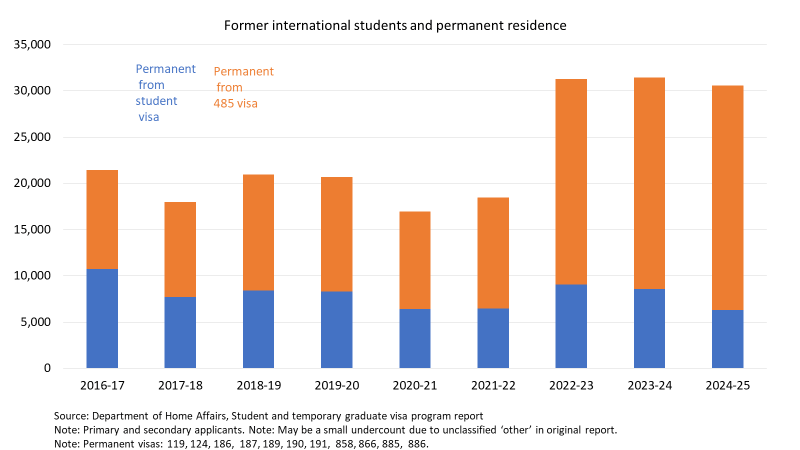
Since 2022-23 the annual number of former international student visa holders getting PR has increased significantly. Before COVID it was around 20,000 a year, after COVID it was around 31,000 a year. These are primarily work-related visas, with the subclass 190 state or territory Skilled Nominated visa the largest category.

One-step moves from a student visa have become less common. Their share of the total halved from 40% of the total in 2019-20 to 20% in 2024-25. The two-step track – student, temporary graduate visa – to PR has become more common.

Read More »

Measuring low SES and higher education policy

Australian higher education policy uses a geographic proxy to measure socioeconomic status. People living in the lowest 25% of areas by the ABS Index of Education and Occupation are deemed ‘low SES’.

The IEO is one of four SES measures devised by the ABS using census results. The other three are the Index of Relative Socio-economic Disadvantage (IRSD), the Index of Relative Socio-economic Advantage and Disadvantage (IRSAD), and the Index of Economic Resources (IER).

During the Senate inquiry into the new funding legislation Greens Senator Mehreen Faruqi, drawing on the University of Sydney’s submission which said it used IRSAD for awarding scholarships, asked witnesses about possible use of IRSAD instead. Senator David Pocock also asked about SES indicators for the ACT, which has few low SES students on the official definition.

I was one of several people to receive a written question on notice on equity definitions. This post draws on my response.

Predicting educational disadvantage

The chart below shows 2021 educational participation rates at age 20 by the four ABS SES indicators. Like the higher education version it uses SA1 areas, which on average contain about 400 people. I used census longitudinal data to capture SES when these students were aged 15 in 2016. This is a more reliable indicator of their formative years than current location, which could reflect a move closer to a university. A weakness of the funding bill currently in the Parliament is that its SES proxy is the student’s current address.

As a predictor of educational participation the IEO is the most powerful of the four. Parental education and occupation indicators show the largest high-low gaps. Young adults in the top decile are 4.2 times as likely to be at university than young adults in the lowest decile. The Index of Economic Resources is the least predictive, with top decile residents 2.3 times as likely to be at university as the lowest decile.

For outreach programs I can see merit in the IEO, to counteract absent university role models and possibly low parental expectations of higher education.

Read More »

The coming cuts to student-related secondary temporary visa holders

Last week The Australian reported on apparent forthcoming limits on student secondary visa holders, the partners and children of the primary visa holder students. This has been rumoured for months. Along with long-foreshadowed changes to points-tested permanent visas, restricting secondary visa holders is a major yet-to-be-deployed policy weapon against temporary migration.

This post looks at the characteristics of and trends in student-related secondary visa holders.

Student-related secondary visa population trends

While students rather than temporary graduate visa holders seem to be the main policy target, as the chart below shows the secondary student visa holder population is already trending down, while temporary graduate secondary visa holders are increasing. The overall totals have fluctuated in a narrow range around 140,000 since late 2023.

Student secondary visa grants

As the chart above suggests, the relationship between student and temporary graduate secondary visas has changed over time. The recent temporary graduate takeover partly reflects a prior spike in secondary student visa grants, shown in the chart below. This was part of a high general increase in student-related visa numbers due to pent-up demand and policy incentives I described in an earlier post.

Read More »