Last week The Australian reported on apparent forthcoming limits on student secondary visa holders, the partners and children of the primary visa holder students. This has been rumoured for months. Along with long-foreshadowed changes to points-tested permanent visas, restricting secondary visa holders is a major yet-to-be-deployed policy weapon against temporary migration.
This post looks at the characteristics of and trends in student-related secondary visa holders.
Student-related secondary visa population trends
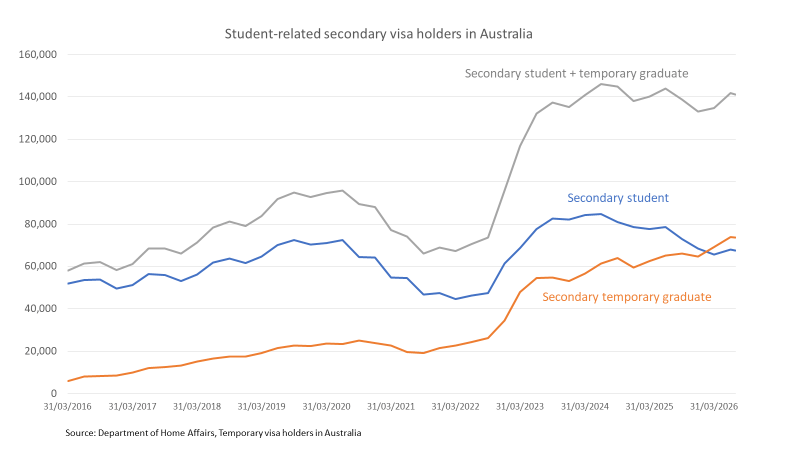
While students rather than temporary graduate visa holders seem to be the main policy target, as the chart below shows the secondary student visa holder population is already trending down, while temporary graduate secondary visa holders are increasing. The overall totals have fluctuated in a narrow range around 140,000 since late 2023.
Student secondary visa grants
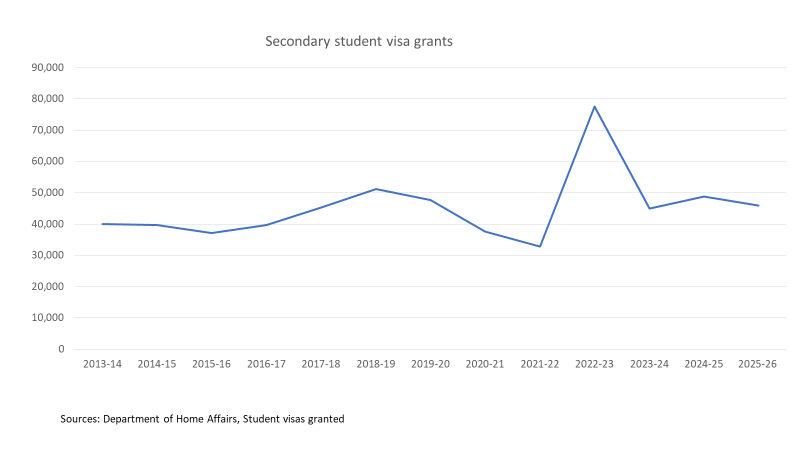
As the chart above suggests, the relationship between student and temporary graduate secondary visas has changed over time. The recent temporary graduate takeover partly reflects a prior spike in secondary student visa grants, shown in the chart below. This was part of a high general increase in student-related visa numbers due to pent-up demand and policy incentives I described in an earlier post.
Secondary visa holder countries of origin
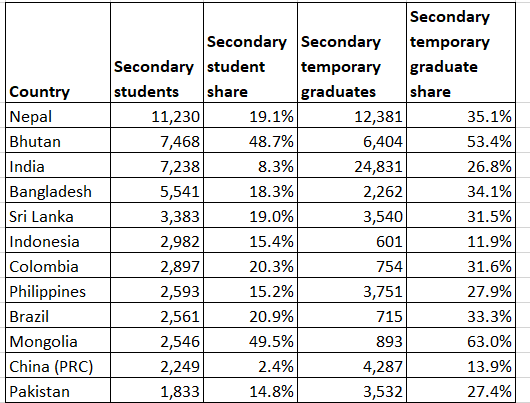
South Asian countries are the largest sources of secondary visa holders, only partly because they are major sources of students. The largest source countries for secondary visas are Nepal for student visas and India for temporary graduate visas. China is the largest source country for primary visa holders but only ranks 11th for secondary student visa holders. Measured in percentages, Bhutan and Mongolia stand out, with secondary visa holders making up nearly half of student visa holders and more than half of temporary graduate visas. The data is at 30 June 2026.
Demographics of secondary student visa holders
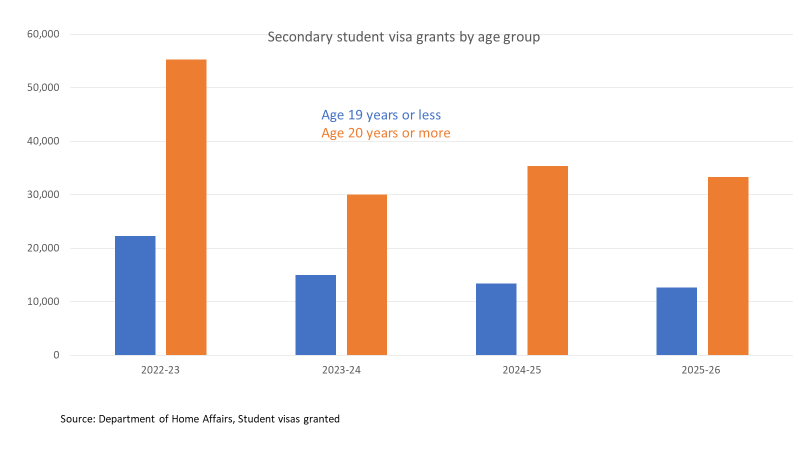
Only the original student visa grant data has the age data needed to identify the mix of children and partners in the secondary visa holder pool. Its age 15-19 years category may include some partners but I decided to include it in the children count. I made the opposite judgement for the 20-24 age category. With these assumptions, typically children are 27-28% of the secondary student visa holders.
Gender balance of secondary visa holders
Unlike domestic students, international students have an even gender balance. But for secondary student visa holders there is a male skew, near 60% of the total with a downward trend this decade. For the 19 years and under group the male share is about 51%, as expected given natural birth patterns. But above age 30 the male share of secondary applicants is two-thirds or more.
I am not sure how to interpret this result. I looked at the South Asian figures, given a history of male majorities from those source countries and their migration focus. Both primary and secondary visa holders are about 60% male, suggesting that more female than male students bring partners.
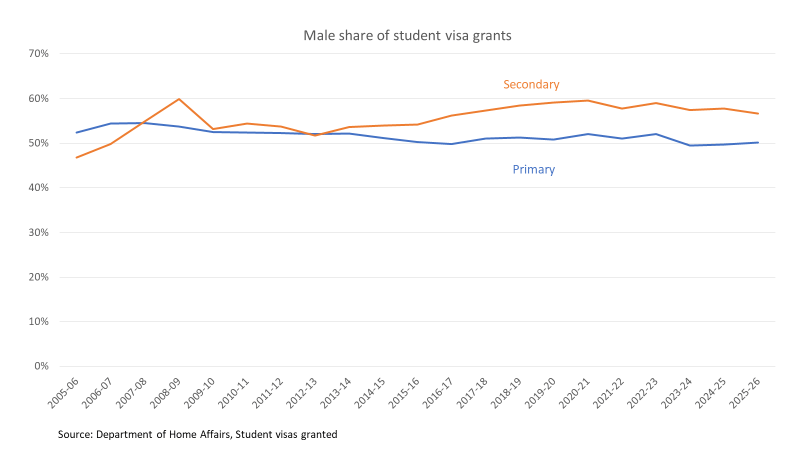
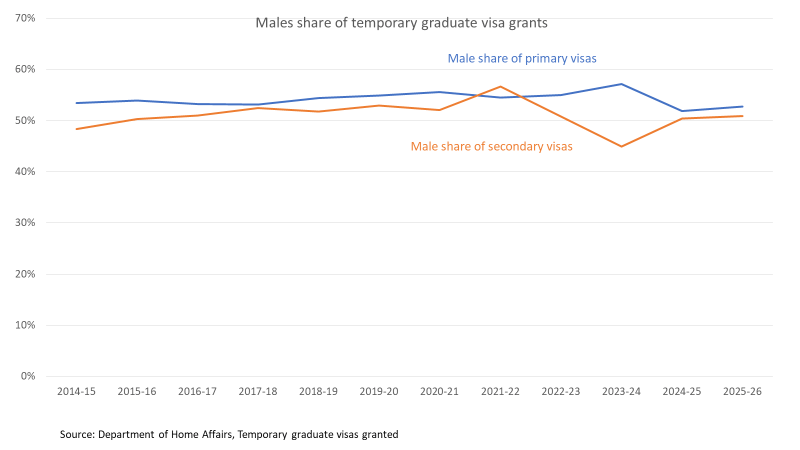
Although secondary student visa grants have a male bias compared to primary visas, that has not been the case in recent years for temporary graduate visa grants. Other than an outlier year in 2023-24 the gender ratios are fairly even for both primary and secondary visa holders. Perhaps couples and families are more likely to remain in Australia on temporary graduate visas.
Secondary income earners
Secondary visa holders have the same work rights as the main visa holders, currently 48 hours a fortnight during semester for student visas and unlimited hours for temporary graduate visas.
For some students coming as a couple could be part of making the economics of study work. The $1.3 billion earned by student secondary visa holders in 2022-23 is 14% of all earnings of student visa holders, similar to the secondary share of student visa holders. However, as 27-28% of secondary student visa holders are children this figure is consistent with adult secondary visa holders working more to support the family than primary visa holders. This is supported by median incomes: $20,588 for primary visa holders and $31,561 for secondary visa holders.
Secondary temporary graduate visa holders similarly earned about $1.3 billion in 2022-23, 16% of all income for this group. With primary visa holders now able to work full-time their median income was $53,333 compared to $48,051 for secondary visa holders.
In both cases this is just money the ATO knows about. In the labour markets where students find work cash-in-hand payments are common.
Are secondary visa holders a predictor of migration intentions?
The table above on secondary shares of student and temporary graduate visa holders suggests bringing family members as students is a sign of longer-term migration intention. Countries with high rates of secondary student visas tend to also have high rates of secondary temporary graduate visas.
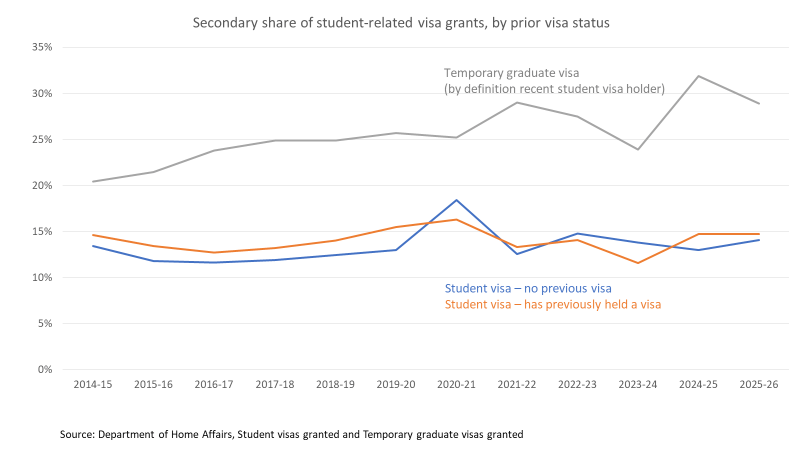
The chart below shows that the recent share of secondary visa holder grants among the temporary graduate visa population is, at about 30%, twice as high as for the student visa population. I would expect the temporary graduate rate to be at least a little higher. Graduates are older than students, with additional time for marriages and births to happen. What we see in the chart is the combination of South Asian students being more likely to bring their families with them and to move to temporary graduate visas.
I wondered if another option for remaining in Australia, applying for a student visa after already having had another visa, might also show as having a high level of secondary visas. But there is no significant or consistent difference between the secondary student share of those who have already had another visa and those who have not.
None of my data sources directly say how many people exit temporary graduate visas each year. But reconstructing as best I can recent cohorts of temporary graduate visa holders mostly want to stay in Australia.
According to Home Affairs data, for 2024-25 58,409 former temporary graduate visa holders moved to another Australian visa. About 4,700 of these were to short-term visa categories, such as tourist or working holiday. The rest went to a mix of longer-term temporary or permanent visa categories. There is no primary/secondary breakdown. By contrast the ABS NOM figures for 2024-25 report only 11,250 temporary graduate NOM departures, about 20% of whom were secondary visa holders.
Policy changes
According to media reports, the policy focus is on ending secondary visas for student visas except for research students and students from the Pacific and East Timor.
The impact of this limit will be larger than just fewer secondary visa holders, as some students with families will not come at all if they must do so alone. Apart from the impact on prospective students this will be another major blow to the international education industry, especially those institutions relying on South Asian source countries.
Over the medium term, this policy change will drive smaller inflows into the temporary graduate visa program and lower outflows from that into other visa programs.
There is nothing in the media reports about changes to the temporary graduate secondary visa policy. I hope this means that no major change is planned. While migration policies need modifying from time to time, the government needs to act ethically. The Australian government-student relationship is transactional, but Australia should keep its side of any bargain. Students were induced to come to Australia on the promise of temporary graduate visas for themselves and their families. This promise should be honoured.

