Yesterday the higher education funding legislation had its biggest revision in many years. I summarised the Senate changes to the original funding bill in this post. But along with these amendments a new provision added two higher education providers to Table B of the Higher Education Support Act 2003. These are Alphacrucis University College and the Australian University of Theology. There are financial advantages to being listed on Table B, as I explain below. But there are also regulatory and governance disadvantages.
Liberal Senator Matt O’Sullivan, who introduced the amendment, told the chamber that ‘they are both reputable, highly effective and respected institutions that have met all the thresholds required to be listed as table B providers. We are asking the government and all those in this parliament to recognise these wonderful institutions and list them in legislation. In doing that, can I take a moment to recognise, as is appropriate,… that [it] wouldn’t happen without the support of the government.’
The trouble is that no official criteria exist for addition to Table B, although there is a precedent that only one of these institutions satisfies. There may also be constitutional issues with the way this amendment was handled in the Parliament.
Financial benefits of Table B
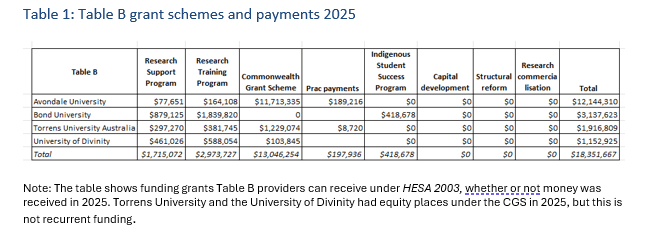
The main institutional benefit of Table B listing is access to the Research Support Program and the Research Training Program. Funding under both schemes is driven by prior performance, which limits how much newer institutions can receive. But as the table below shows, existing Table B institutions shared about $4.7 million in funding from these sources in 2025.
Table B providers are also eligible to collect Prac Payment funds on behalf of their students and to be funded under the Indigenous Student Success Program. The table shows other categories for which Table B institutions are legally eligible, but for which in practice they received no funding in 2025.
All providers registered under HESA 2003, which includes Table B institutions, are technically eligible for CSPs in ‘national priority’ or from 2027 ‘priority’ classes of courses, but under both the old and new funding legislation there are only two CSP categories, Table A and non-Table A. Table B listing does not confer any additional benefit. Only Avondale has long-term recurrent CSP funding. Alphacrucis has some CSPs for 2026, but these are equity places that are being phased out.
Addition to Table B also enables students at these institutions to avoid a longstanding funding anomaly: that undergraduate full-fee students using the FEE-HELP scheme pay a 20% loan fee unless they are at a Table B provider.
Based on back-of-the-envelope calculations – taking 2026 FEE-HELP estimates, assuming each provider’s 2024 domestic undergraduate/postgraduate EFTSL divide still applies in 2026, and assuming undergraduates and postgraduates pay the same fees on average – Table B would save Alphacrucis students approximately $2.2 million and Australian University of Theology students $1.6 million.
Other extra rights for Table B institutions
Under the legislation passed this week, Table A and B institutions must be consulted by ATEC on their allocation of international student commencements, but not other providers: section 46D of the ATEC Act 2026.
In practice other policy measures have cut international student demand so much that these soft-cap commencing student allocations are not significant for most education providers, as they cannot be reached. Neither of the two additions to Table B have got beyond priority 1 processing level, which means their commencements are sitting below 80% of their allocation.
New additions to Table B – university college precedent
Addition of the Australian University of Theology to Table B followed a longstanding bipartisan precedent, that institutions with university status get put on Table B. The logic behind this is that university status requires research, with research funding helping to maintain this status.
Under the current Threshold Standards, ‘university college’ status does not require research, although the standards envisage that some providers see university college status as an intermediate point on the way to university status. Indeed, the Australian College of Theology made this move in December 2024 to become the Australian University of Theology.
While Alphacrucis University College may have university aspirations – it had 94 research students in 2024 – it did not get Table B status for this reason. There is no policy of helping aspiring universities meet the research criteria with public funding. The reasons stated in the Senate are that it is reputable, highly effective, respected and indeed wonderful.
The trouble with these adjectives is that the seven other providers that also have university college status, not to mention dozens of other non-university higher education providers, might think that these words describe them as well.
I have no fundamental objection to university college status having funding implications. But this should be done through a policy, not ad hoc deals.
The changed governance consequences of Table B
Since the last addition to Table B, Avondale University in 2021, the regulatory implications of Table B have, however, been radically changed.
Table B institutions are caught up in the fundamentally altered university compact process, exposing them to unprecedented government/ATEC interference in their internal affairs.
I hope that Table B providers get less comprehensive compacts than the Table A public universities, but nothing in the ATEC legislation requires that.
Less favourable policy treatment for Table B institutions
Occasionally listing on Table B alters regulatory obligations.
Table A and B providers, but not other providers under HESA 2003, must have freedom of speech and academic freedom policies: section 19-115. However all providers must protect freedom of speech and academic freedom under the Threshold Standards, so the HESA 2003 requirements may be another case of regulatory redundancy.
Table A and Table B providers had to comply with the gender-based violence regulations by 1 January 2026, while other providers have until 1 January 2027.
New additions to Table B – Constitutional issues?
In consideration of a government amendment to the bill, the one that made use of equity needs based funding slightly more flexible, there was a minor constitutional disagreement between the Senate and the House of Representatives.
This concerned the requirements of section 53 of the Australian Constitution, which says, among other things, that ‘proposed laws appropriating revenue or moneys, or imposing taxation, shall not originate in the Senate’ and that the ‘Senate may not amend any proposed law so as to increase any proposed charge or burden on the people. But a proposed law shall not be taken to appropriate revenue or moneys, or to impose taxation, by reason only of its containing provisions for the imposition …[of] fees for services under the proposed law.’
The advice of the Senate clerk was that section 53 does not apply in the case of the equity expenditure amendment. This is because it does not change the amount appropriated, just how it can be spent. The House of Representatives Deputy Speaker, by contrast, claimed that ‘it changes the destination of money appropriated, which will increase a burden in relation to an appropriation.’ This is why the House disagreed with the Senate equity expenditure amendment and passed its own identical amendment to fix the section 53 problem.
On a plain reading of section 53 I think the Senate clerk’s reading is more plausible in the case of the equity expenditure. But for the Table B additions this is not just a matter of organisations already getting grants being allowed to spend them in a slightly different way.
Abolishing the 20% loan fee for these two providers effectively appropriates money for extra loan subsidies, and so arguably the Table B amendment is an appropriation law that cannot begin in the Senate. On the other hand, the loan fees are possibly ‘fees for services’, an amendment the Senate could propose without contravening section 53, and possibly can therefore initiate a reduction without constitutional issues.
For many ‘other grants’ authorised under section 41 of HESA 2003, Table B providers are automatically eligible. For most of these the total amount of money is fixed, and so arguably on the Senate clerk view the fact that additional education providers take a share is irrelevant.
But one of these programs, the Prac Payment, operates on a quasi-demand driven basis. Technically there is a fixed appropriation, but it is adjusted in light of actual recipient numbers. Alphacrucis already receives Prac Payments through a specific listing in the guidelines, but the amendment entitles them to access to the scheme.
On the House of Representatives view the Table B amendment does ‘change the destination of money appropriated’ and therefore has issues, on the Senate clerk’s view maybe there is no problem. But the Table B amendment seems to more obviously raise potential issues than the equity expenditure amendment. There will be additional Commonwealth expenditure as a result, and it changes which institutions get funded, not just how the money is spent.
In a less sub-optimal policy process these potential legal problems would have been considered and resolved.

