As foreshadowed in Tony Burke’s September 2026 National Press Club speech, the government has now implemented a range of policy changes for onshore student visa applications. There is a new general rule against onshore student visa applications, from which there are exceptions, the most significant of which is letting current students apply for a new student visa if it is at a higher qualification level. The Department of Home Affairs summary of the changes is here.
Why is policy changing?
The reason for this change is to limit the number of current visa holders applying for a student visa to prolong their stay in Australia.
Onshore applicants for a student visa get a bridging visa while their application is processed. As of December 2025 the median processing time for an onshore student visa application was 134 days, delivering another 4 to 5 months living and working in Australia even if the visa application is unsuccessful.
Rejected onshore student visa applicants can appeal the decision in the Administrative Review Tribunal. As of 31 August 2026 the ART had a backlog of 53,347 student visa appeals. Applicants receive a bridging visa while waiting for their case to be decided. The official indication of median processing time to decide a student visa refusal is 17 months, but that might be too low. For the first two months of 2026-27 the ART resolved only 1,500 applications per month, although ending in-person hearings in most cases may speed things up.
As of 31 December 2025, 107,449 people were on bridging visas while waiting for a student visa application to be resolved.
Onshore applications – key statistics
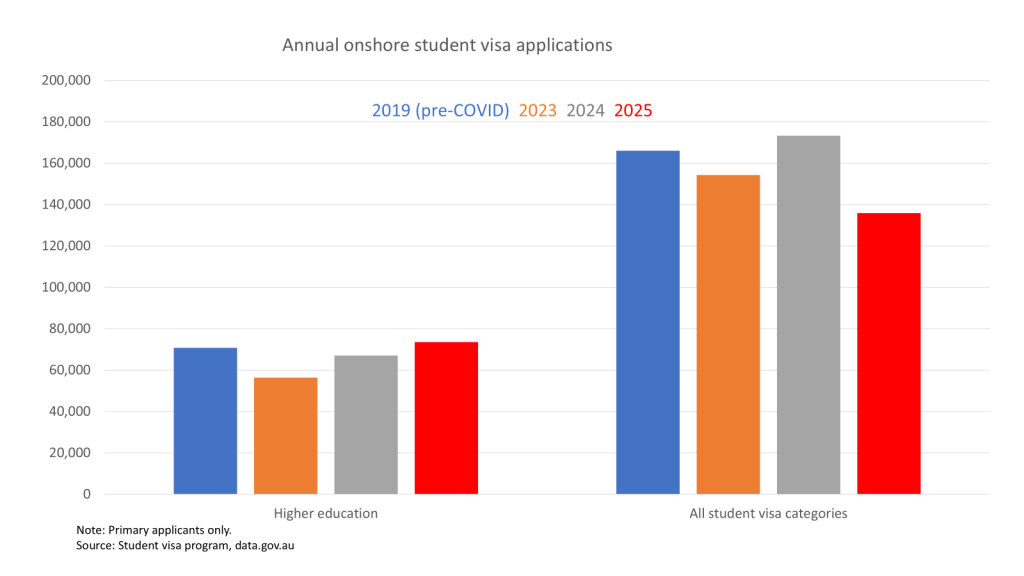
Due to other policy changes, onshore student visa applications were already trending down prior to this announcement. In 2025, 135,979 onshore student visa applications were made, 30,000 below 2019 pre-COVID levels. In 2025, 54% of onshore student visa applications were for higher education, with the absolute number still above 2019 levels. Policy change has hit VET and ELICOS harder than higher education.
For 2026 up to August, 95,936 onshore applications have been made, 4.7% fewer than by August 2025. For higher education as of August 2026 56,898 applications have been made, down 1.3% on the same time last year. The higher education share of the total is 59%. Note that in the Department of Home Affairs statistics ‘higher education’ does not include postgraduate research or DFAT or Department of Defence sponsored students taking higher education courses.