Government amendments to its student places capping bill

Last week the government made two substantive amendments to its student places capping bill, officially named the Universities Accord (Opening the Doors of Opportunity) Bill 2026. One amendment gave public universities a floor number of Commonwealth supported places. The other restored two limits on ministerial conditions.

This post explains these changes and comments on whether they remedy the underlying defects.

In summary, ATEC will have a floor number of CSPs that it must allocate to each public university, but the problem of automatic cuts for universities with growth places remains. The bill also still lacks a corresponding requirement on the minister to set a CSP ‘total allocation pool’ of places sufficient to cover all public university floor CSPs.

The two restored limits on ministerial conditions are an improvement, but the bill still lacks appropriate mechanisms for adding necessary but limited conditions.

Floors on places

The policy intent, as expressed in the bill’s explanatory memorandum, was always to provide a floor number of CSPs for public universities.

This floor was to be the university’s ‘core student load’.

Using the 2028 allocation year as an example, the bill defines a university’s core student load as the lesser of:

  • Its ‘domestic student profile’ for the immediately preceding year, i.e. its core student load for 2027 plus its additional growth allocation, if any; or
  • The number of CSPs it delivered in the most recent year with verified data, which will be 2026 CSPs verified in April 2027: bill section 30-25(1).

But instead of making the lesser of these figures the floor number of CSPs, under the bill’s original section 30-20 ATEC’s CSP allocation for a university ‘must not exceed’ the lesser of these two numbers. ‘Must not exceed’ clearly implied that the number could be lower.

The amendment changes ‘must not exceed’ to ‘must be equal to’, which creates a floor.

A floor will often mean cuts to domestic student profiles

While the bill now creates a floor number of places it can, and I believe often will, still result in automatic year-on-year cuts to universities’ minimum domestic student profiles. This is due to the historical nature of verified data.

Read More »
ATEC’s big test: Meeting demand for higher education in Sydney

At the AFR higher education conference this week Jason Clare was open to amending his capping student places bill. He subsequently inserted amendments on ministerial conditions and floor numbers of places for public universities.

But the minister remains in denial about the consequences of capping over-enrolments at a low level, to prevent what he calls ‘hunger games’ competition between universities. For universities allocated less than 15,000 Commonwealth supported places the cap is 5% of their total. For larger universities the cap is 750 places, equivalent to 2-3% of their allocation. Above these levels CSPs will be zero-funded, compared to student contribution only funding under the current system.

In response to a journalist’s question about this issue the minister said that ‘if you think that a kid from the western suburbs [of Sydney] is going to design something that makes it harder for kids from the western suburbs to get a chance to go to university, then you’re wrong. This is about doing the opposite.’

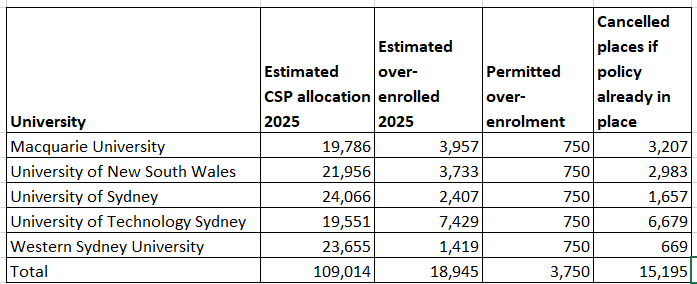
But on the available data Sydney is the place where his over-enrolment policy puts higher education opportunities at greatest risk.

ATEC seems to be engaging in bureaucratic manoeuvres to avert this outcome, but as transitional measures in the bill lapse that task will become more difficult.

Sydney over-enrolment

Based on 2025 estimates produced by ATEC (not published but in an appendix to my Senate inquiry submission), Sydney was the only multi-university city where every institution was over-enrolled. In the table below I have added to ATEC’s figures the over-enrolment caps proposed by the government. These caps would not be imposed immediately – more on this below – but if they had been in place for 2025 it would have been disastrous for aspiring Sydney students. It would have cost more than 15,000 places, the equivalent of shutting down a medium size public university (the Sydney universities are all big).

At a national level ACU and Notre Dame, which both have Sydney campuses, had some regulated capacity to take more students. The University of Wollongong also serves parts of Sydney, but it was already over-enrolled in 2025.

Read More »

How will the government finance more higher education enrolments?

The government has grand hopes for additional higher education participation, on the way to 80% tertiary attainment by 2050. But how they will fund enrolment growth is much less clear.

The government is setting itself a double challenge – not just delivering more domestic student places but simultaneously reducing ‘over-enrolments’, student contribution only places with no public subsidy. In a May provider briefing, ATEC put the number of over-enrolled places in 2026 at about 60,000.

On calculations in my Senate inquiry submission I estimated that, on 2025 numbers, maximum over-enrolment capacity under the government’s restrictions would be about 22,500 – on the unlikely assumption that every university could precisely use its full allowance.

With a low over-enrolment cap the government needs at least 37,500 additional fully-funded places just to maintain 2026 enrolments. That would cost taxpayers around $500 million without creating a single additional place.

The government has delayed this expense with transition arrangements for currently over-enrolled universities, but that is the goal they have set themselves.

How many new places has the government promised?

In his second reading speech for the funding reform bill, Jason Clare said that ‘next year there will be 16,000 more places for more students in the system. The year after that there will be another 16,000. The year after that another 16,000. In 2030, this increases to 19,000 additional fully funded Commonwealth supported places.’

While I would not necessarily take this at face value – the minister’s statements don’t always match reality – ‘more places for more students’ implies places over-and-above the conversion of over-enrolment places, although for the many universities that are already over-enrolled it’s hard to do that without also adjusting up their over-enrolment ‘glidepath’.

In the May provider briefing ATEC says it has 37,000 CSPs to allocate in 2027, of which 7,000 are already committed to the nuclear submarine program, regional study hubs and non-Table A providers. That leaves 30,000 places. In the provider briefing they talk about 15,000 to 20,000 of the 30,000 going to convert over-enrolments to fully-funded places. But to align with the minister’s 16,000 ‘more places for more students’ the over-enrolment conversions should be more like 14,000 places.

What do the Budget papers say?

Under the new funding bill, the Commonwealth Grant Scheme will continue funding the Commonwealth contribution component of Commonwealth supported places. Budget projections on the CGS are currently our best guide to future funding.

Read More »

Mapping Australian higher education – August 2026 update

I don’t currently have the capacity for a new edition of Mapping Australian higher education 2023 but I am still updating the data behind the tables and charts. The latest spreadsheet is here.

The main changes since the last update are:

  • 2026 Commonwealth Grant Scheme expenditure
  • 2026 HELP lending
  • 2025 staff data
  • 2025 graduate outcomes
  • 2024 research expenditure
  • Reorganised lists of university lobby groups
  • Ongoing changes in non-university higher education providers – despite the hostile policy environment new providers are still being registered by TEQSA

My Senate inquiry submission on the government’s student places capping bill

Submissions to the Senate inquiry into the government’s student places capping bill – with the official but misleading title of the Universities Accord (Opening the Doors of Opportunity) Bill 2026 – were due last Friday. The submissions are not yet appearing on the Senate’s website but mine is here. [Update: Submissions are now available.]

It extracts the needed amendments to the bill from my series of explainer posts: on setting the number of Commonwealth supported places, on ATEC’s distributions of CSPs to public universities and to private universities and non-university providers, on capping over-enrolments, on effectively demand driven funding for equity students, on needs based funding, on allocating international student commencements, on ministerial conditions on student places funding, and on ATEC’s options for rewarding and punishing universities.

I will post again on the over-enrolment parts of the bill – in competition with Job-ready Graduates student contributions as the worst domestic student policy idea of the 2020s – but copy in my submission overview as a summary of its key themes:

The Universities Accord (Opening the Doors of Opportunity) Bill does not do what it says on the cover.

The bill’s sole mechanism for increasing enrolments in universities is more efficient use of existing funding.

The bill does not appropriate any new funding for additional student places. As under the current system, the minister will need to work through the government’s internal budget processes to secure that money.

By contrast, the bill has two new features that will reduce how many student places universities can offer.

The most important of these is caps on over-enrolments, on student contribution-only places delivered by universities above their allocated number of student places. If these laws had been in place in 2025, the maximum over-enrolments allowed would have permitted about half of the over-enrolments actually delivered, at the cost of more than 20,000 places across the system.

A planned default allocation of student places to public universities, while intended to reduce unused places, also threatens cuts. To use an example, a university’s default allocation of places for 2029 will be the lower of their places allocated for 2028 or the places actually delivered in 2027. If the university had received additional places for 2028 and respected their over-enrolment limit for 2027 the default position would wipe out some or all of their new 2028 places.

Due to problems with the bill’s drafting it will not achieve some of its other goals. The explanatory memorandum presents the default allocation described above as preventing a university’s allocation going backwards, but this is not what the bill itself guarantees.

The bill’s explanatory memorandum recognises problems with the current definition of low socioeconomic status, but the bill itself inserts a provision that will reduce how many low SES students attract needs based funding.

Another major issue with the bill is excessively broad ministerial discretion. The bill lets the minister impose conditions on receipt of Commonwealth Grant Scheme funds with no restrictions on how this power can be used. For allocations of international student commencements, the bill suspends an existing limit on the minister directing ATEC in respect of specific education providers.

The 2026 early implementation of enrolment restrictions, without statutory authority, shows that the government cannot just be trusted to do the right thing. Clear legal limits are required.

Ends