In his second reading speech for the Universities Accord (Opening the Doors of Opportunity) Bill 2026 education minister Jason Clare said that it will ‘help more people from poor families and the regions and the bush to get into university. In simple terms, if you get the marks, and you’ve got what it takes you will get a place.’ Later in the speech, he described the new policy as ‘effectively uncapping the system for these students’.
This is the latest iteration of a concept first announced as ‘effectively demand driven’ funding in the Accord final report and then described by the Department of Education as ‘managed demand driven funding’.
Whatever its name, how this policy would be implemented remained unclear. The policy implies eligibility criteria – ‘if you get the marks’ – that do not exist at the system level. It raised questions about the coherence of the government’s position. Does it make sense to impose tougher caps on enrolments generally while claiming to ‘effectively uncap’ a sub-section of students? Isn’t this just a part-solution to an avoidable problem caused by hard caps?
The silence of the bill
Anyone hoping that the funding bill would provide clarity will be disappointed. There is no uncapping of places for any category of student that isn’t already demand driven. But another feature of the system gives ATEC some flexibility to allocate additional places late in the enrolment period.
A recap on the new system
First a recap on how the new system will work. The first step is for the minister to set a total allocation pool of places, which will cover all coursework places other than medicine and the demand driven programs for Indigenous students.
The second step is for ATEC to allocate those places to universities. This will be a combination of ‘core student load’, a historical figure, and an ‘additional growth allocation’. Together these are the ‘domestic student profile’ of each university.
On top of the domestic student profile universities will have an over-enrolment buffer, of 750 places or 5% of the domestic student profile, whichever is lower. As part of transition measures some universities can have total places exceeding these levels but caps on commencing students.
Varying the total allocation pool
The new system will not include any power to uncap student places. But there will be a power to vary the original total allocation pool, which in turn would give ATEC capacity to increase places at universities with extra demand from equity group applicants.
This power appears in section 30-5(5) of the Universities Accord (Opening the Doors of Opportunity) Bill 2026. It says that the minister can, by legislative instrument, vary up the the number of total allocation pool places (downward variations are not permitted).
The minister can do this on his own initiative or on request from ATEC: section 30-5(6). In the scenario discussed in this post the trigger would be a request from ATEC.
In making a decision the minister must consider advice given by ATEC and whether an increase would promote the objects of the Higher Education Support Act 2003. The relevant object for this post is to support a higher education system ‘characterised by quality, diversity and equity of access’: current section 2-1(a)(i) of the Higher Education Support Act 2003.
‘Uncap’ appears in quotation marks below as a cap is still set; if the section 30-5(5) power is used it is just a higher cap than before.
Is this a new power not available in the current system?
The current funding system has no formal process by which additional funding is requested then granted or denied.
But variations can be made simply by rewriting funding agreements between the government and universities. This is not uncommon. Ad hoc additional places that the government distributes from time to time are often decided too late to go into the first funding agreements for each year. This year the extra $50 million for over-enrolled universities will be paid after a late amendment to the funding agreements.
The proposed new process is more bureaucratic than the old one, as it requires a legislative instrument. It is also intended to operate in a dynamic environment, during offers and enrolments. How this tension between bureaucracy and fast decision making might be managed is discussed later in the post.
Does it manage the real constraint?
If the government wanted more flexibility in funding levels it could implement it under the current system. The real constraint is the government’s internal budget controls. In the budget forecasts there is no major increase in the Commonwealth Grant Scheme, which finances Commonwealth contribution tuition subsidies. It looks like 1-2% a year after inflation, which has to finance the ‘additional growth allocation’ places process discussed in an earlier post as well as the last-minute places of this post.
While the government is making more efficient use of the funding it has committed, by moving places from universities that aren’t using them, overall the budget looks very tight for financing new commitments such as ‘uncapped’ funding for equity students.
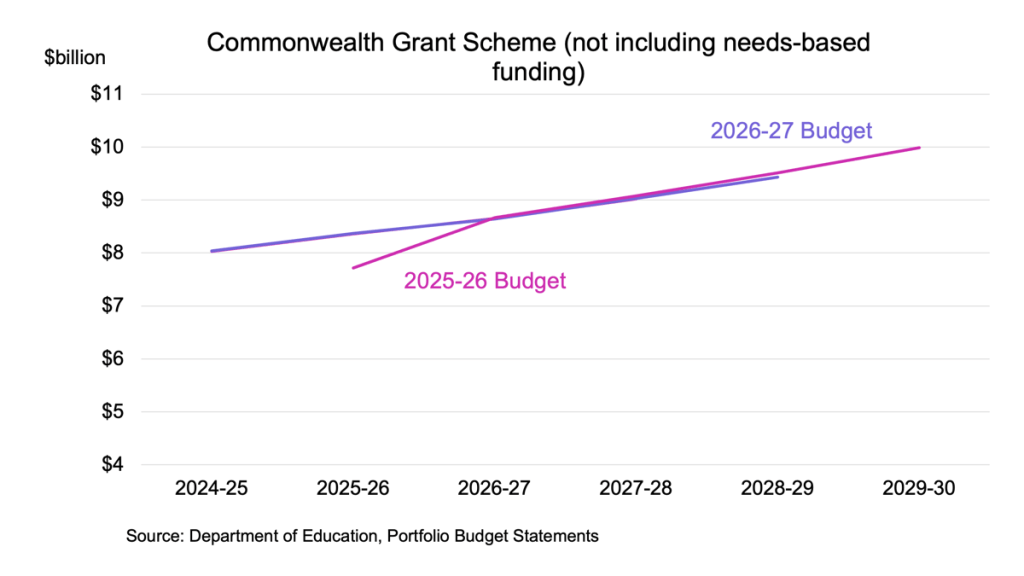
To make this work the minister could hold back some funding authorised through internal budget processes when he sets the ‘total allocation pool’ of places for ATEC to distribute. But this runs the risk that the system will deliver fewer places than its funding could theoretically support.
Which equity groups are covered by ‘uncapping’?
While additional equity places may be the reason for the minister decides to increase the cap the power to allocate places to universities belongs to ATEC.
The minister steers ATEC via a statement of strategic priorities. His interim statement mentions lifting participation for low SES, Indigenous and regional students in its section on the ‘managed growth’ funding system.
The first formal ministerial statement should be more explicit about the flexibility around target equity groups, but combined with the content of the minister’s second reading speech and an ATEC provider briefing in May (slide at 46 minutes) it is clear that low SES and regional/remote applicants will be target equity groups.
I am not sure where this leaves Indigenous students. While they have genuinely uncapped demand driven programs for bachelor degrees and medicine, that still leaves sub-bachelor and postgraduate coursework. If Indigenous students in these categories are omitted from the variation policy the regional and low SES categories would include many, although not all, of the students who might otherwise miss out.
How will ATEC decide if an applicant from an eligible equity category should be funded?
It is not enough for an applicant to come from an equity background. There is another eligibility test, some version of the minister’s ‘you get the marks’.
In the provider briefing ATEC said that the applicants ‘have to be eligible for entry to at least one Australian university that they’ve shown a preference for’ (transcript p. 30).
But this can be circular. An applicant is eligible for a CSP if a university has made an offer, in which case they can have a place and there is no need to go back to ATEC.
The notion of eligibility here has some implied minimum threshold below which the university will not go, no matter how many ‘bonus points’ the applicant might get for various attributes (including equity background).
Some universities set minimum ATARs for academic reasons. Or perhaps ‘eligibility’ could be determined by the lowest ATAR to receive an offer in the previous year for the target course, which is already reported, although many applicants don’t have ATARs.
Eligibility needs a clearer definition, so that universities know when they can apply for additional places (and also to reduce gaming of the system).
Then there is the issue of when ‘eligibility’ is tested. If an equity applicant has their first preference for University A, which rejects them as it is too close to its cap, does the fact that University B would take the equity applicant create scope for University A to ask for more places, or should the applicant go to University B?
From ATEC’s perspective the preferable answer is that the applicant goes to University B. No additional cost. In practice only universities at the end of preference lists might be able to apply for additional places.
How will cap lifting work in practice? Equity and non-equity places
In the May briefing, providers were told that during the compacts process ‘we’ll be looking to agree an equity proportion of each institution’s total student allocation’ (transcript p. 17).
It is not clear what data will be used to set these proportions. Historical data will presumably play a role. The briefing paper mentions asking universities about their equity and non-equity demand (p. 17), which is more forward looking. But the timing makes this speculative. Compact negotiations are happening ‘towards the end of July through August, possibly into September’ (p. 10). Actual demand data will start arriving during this period but major applications deadlines are after it ends. For example in Victoria ‘timely’ VTAC applications are not due until 28 September. In NSW and South Australia it is 30 September.
Universities will also be months away from knowing their returning student load.
The agreed equity proportion will, at best, be a rough estimate of where universities will end up.
The sub–cap on non-equity students
The agreed non-equity proportion will operate as soft second cap. According to the May briefing, ‘as we go through the offer rounds if demand is pushing up against the agreed amount for non-equity students we expect institutions to start slowing down and not go past that cap. But with equity students if there’s evidence of strong demand then we want the institutions to tell us’ (p. 17).
The legislation does not give ATEC any power to set a sub-cap for non-equity students. If universities go ahead and fill all their places without regard to applicant equity status – as strictly speaking they should do under the merit requirements in current section 19-35 of HESA 2003, although this has long been ignored without legal repercussions – they will be paid up to their Commonwealth and student contribution caps.
Compliance with this informal non-equity sub-cap will be part of ATEC’s decision-making about late allocations of student places. If universities exceed their non-equity sub-cap ATEC will be less inclined to ‘reward’ the university with additional places.
Later in the May briefing ATEC says ‘bear in mind there is the over enrolment buffer so there’s always the opportunity to take those students’ (p. 23). This reads as if a university isn’t already over-enrolled they will be expected to use their over-enrolment buffer on equity students before being given additional places. Maybe over-enrolments aren’t so bad after all…
Increased cap for over-enrolments?
Although it was not mentioned in the provider briefing, the legislation creates some flexibility on over-enrolments for larger universities with over 15,000 CSPs.
The flexibility comes from its provision for an over-enrolment cap that is the lesser of 5% of the domestic student profile or a number specified in the Commonwealth Grant Scheme Guidelines. The government has said that number will be 750, but for the larger universities this could be increased to a number equivalent to 5%, giving them extra capacity to respond to demand without additional Commonwealth Grant Scheme cost.
A reserve pool of places
ATEC wants to avoid asking the minister for additional places.
As part of ATEC’s management of potential additional claims for equity places ‘the Commissioners may choose to reserve some of the total allocation pool in order to provide a quick response to strong evidence of equity demand’ (p. 17).
There is bureaucratic logic to this, since ATEC’s initial equity enrolment estimates are likely to be quite unreliable.
But reserve places run the risk that they will not be used, undermining other ATEC agendas in skills and overall tertiary attainment.
Additional growth allocation
ATEC may also try to reduce the need to ask for additional equity places by giving ‘additional growth allocation’ places to universities most likely to have demand exceeding their equity share.
I don’t have accurate university-level calculations of the share of enrolments in the eligible equity categories. Provider-level equity statistics count regional and low SES separately but the same person can be both, producing double counts. But at some regional universities two-thirds or more of students are likely to be at least one of low SES or regional.
If these universities get spikes in demand it is near-certain that this means more equity students.
Universities will have a strategic judgment to make on the AGA. ATEC will want an initial allocation process that minimises the risk of requests for more places. This means that equity-related applications for additional places should have a relatively high chance of success.
On the other hand, if universities believe that there is an unused pool of places that can be accessed during the offers and acceptances process they might want to hold off on equity-related AGA and compete for late additional places.
Are uncapped places permanent additions to a university’s domestic student profile?
The new funding legislation does not obviously create a provision for temporary allocations of student places, despite these being common policy instruments in the 2020s. Extra equity places would be delivered through an ‘additional growth allocation’, which would form the basis of a subsequent year’s ‘core student load’.
Additional equity demand for designated places
The new funding legislation contains the power to designate courses or kinds of courses. While no plans to designate have been announced, if this happens ATEC will set caps by university for each designated category.
What happens if additional equity group demand is for places in designated courses?
Designation is a tool for keeping enrolments down, so ATEC may be more resistant to saying yes to additional places.
On the other hand, designated places are part of a university’s overall domestic student profile. ATEC could increase the designated course allocation and (effectively) reduce the non-designated course allocation, for a budget neutral outcome.
Decision-making process for varied allocations
By late each year ATEC will know to what extent applications, at least to the tertiary admissions centres, resemble their estimates.
But it will only be during the offers, acceptances and enrolments process during January and February that it will know if the number of CSPs it has effectively allocated to equity students is enough.
I doubt the minister will want his summer holiday interrupted to deal with requests for additional places (although he may deserve it for legislating this mess).
It is likely that a decision as to any potential additional places will be made in December, with the minister then delegating the power to make the final decision to ATEC, using section 238-5 of HESA 2003, as amended by this bill.
What about universities with commencing student caps?
Under the bill, over-enrolled universities will be subject to commencing student limits, as explained in an earlier post.
Adding extra places to a universities domestic student profile will not change the commencing cap, raising the question of what mechanisms ATEC will use in these cases in the event of additional equity demand.
The most obvious response would be to increase the commencing cap, but that undermines the protectionist policy goals behind the whole capping system.
In the over-enrolment post I was unclear on the purpose of a provision for the minister to specify a ‘class of persons’ not subject to the commencing student cap. Maybe the government had equity students in mind, but exempting them would de facto increase the cap by too much for its overall policy goals to be achieved.
An increase in the overall commencing cap is therefore more likely, if anything at all is done in these cases of unforecast equity group demand.
ENDS
 Andrew Norton