As foreshadowed in recent weeks, Tony Burke has today announced changes to student visa policy. Unfortunately at the moment – about 5.30pm on 17 September – there is little detail other than what has been given to journalists and Burke’s National Press Club address. I will update this post as necessary when more information is available.
The key changes are restrictions on secondary visa holders, for both students and temporary graduate visa holders, and additional limits on changing courses.
It appears that the secondary visa holder changes are prospective and won’t apply to students already in Australia, but this needs cross-checking against more policy detail. In the first draft of this post I will focus on secondary visa holder restrictions.
Summary of secondary student-related visa numbers
I analysed secondary student visa holder numbers earlier this month. Some key points from this analysis:
- In recent years, annual secondary student visa holder grants have been in the 45,000-49,000 range.
- Based on age group analysis, 27-28% of them are the children of students (proxy of age 19 years or less).
- The ‘stock’ of secondary student visa holders present in Australia on a given day is already well off its peak of 84,846 in mid-2024, and was 67,549 on 31 July.
- The flows and stocks of secondary student visa holders look anomalous. I think this is largely explained by a surge in secondary student visa grants in 2022-23 (77,599). Their primary visa holders have now mostly completed their courses and moved to temporary graduate visas or left the country, so outflows from secondary student visas have exceeded inflows.
- As a result, as of 31 July secondary temporary graduate visa holders outnumber secondary student visa holders, 73,704 to 67,549.
- Adult secondary student visa holders are likely to be an important aspect of the economics of coming to Australia for some students, with declared earnings of $1.3 billion in 2022-23. Secondary temporary graduate visa holders earned a similar amount.
New restrictions on secondary student visa holders
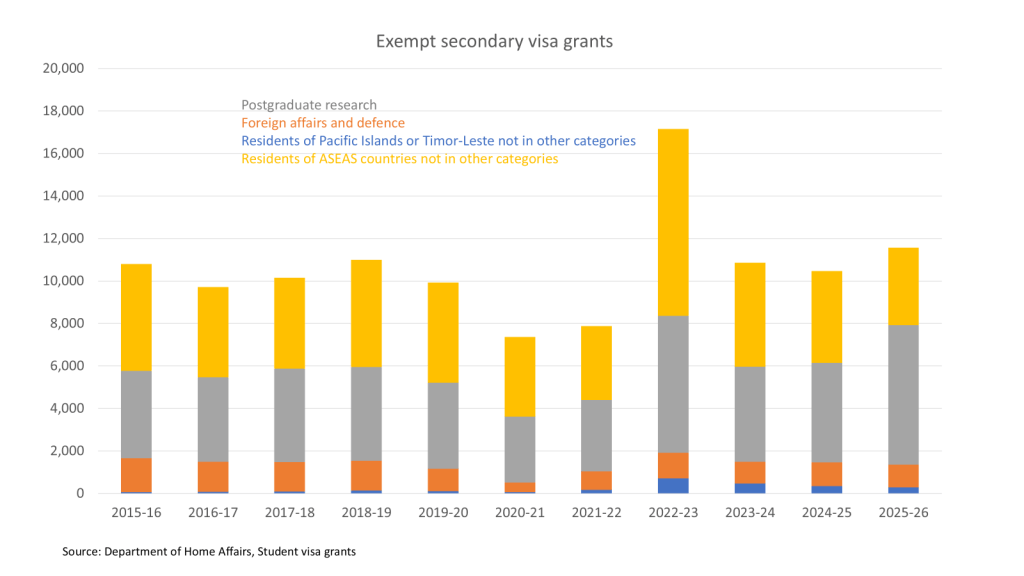
In line with recent policymaking preferences, the following groups will be exempt from restrictions on secondary student visa holders: research students, foreign affairs and defence sponsored students, students from the Pacific Islands, Timor-Leste and ASEAN countries. We can track their numbers through the student visa grants data. Over the last decade these visa categories have typically led to 10-11,000 annual secondary student visa grants. There was a spike in 2022-23, which included pent-up demand from the COVID border closure years.
In 2025-26 the numbers were a little higher than usual, at 11,564. That was driven by a record high 6,562 secondary postgraduate research visas, reflecting sharp increases in primary visa holders. Secondary visa holders for postgraduate research are usually 25-30% of all research visas granted, with 30% in 2025-26.
Some media reports refer to PhDs, which could just be shorthand for research degrees or may deliberately exclude masters by research. On the enrolment data for 2026 to date, masters are about 35% of research commencements. Previous migration policy instruments, such as ministerial direction 115, have included both masters and PhD research degrees. Enrolling in a masters before converting to a PhD is, so far as I am aware, still a standard practice. But the government may be alert to ever-adaptive would-be student migrants who will quickly find any remaining open doors in the system.
Off a low base, we are also seeing growth in non-research, non-sponsored students from the Pacific Islands and Timor-Leste, with 291 visa grants in 2025-26 (609 secondary student visa grants from these sources including all categories). The ASEAN numbers are barely above their COVID levels; presumably affected by the many other measures to reduce international student numbers.
Implications of these changes
I expect these policy changes to have implications well in excess of the secondary visa numbers. An unknown share of primary visa holders will now not consider Australia. They will not want to be apart from their families for what could be four or five years, including a student visa and a temporary graduate visa. Given the financial data reported in my earlier post, the non-student partner’s paid work is probably also an important part of funding study in Australia which will now not be an option.
As with previous policies to reduce international student numbers the secondary visa policy will hit universities reliant on South Asian markets the most.
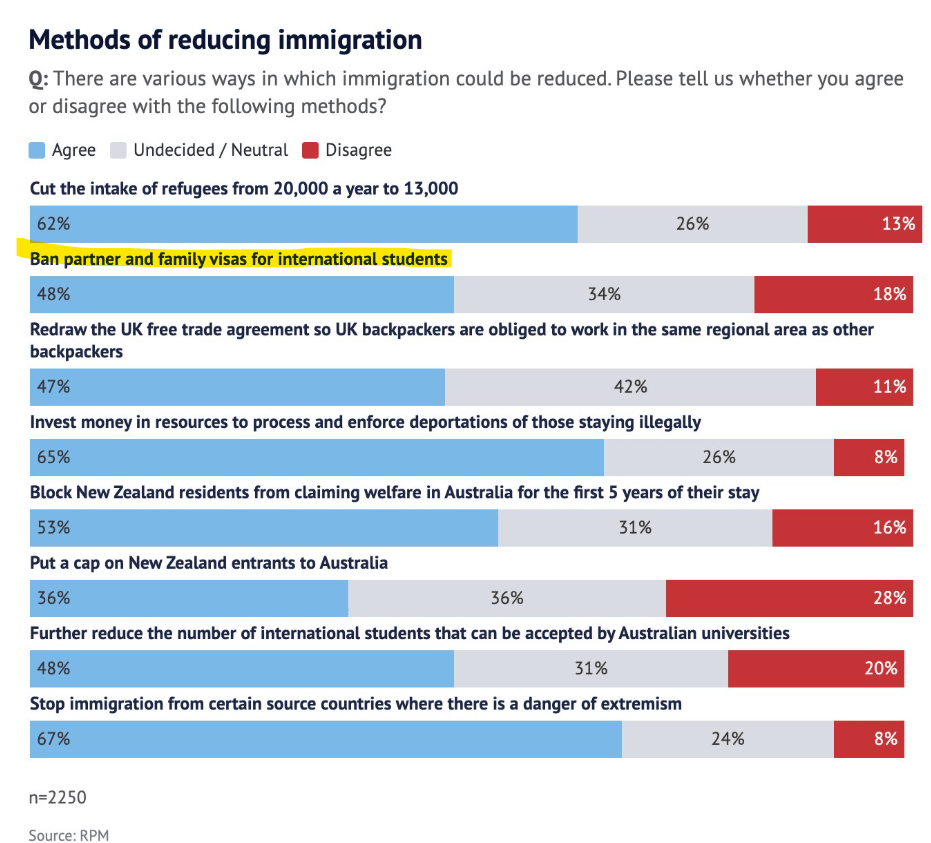
Is restricting secondary visa holders popular?
These changes reflect the dramatically changed political climate on migration. A poll published in the Nine newspapers found a plurality of respondents, 48%, agreeing with the proposition ‘ban partner and family visas for international students’.
To be continued….
 Andrew Norton