In a previous post I described the three points-tested visas that international students use to achieve permanent residence or a clear pathway to it. These are the subclass 189 Skilled Independent visa, the subclass 190 Skilled Nominated visa, with the nomination by state and territory governments, and the subclass 491 Skilled Work Regional (Provisional) visa, which is also state and territory nominated.
The total number of these visas awarded to identifiable former international students peaked in 2022-23 at just under 40,000. It was 31,783 in 2024-25, the latest available full financial year data. The chances of former international students getting points-tested visas dropped more sharply, due to increased demand but fewer places.
This post looks at potential changes to the points available in the points-tested visas and how these might affect international students.
Maximum points for different attributes
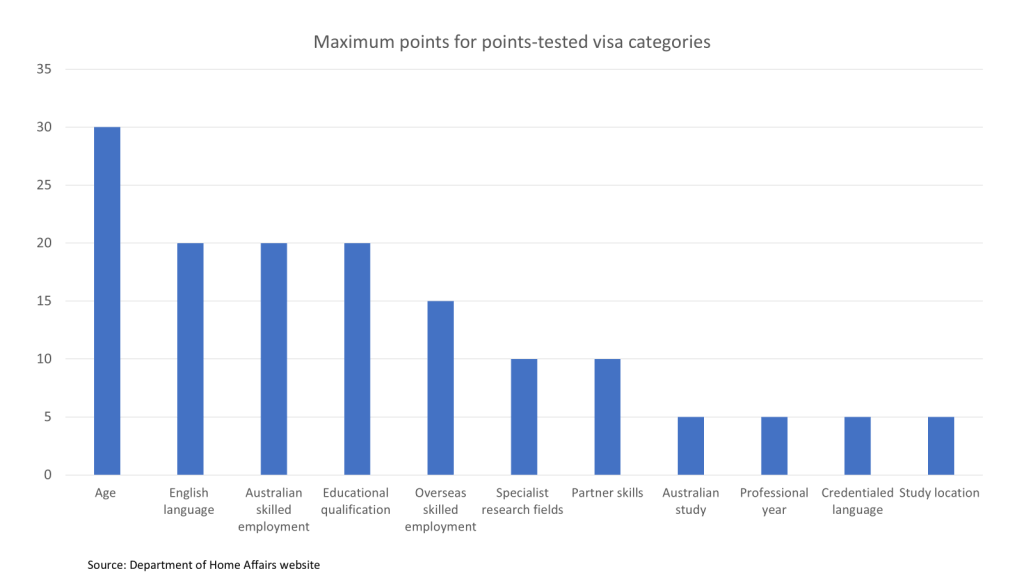
The chart below shows the maximum points available in categories relevant to all three points-tested visas. For study location, credentialed language (interpreting or translating), a professional year (training linked to work experience), Australian study, and a specialist educational qualification (research degree in science, IT or engineering) the points are a flat number. Applicants either meet the criteria or they do not. The other categories offer graded points up to the maximum shown, for example the system favours more over less skilled work experience and ‘superior’ over ‘proficient’ English.
The maximum standard points total 145, although some combinations are unlikely. Somebody with extensive skilled work experience probably does not need a professional year. Combining maximum points for both Australian and overseas skilled work experience would block maximum points for age.
For the subclass 190 visa, applicants receive an extra 5 points for state or territory agency sponsorship and for the subclass 491 visa this sponsorship is worth an extra 15 points.
Points that favour international students
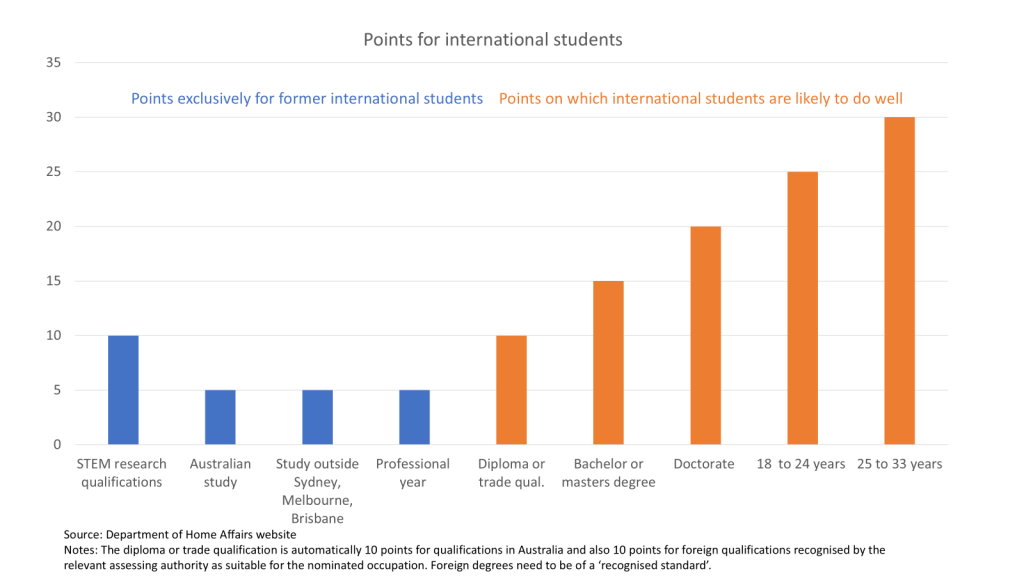
Twenty-five of the 145 points are exclusively for former international students: at least two academic years study with a successful course completion at an Australian educational institution; a STEM research qualification at such an institution; regional study rather creatively defined as places other than Melbourne, Sydney or Brisbane; and a professional year in IT, accounting or engineering.
Former international students will also tend to do well in points for their qualifications and for being relatively young. In 2025-26 more than 85% of student visa grants went to people under 30 years old.
The relative youth of international students, however, limits their chances of scoring highly on work experience. Two years of skilled work on the standard temporary graduate visa would get them 5 points, far less than the maximum 20 points in this category achieved with 8 years of work.
Points needed for visa invitations in different occupations
Accumulating a specific number of points does not guarantee permanent residence. Instead, people seeking PR submit an expression of interest (EoI) for one or more points-tested visa in relation to a particular occupation (subclass 491 regional applicants have access to a longer list of occupations). Within the annual allocations of these visas, the Department of Home Affairs then conducts periodic offer rounds tied to specific occupations.
In the June 2026 offer round for the subclass 189 visa various trades occupations had the lowest possible 65 point cut-off – plumbers, carpenters, plasterers, glaziers, stonemasons, tilers. The lowest points for graduate occupations was 75 – registered nurse, secondary school teacher, social worker, physiotherapist, paediatrician, occupational therapist, GP, clinical psychologist, audiologist. The highest cut-off was 100 for a urologist.
While international students have favoured access to points, their large numbers mean that this can inflate the points required for their nominated occupation.
Critique of the points test
The points test is criticised for insufficiently predicting long-term success in the Australian labour market. The Grattan Institute’s migration work and the ANU’s Tax and Transfer Policy Institute have both been influential. The broad direction of their work was reflected in the 2023 Parkinson review of the migration system and the 2024 review of the point test discussion paper.
The most recent ANU work argues against awarding points for studying in Australia, regional study, community language, Professional Year programs and specialist education.
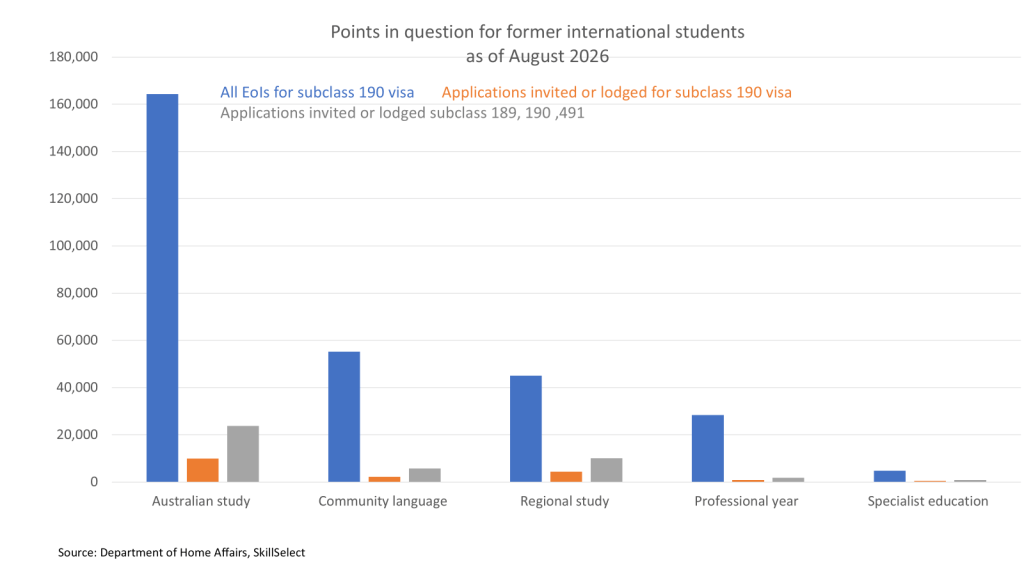
The chart below attempts to assess how these suggested changes would affect international students, in isolation from any other changes that may benefit them.
This analysis is not straightforward. There is no count of unique former international students in the EoI system. The blue bar shows the most popular visa, the state/territory nominated subclass 190 visa. More than 160,000 subclass 190 EoIs claim Australian study points. However, the number of EoIs invited to lodge an application using these points is much lower. I am not sure whether this is a full count. A check of the June 2025 SkillSelect numbers against actual 2024-25 visa grants came up with a figure that looked too low – although slow processing means that invitations to apply and subsequent visa grants can occur in different years.
A third of the Australian student subclass 190 group claims the 5 points for community language credentials, which is about 60% of all subclass 190 uses of these points. The 2024 points test discussion paper observed that many applicants score well on skills, age and English proficiency, so less relevant factors such as community language place them ahead of competing EoIs. These points look questionable to me, since presumably most people are being tested for their ability to translate their native language into English, which the points for English proficiency already test indirectly. Only a small percentage of this group, however, get invitations to apply for a subclass 190 visa.
A smaller number of subclass 190 EoIs use regional study, points, but a larger number than EoIs with community language points get invited to apply. Professional year numbers are also fairly low. From migration agent advice, getting a points-tested visa using accountant as an occupation has become difficult, reducing demand for the associated professional years.
Points-tested visa announcements
In the May 2026 Budget the government said that it is ‘reforming the permanent migration points test, to select better educated, higher-skilled and younger migrants overall.’
But the most specific statement since then, Tony Burke’s September 2026 National Press Club speech, partially contradicted that, saying that ‘anyone who is skilled in the housing trades will get the same number of points as though it were a university qualification, to make sure that we are getting the construction trades that we desperately need.’ Based on the current system, that would increase a trade qualification from 10 points to at least 15 points, the current level for a bachelor or masters degree.
More points for ‘better educated’ and ‘younger’ migrants could partly offset lost points for former international students, but the policy intent seems to be to make it more difficult for them to use the points-tested pathway to permanent residence.
Under current policy and plausible scenarios, employer sponsorship looks to be the most promising route to permanent residence for former international students, which is why we see them pursuing the subclass 482 Skills in Demand visa. This bypasses the constrained supply of points-tested visas and diverts them to the subclass 186 Employer Nomination Scheme, for which there is a temporary residence transition stream.
In the short to medium term, the large post-COVID student cohorts will keep demand for permanent residence high and prospects of success low. But as international student numbers fall, their prospects of achieving permanent residence should improve.

