Job-ready Graduates – its effects on university Commonwealth supported places decisions

The student contribution increases of Job-ready Graduates get regular media coverage, focusing on the plight of debt-laden arts graduates. Far less attention is given to how JRG affected university decision-making.

For universities JRG had multiple elements. Total overall Commonwealth supported student funding rates by discipline were changed, some increasing but most decreasing. The changes to student contributions altered incentives for over-enrolments. Previous separate allocations of sub-bachelor and postgraduate Commonwealth supported places (CSPs)were ended, merged into a single fund with bachelor degrees.

To explore these effects, Ren-Hao Xu from UWA and I interviewed 15 leaders and officials from five universities in 2024 and 2025. We chose universities with various sizes, locations, missions and rankings to find out how they interpreted the JRG incentives and how these affected decision making. An academic article reporting our methodology and findings was recently published in the Australian Educational Researcher journal.

Over-enrolment

One thing I was especially curious about was to what extent over-enrolment – taking students on the student contribution only – was deliberate and to what extent accidental, reflecting the inherent difficulties in hitting precise full-time equivalent enrolment targets.

For the over-enrolled universities in our study the answer was mostly deliberate.

Two universities in our study had mission-related reasons for over-enrolling. The vice-chancellor of an equity-focused university told us that ‘we’ve also felt that we should over-enrol based on demand due to the university’s mission to serve students from disadvantaged backgrounds.’ The vice-chancellor of a regional university was willing to over-enrol as there was no other local university students could attend.

Other universities took a more strategic approach. One noted the likely Accord system re-set, knowing that during past policy shifts enrolments as of a recent year were used at the basis of the new funding system. This was a chance to lock in a larger base funding amount (an approach that has so far only partly worked, with just $50 million allocated to convert over-enrolments to fully-funded places).

Read More »

The last university over-enrolment crackdown – some possible lessons

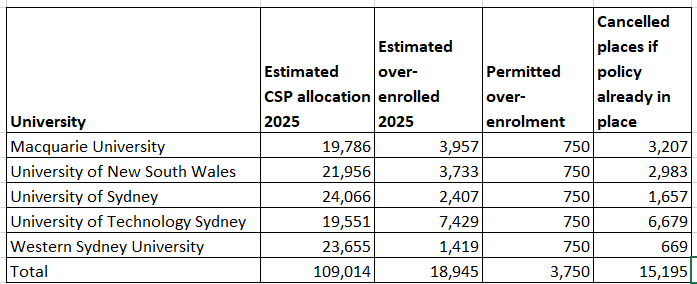
As announced last year, the government plans to crack down on so-called ‘over-enrolments’ – enrolling additional students on a student-contribution only basis once all a university’s Commonwealth Grant Scheme allocation has been used.

When a proposed new funding system is in place, from 2027, student contribution-only places will only be possible in a buffer zone above a university’s Australian Tertiary Education Commission allocation. 2% and 5% buffers have both been suggested. Currently over-enrolled universities will receive some additional funding to bring over-enrolments within their official allocation of places. However, this will not in all cases reduce over-enrolments to the permitted range. Significantly over-enrolled universities need to moderate student intakes in 2026 to bring their medium-term enrolments down.

Not many current Department of Education staff were there the last time a minister thought reducing over-enrolments might be a good idea. The story is worth telling.

Brendan Nelson and over-enrolment

From November 2001 to January 2006 the education minister was Brendan Nelson, a Liberal. Nelson was worried about the quality implications of significant over-enrolments. The first reference I can find to Nelson’s concern is in a media release from December 2001, a month into his term.

Read More »

University funding systems and what graduates see as important in a job

For a side-project I’ve recently engaged with the subject of whether higher education funding systems shape the educational and career choices of students and graduates.

On one theory, where fees are charged students focus more on courses and jobs with high pay. Courses that satisfy intrinsic interests but do not offer good salary prospects would be less popular in countries with fees or after fee increases. Focus-group research on the views of students in European countries provides some support for this view (I have not cross-checked this against enrolments).

Under fee systems, depending on loan arrangements, taking courses with good job prospects may be necessary to reduce the risk of default on student debt repayments.

On another theory, also with some evidence from the European focus-group research, students in fee-paying countries may be more interested in courses that lead to personal financial rewards than courses that serve some broader public purpose. There are echoes of this argument in the local complaint that Australian higher education in the ‘neoliberal’ fee-charging era has lost sight of the ‘public good’.

I’ve discussed the role of interests in course choices before. In this post I look at the attitudes of graduates. My data source is survey evidence from the International Social Survey Programme. Unfortunately Australia only occasionally participates in these multi-nation comparative studies, but the ISSP’s 2015 work orientation questionnaire has Australian data.

What Australian graduates see as important in a job

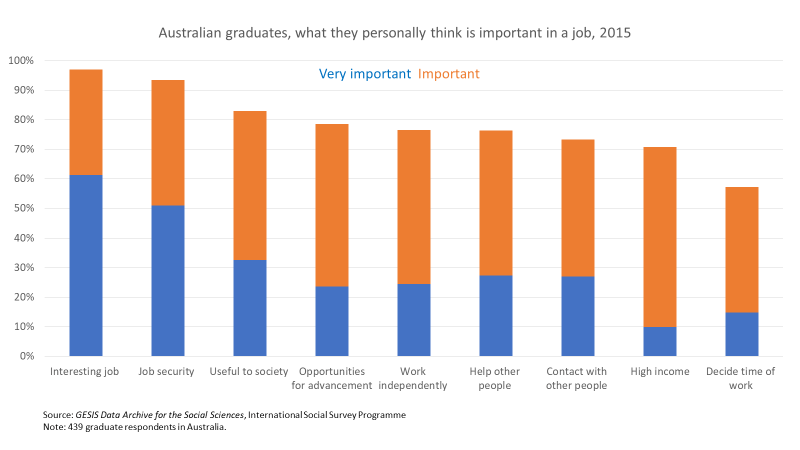
In the ISSP respondents are asked what job attributes they personally see as important.

A job being interesting is the single-most desirable attribute of a job for Australian graduates. This is consistent with interests being the dominant factor in course choice.

The ISSP question has two other-regarding options, being useful to society and helping other people. I presume helping others is a hands-on form of being useful, such as a teacher or nurse, while a policymaker, engineer or executive can produce useful-to-society structures and systems without directly helping specific individuals.

Perhaps because being useful to society is more general it is rated above helping others, and is the third mostly highly rated attribute overall.

Only 10% of graduates rate a high income as very important, the lowest of any attribute and the overall importance of money is the second-lowest of the options given. Money is nice to have but other job attributes are more important.

Read More »

Accord implementation proposals, part #4: Managed demand driven funding for equity students

When the Accord final report was published one recommendation that confused me was a policy to increase equity student enrolments that was “effectively ‘demand driven for equity’ but with planned allocation of places to universities”.

A demand driven system, under which universities can enrol unlimited numbers of students meeting set criteria, can sit alongside a system of allocated student places or funding. Current Indigenous bachelor degree demand driven funding, which would be retained in the Accord model, sits alongside a soft capped block grant for most other students. But for the same courses, or student categories, demand driven and allocated student place systems are mutually exclusive.

Any hope of clarity has been dashed by the Accord implementation paper on managed growth. It proposes “managed demand driven funding for equity students”.

Read More »

The Accord equity target that cannot, and perhaps should not, be achieved

The Universities Accord terms of reference asked the review panel to recommend higher education equity and attainment targets, and in their interim report they offer suggestions.

The general goal is equity group parity in higher education participation by 2035 (pp. 18, 20). There is some ambiguity about whether this applies for all equity groups. A few times only three of the main four – low SES, regional, and disability – are specifically mentioned for the 2035 target (pp. 9, 42, 43). For Indigenous students a target is referred to but not specified on p.43. The Indigenous contribution to the 2035 target is however, mentioned at pp. 40-41.*

Other potential equity groups such as first in family, care leavers, people from single parent families and children of asylum seekers may be added (p. 42)

The equity targets interact with an overall target of 55 per cent attainment by 2050. It is unclear whether this target is for people aged 25 to 34 years (pp. 9 & 36), employed persons (p. 33, distinguished from the 25 to 34 cohort), or all people/unspecified base (p. 22).

Whatever the exact 2050 target, it is well above current levels. Equity group parity is not just achieving the overall population participation and attainment rate now. It is chasing a rate that will, if other Accord policies work, be moving up.

This post discusses the practical obstacles to equity group targets that apply regardless of the precise targets set. It also questions whether a large increase in higher education participation would reliably be in the best interests of the additional students.

Read More »

How would student places be allocated under the Universities Accord?

The task of interpreting the Universities Accord interim report is like that of a biblical scholar trying to extract meaning from fragmentary and sometimes contradictory texts. But building on my post on a universal learning entitlement, in this post I try to understand what kind of student places allocative system the report proposes.

Existing and possible Accord allocative systems

All funding systems need methods for determining total resources and then allocating them between institutions, courses and students. The chart below has the three allocative models currently in use – what I call technocratic, block grant, and demand driven – and the Accord model, which on my reading has elements of the technocratic and demand driven models. However these models are in tension with each other – technocracy puts experts in charge while demand driven funding is based on decentralised decision making.

DecisionTechnocratic (current system for medical students)Block grant (current system for most students)Demand driven (current system for bachelor degree regional Indigenous students with likely extension to all Indigenous students)Accord model?
Total number of places/dollars for each year (system level)Government decisionGovernment decisionUniversity and student decision. Aggregate outcome of student decisions (especially if universities have less control over who they admit).
Or aggregate of Tertiary Education Commission university allocations.
Total number of places /dollars for each universityGovernment decisionGovernment decisionUniversity and student decision.Aggregate of student decisions with full learning entitlement model, possible voucher system.
Or as negotiated/allocated by the Tertiary Education Commission.
Total number of places/dollars for each course or disciplineGovernment decisionUniversity and student decision.University and student decision.Target allocations for courses determined by Tertiary Education Commission.
Possible caps via aggregate voucher allocations/university-level enrolment caps on low priority courses.
Student-level allocative criteria, such as academic results or equity group status.Can be a government decision, but for medical students a university and student decision.University and student decision.University and student decision.Possibly a government decision through Tertiary Education Commission/national admission centre. Or keep current system but use targets to push unis to enrol more students, in general and from priority groups.
Read More »

The decline of the humanities

A couple of days ago the Sydney Morning Herald published an article on falling enrolments in university humanities subjects, with a focus on history and English.

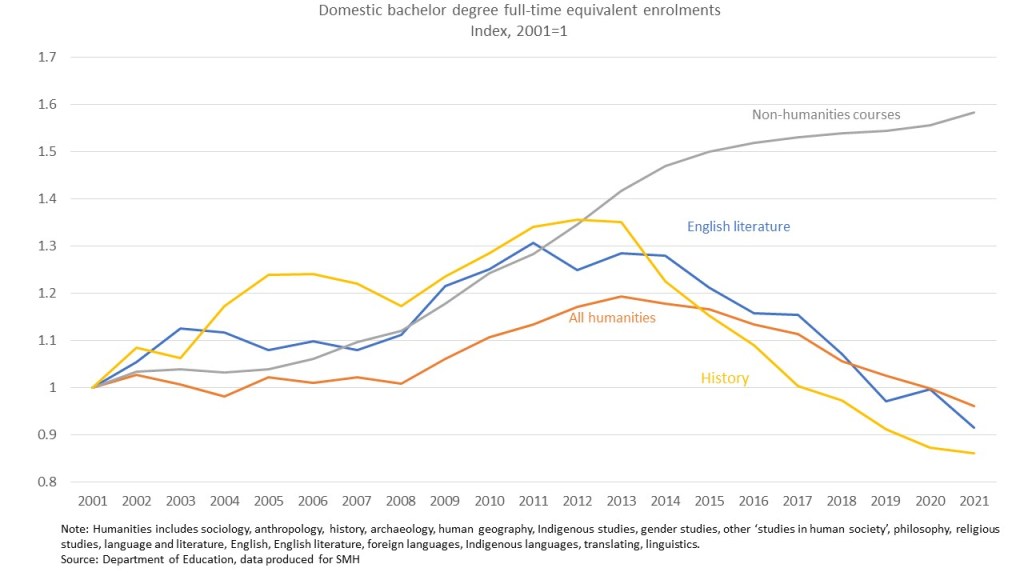
I’ve converted the data into an index to make it easier to see the trends in fields with different absolute numbers of full-time equivalent enrolments. In the late 2000s and early 2010s the humanities shared in general enrolment growth, but after that went into decline. History’s growth and decline were greater than the humanities in general.

Read More »

University offers under Job-ready Graduates

In an earlier post I looked at how university applicants responded to COVID-19 and the new Job-ready Graduates student contributions. In this post I look at how universities responded, based on the offers statistics released yesterday. All the numbers are for domestic undergraduate applicants only.

The incentives faced by universities

In the lead up to 2021 university offers university leaders made various statements about trying to meet expected extra domestic demand, as COVID cut job and travel alternatives to study. But universities also faced, and face, a difficult finanacial situation. They are simultaneously being hit by the Job-ready Graduates policy, which reduces their per student funding in many fields, and by the loss of international student revenue, with the borders now closed to new international students since March 2020. These events compromise university capacity to fund domestic undergraduate student places that do not cover their own costs

Capacity aside, Job-ready Graduates creates complex incentives. By funding at average teaching costs it creates an economies of scale model. That’s one reason why we see the closure of low enrolment subjects and courses. If there is no longer any profit on some courses that may also disincline universities from expanding. On the other hand, if universities want to maintain a course then driving up enrolments may the key to it, by spreading fixed or semi-fixed costs over larger numbers of students. And in the $14,500 student contribution fields – arts (with a few exceptions), business and law – there may be a de facto demand driven system.

Universities also need to consider a complex short-to-medium term negative effect caused by JRG only partially grandfathering pre-2021 students. The link has explanatory detail, but the practical consequence is that more of a university’s total Commonwealth teaching grant has to be spent on continuing students, leaving less money for new students.

Yet another complexity for universities is that COVID-19 made estimating student numbers more difficult. For admissions, the key risk was that offer acceptance rates would be higher than usual, and the university would end up with loss making ‘over-enrolments’ (enrolments that earn a student but not a Commonwealth contribution). This created an incentive to be cautious about offer levels.

Read More »

The first Job-ready Graduates university applications data

The 2021 university applications data is out today, of more interest than usual due to two big events, COVID-19 and the Job-ready Graduates policy changes.

Early in the pandemic I thought there might be a moderate increase in school leaver applications and a larger one for mature age students. The primary reason in each case was the counter-cyclical aspect of higher education demand, with some people studying when work is hard to find.

On top of this, under Job-ready Graduates the government introduced significant changes to student contributions, so that some courses cost 2021 commencing students much more than those who commenced in previous years, while other courses cost less.

Total applications

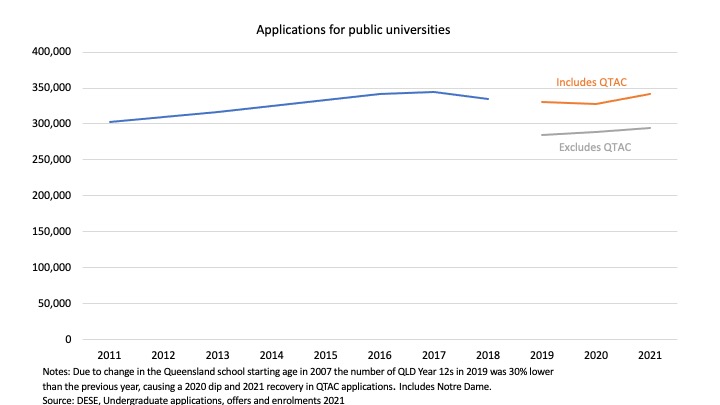
The trend in total domestic application numbers is complicated by a change to the Queensland school starting age in 2007, which produced a dip in Year 12 numbers in 2019 with negative consequences for university applications for 2020 and a rebound in 2021. DESE has produced trend lines with and without QTAC figures to account for this issue, with the non-QTAC figures producing an increase of 2.3 per cent between 2020 and 2021 (4.4 per cent with QTAC). It’s not super-fast growth, but the 2.3 per cent is the highest since 2015.

Read More »

Has Job-ready Graduates increased the number of commencing students?

This morning the government released the first enrolment data since the Job-ready Graduates policy began. It covers only 25 of the 40 full universities (including private universities). No information is available on which universities are in the 25, but based on previously published first-half-of-the-year enrolments I estimate that they enrol just over two-thirds of domestic students.

The government had previously published tertiary admission centre applications data, which based on previous years would represent just under two-thirds of all applications.

As each source has significant missing data any conclusions must be tentative. The chart below lines the two sources up by field of education. Each of demand and supply is up about 7 per cent, but there are significant differences between the two at the broad field of education level.

Apparent trends to date

Demand for IT, science and engineering is up, but supply is up by much more. It is possible that the idiosyncrasies of what is in each of the demand and supply datasets explains some of this discrepancy, but also that the national priority places and short courses allocations, which have a policy bias to these fields, are driving up supply more quickly than demand.

Read More »