The task of interpreting the Universities Accord interim report is like that of a biblical scholar trying to extract meaning from fragmentary and sometimes contradictory texts. But building on my post on a universal learning entitlement, in this post I try to understand what kind of student places allocative system the report proposes.
Existing and possible Accord allocative systems
All funding systems need methods for determining total resources and then allocating them between institutions, courses and students. The chart below has the three allocative models currently in use – what I call technocratic, block grant, and demand driven – and the Accord model, which on my reading has elements of the technocratic and demand driven models. However these models are in tension with each other – technocracy puts experts in charge while demand driven funding is based on decentralised decision making.
| Decision | Technocratic (current system for medical students) | Block grant (current system for most students) | Demand driven (current system for bachelor degree regional Indigenous students with likely extension to all Indigenous students) | Accord model? |
| Total number of places/dollars for each year (system level) | Government decision | Government decision | University and student decision. | Aggregate outcome of student decisions (especially if universities have less control over who they admit). Or aggregate of Tertiary Education Commission university allocations. |
| Total number of places /dollars for each university | Government decision | Government decision | University and student decision. | Aggregate of student decisions with full learning entitlement model, possible voucher system. Or as negotiated/allocated by the Tertiary Education Commission. |
| Total number of places/dollars for each course or discipline | Government decision | University and student decision. | University and student decision. | Target allocations for courses determined by Tertiary Education Commission. Possible caps via aggregate voucher allocations/university-level enrolment caps on low priority courses. |
| Student-level allocative criteria, such as academic results or equity group status. | Can be a government decision, but for medical students a university and student decision. | University and student decision. | University and student decision. | Possibly a government decision through Tertiary Education Commission/national admission centre. Or keep current system but use targets to push unis to enrol more students, in general and from priority groups. |
Total numbers of places/dollars
The Accord panel wants targets for participation and attainment, with 55 per cent workforce attainment by 2050 (p. 22; I’ll explain elsewhere why I think targets are a mistake). The report says that this implies a higher overall population attainment but I think it means lower population attainment, as people without qualifications are less likely to be working – see the chart below. 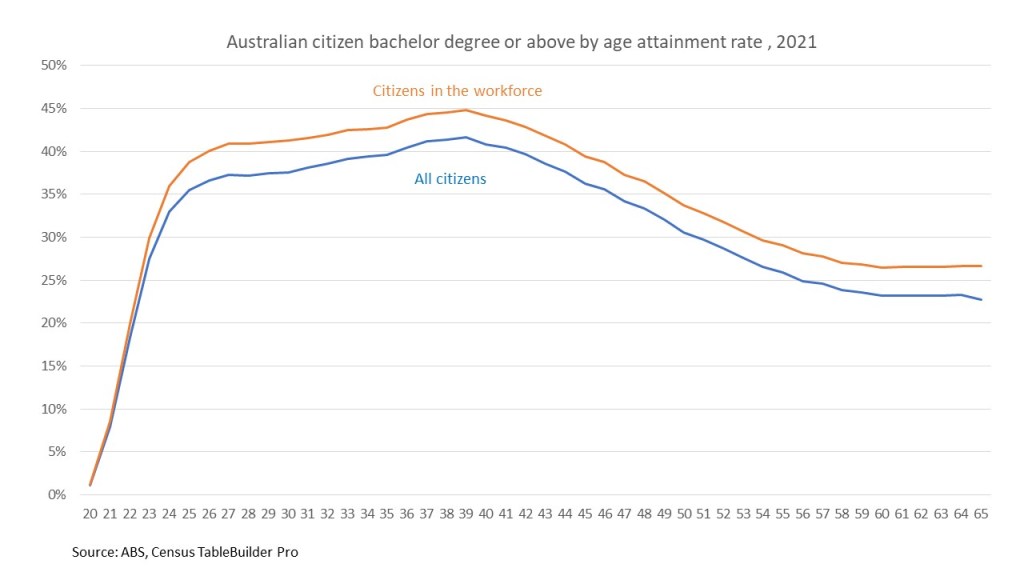
Fifty-five per cent attainment is about 10 percentage points above the current peak attainment of workers. Current attainment levels are heavily influenced by migrants with overseas qualifications and former international students, and so for people whose families have been in Australia longer the task is much larger.
If I understand the universal learning entitlement idea it implies caps on government-supported education at an individual career but not an annual system level, as people could draw on it through their careers as needed to acquire or update skills. System size would be determined by how many students enrol. Universities may face more pressure to supply places than under the previous demand driven system, through mechanisms discussed in the next section.
However a full learning entitlement model would probably not get through Cabinet in the current fiscal environment.
Recognising fiscal constraints, the Accord interim report recommends priority funding for students from equity groups (p. 43). They could be first to get learning entitlements. On my Census-based analysis just under 40 per cent of 18-24 year old Australian citizens were members of at least one focus equity group (Indigenous, low SES, regional and remote, disability) in 2021.
A general allocation by university for other students might be similar to today’s block grants, with possible modifications discussed below. The government would design this so as to control its outlays to an acceptable maximum amount.
Places at each university
In a full learning entitlement or demand driven model the number of places at each university is determined by how many enrolments they attract, as suggested by interim report learning entitlement statements about choice of university.
But in the other models, including what might be a hybrid first stage Accord system, resources are allocated centrally. One task of the Tertiary Education Commission is ‘determining funding allocations, including through the negotiation of mission-based compacts with universities’ (p. 112).
Given the Accord panel’s focus on headcount attainment the current flexible block grant allocated in dollars might change. The same number of dollars can convert into very different numbers of places depending on what discipline they are in (reforming Job-ready Graduates Commonwealth contributions would alleviate but not eliminate this issue). Block grants have previously had target numbers of student places, which could take into account the varying relationships between EFTSL and headcount across the sector.
The interim report recognises that demography-driven increased demand is not evenly distributed around the country (pp. 38-39, 104), with funding potentially reflecting population patterns. To reach its participation and attainment targets the interim report proposes ‘short-term step-change targets, disaggregated by state, region, provider and other relevant criteria’ (p. 9).
The interim report also recognises that new institutions might be needed (pp. 105-106). A fully demand driven/learning entitlement system for new institutions could help them grow to an economic scale.
Courses and places per course
Historically, with the exception of medicine, allocation of student places to specific courses has been unusual except for new places, which are only ever a small proportion of all places. More typically there has been a flexible block grant or allocation to funding clusters (disciplines or groups of disciplines with the same funding rate).
These systems gave universities considerable autonomy over which courses to provide and how many places to offer in each, which was greatest under demand driven funding (2012-2017). But demand driven funding is deemed ‘no longer reflective of current requirements’ due to its focus ‘only on the willingness of a student to learn, and the willingness of a provider to enrol’ (p.131).
This suggests a system more driven by bureaucratic determinations ‘within a system that takes account of…the overall supply of a… well-located workforce that meets the changing requirements of the economy’, p. 131, includes ‘better planning than demand driven funding’, p. 131, with ‘the Tertiary Education Commission and its relationship with Jobs and Skills Australia could be an important part of this’ , p.131, ‘with the system needing to supply graduates who meet the societal and economic needs of their region and the nation’, p. 132.
The Accord panel wants a much better understanding and control of the overall and geographic pipeline of graduates destined for occupations of interest. Currently only seven of the nearly 400 occupations the ABS regards as requiring a degree are tracked in the higher education enrolment data.
The recent list of courses eligible for a longer temporary graduate visa could be a sign of where this is going. The course list would be longer – occupations not in shortage now will be if universities don’t offer courses beyond this list – but the practice of naming courses may continue. In its 20,000 [sic] places policy the government gave universities discretion in allocating places within clusters of named courses. As proposed in England, places in courses that don’t serve labour market needs may be capped.
The role of universities would be much diminished, but the idea of an Accord suggests that they would retain some say in ‘negotiations’ with the Tertiary Education Commission about their role in delivering on TEC/JSA-determined skills needs. They would probably, as with the 20,000 places policy, have room for local decision making on the detail of implementation.
However this technocratic central control interpretation is in tension with the interim report’s statements about student choice: ‘funding relates to…student characteristics and choices rather than historical allocations’ p.9, ‘students pursuing courses which align with their abilities and interests’, p. 131, ‘a higher education course of their choice’, p. 131 ‘while student choice is essential…’ p. 132.
Perhaps this means that students can choose between TEC approved options. The proposed ‘universal learning entitlement’ would be consistent with a voucher system that permitted choice of institution (perhaps more choice than under demand driven funding, see next section) but more limited choice of course than under demand driven funding.
The interim report discusses improved career advice (p. 63), which is one mechanism for managing student preferences in desired directions. But student choice is a constraint on technocratic policymaking. Universities reliant on public funding will ultimately ‘agree’ to whatever the government wants, but students will not. Limiting prospective students’ options might get them to take a TEC-preferred second or lower preference course within their cluster of interests. But if a course they want to do is not available at a nearby university they may not pursue higher education at all. That would make overall and equity participation and attainment targets more difficult to meet.
Allocating student places to students
As I wrote in my post on the universal learning entitlement allocating student places to students could be another big change under the Accord proposals. The right of universities to reject applicants – the ‘willingness of a provider to enrol’ – could be curtailed, with students meeting some threshold requirement given a stronger right to place. At minimum, universities will be under significantly more pressure to recruit students from equity groups.
Conclusion
In what the Accord panel has said about allocative systems to date there is a tension between student choice and greater central control over the occupational profile of students and graduates. Combined with a lack of detail this makes it hard to see clearly where the panel is headed. But the overall tenor of the report is low trust in the decisions made by universities and students, with an implied confidence in technocratic alternatives, implemented by the TEC.


The Accord panel’s deliberations over allocative systems are like theologians of a previous age arguing over some obscure point of scripture, while economic and technological revolutions transform the world around them. I suggest the Australian higher education system needs to look at new more flexible options for all students, or the students will choose to study somewhere else (I did).
The Accord panel target of 55% attainment I suggest should be interpreted as being for post-school education, including the vocational sector. It is reasonable to aim for at least a vocational certificate IV, for 55% of the workforce. That would be better for productivity, and jobs.
To complement priority funding for students from equity groups, I suggest measures to improve the quality and flexibility of education for all students.
A centrally planned allocation of places is obviously unworkable. Rather than waste time working out demand versus planned, Australia could develop a more flexible system, with qualifications suited to a wider range of roles. As it is graduate do not necessarily work in the field they trained for anyway.
One way to improve career advice is to build it into the education system. My day job for the last eight years has been to do this. Rather than wait for studnts to come for career advice when it is too late, the approach I help with is to have studnts look at career options as part of their assessed coursework. One benifit of this is that studnts never complain about having to write an assignment about getting a job, as this is something they will need to know how to do.
LikeLike