Job-ready Graduates – its effects on university Commonwealth supported places decisions

The student contribution increases of Job-ready Graduates get regular media coverage, focusing on the plight of debt-laden arts graduates. Far less attention is given to how JRG affected university decision-making.

For universities JRG had multiple elements. Total overall Commonwealth supported student funding rates by discipline were changed, some increasing but most decreasing. The changes to student contributions altered incentives for over-enrolments. Previous separate allocations of sub-bachelor and postgraduate Commonwealth supported places (CSPs)were ended, merged into a single fund with bachelor degrees.

To explore these effects, Ren-Hao Xu from UWA and I interviewed 15 leaders and officials from five universities in 2024 and 2025. We chose universities with various sizes, locations, missions and rankings to find out how they interpreted the JRG incentives and how these affected decision making. An academic article reporting our methodology and findings was recently published in the Australian Educational Researcher journal.

Over-enrolment

One thing I was especially curious about was to what extent over-enrolment – taking students on the student contribution only – was deliberate and to what extent accidental, reflecting the inherent difficulties in hitting precise full-time equivalent enrolment targets.

For the over-enrolled universities in our study the answer was mostly deliberate.

Two universities in our study had mission-related reasons for over-enrolling. The vice-chancellor of an equity-focused university told us that ‘we’ve also felt that we should over-enrol based on demand due to the university’s mission to serve students from disadvantaged backgrounds.’ The vice-chancellor of a regional university was willing to over-enrol as there was no other local university students could attend.

Other universities took a more strategic approach. One noted the likely Accord system re-set, knowing that during past policy shifts enrolments as of a recent year were used at the basis of the new funding system. This was a chance to lock in a larger base funding amount (an approach that has so far only partly worked, with just $50 million allocated to convert over-enrolments to fully-funded places).

Read More »
The first Job-ready Graduates university applications data

The 2021 university applications data is out today, of more interest than usual due to two big events, COVID-19 and the Job-ready Graduates policy changes.

Early in the pandemic I thought there might be a moderate increase in school leaver applications and a larger one for mature age students. The primary reason in each case was the counter-cyclical aspect of higher education demand, with some people studying when work is hard to find.

On top of this, under Job-ready Graduates the government introduced significant changes to student contributions, so that some courses cost 2021 commencing students much more than those who commenced in previous years, while other courses cost less.

Total applications

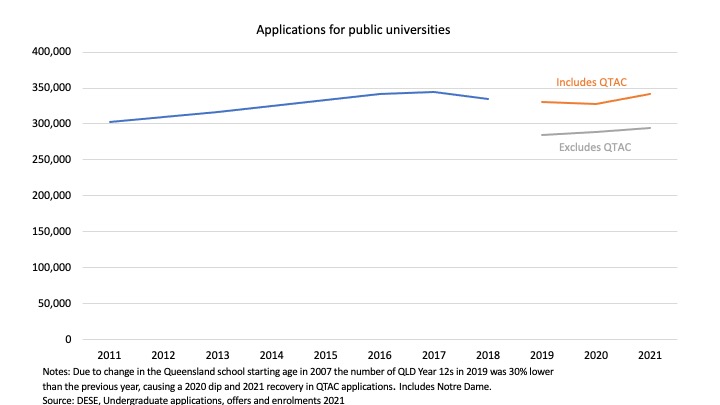
The trend in total domestic application numbers is complicated by a change to the Queensland school starting age in 2007, which produced a dip in Year 12 numbers in 2019 with negative consequences for university applications for 2020 and a rebound in 2021. DESE has produced trend lines with and without QTAC figures to account for this issue, with the non-QTAC figures producing an increase of 2.3 per cent between 2020 and 2021 (4.4 per cent with QTAC). It’s not super-fast growth, but the 2.3 per cent is the highest since 2015.

Read More »

How much the government paid for Centre Alliance’s Senate vote, and other updates from the funding agreements

This post updates one I wrote in April, including new information from revised university funding agreements posted on DESE’s website.

South Australian university Senate special deals

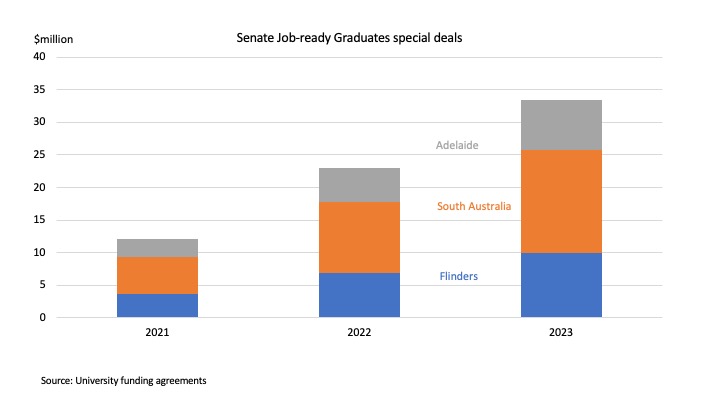
The updated funding agreements let us see how much the government paid to get Centre Alliance Senator Stirling Griff to vote for Job-ready Graduates, which is $68.6 million for South Australian universities over the 2021-2023 funding agreement period. Unlike much of the other additional money in the funding agreements, these increases are ongoing rather than temporary.

I am not sure what criteria were used in dividing the money between the South Australian universities. In 2021 Adelaide gets 1.9 per cent more than it presumably would have otherwise, Flinders 2.7 per cent, and the University of South Australia 3.1 per cent.

More short course places allocated

In my earlier post the allocated short courses fell short of the announced budget value of $252 million. Now they slightly exceed it at $258.7 million, divided between 256 undergraduate certificates valued at $102.9 million and 491 graduate certificates worth $155.8 million. My updated spreadsheet of short courses is here.

Read More »

New allocations of money and student places in the university funding agreements

Update 7/7/21: Some of the data in this post has been updated here.

———————————————————————-

Last month I wrote an overview and critique of the new university funding agreements. This post looks at new allocations of funding for student places, while a subsequent post will look at total funding allocations. Not all my numbers match previously announced total funding for the relevant program, so that is a caveat on both posts.

Under Job-ready Graduates universities are free of sub-bachelor and postgraduate student places being allocated by funding cluster, but the funding agreements show that universities have significant additional work to do in applying for and reporting on a range of small programs.

Numbers of universities getting different allocations

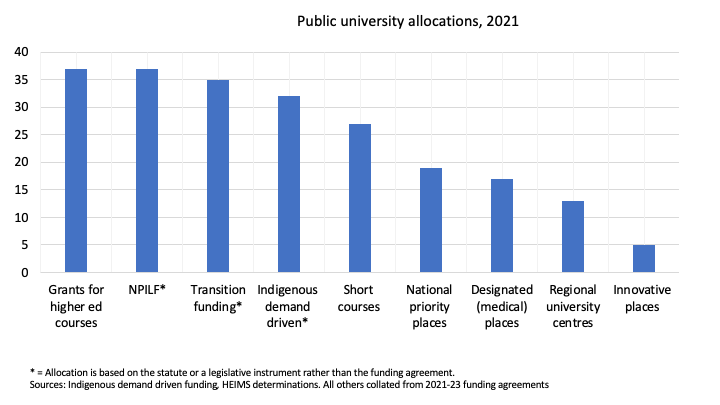
Job-ready Graduates introduced several new or substantially revised pots of money. Not all universities receive each of these. As the chart below shows, programs driven by criteria or formulas set out in legislative instruments (NPILF and transition funding) or the legislation itself (demand driven funding for Indigenous students from regional and remote areas) benefit the largest number of universities. Apart from the general grants for higher education courses (sub-bachelor through to masters coursework, except medicine), the ministerial/departmental discretion programs benefit fewer universities.

Short courses funding

According to the funding agreements, 27 of the 37 public universities have received once-off 2021 funding for undergraduate certificate and/or graduate certificate short courses. When a university’s funding agreement reported $0 for short courses I cross-checked against CourseSeeker with its ‘short course’ filter on and found three more universities. I am not sure whether this is because those universities adopted the ‘short course’ brand without a specific funding allocation, or because their funding agreements are yet to be updated, or because CourseSeeker is wrong. My adding up of the value of funding agreement short courses gets me to $213 million, out of the $252 million allocated for 2020-21 in the October 2020 Budget.
Read More »

Has Job-ready Graduates increased the number of commencing students?

This morning the government released the first enrolment data since the Job-ready Graduates policy began. It covers only 25 of the 40 full universities (including private universities). No information is available on which universities are in the 25, but based on previously published first-half-of-the-year enrolments I estimate that they enrol just over two-thirds of domestic students.

The government had previously published tertiary admission centre applications data, which based on previous years would represent just under two-thirds of all applications.

As each source has significant missing data any conclusions must be tentative. The chart below lines the two sources up by field of education. Each of demand and supply is up about 7 per cent, but there are significant differences between the two at the broad field of education level.

Apparent trends to date

Demand for IT, science and engineering is up, but supply is up by much more. It is possible that the idiosyncrasies of what is in each of the demand and supply datasets explains some of this discrepancy, but also that the national priority places and short courses allocations, which have a policy bias to these fields, are driving up supply more quickly than demand.

Read More »

A farewell to arts?

I am on a panel discussion this evening called ‘A Farewell to Arts? On the Morrison Government’s University Legislation’. I will do my preparation in public via this blog post, working through the event questions.

Why does the Morrison Government want to dissuade students from enrolling in an Arts degree? [A reference to more than doubled student contributions.]

As the policy name ‘Job-ready Graduates’ suggests, the main stated reason for changes to student contributions is to promote graduate employment outcomes. Or as the JRG discussion paper puts it ‘incentives in the current funding system could encourage sub-optimal choices for students and institutions, leading to poorer labour market outcomes and returns on investment in higher education.’ The assumption is that if arts becomes more expensive students will instead choose a course with lower student contributions and better employment prospects.

Employment outcomes can be measured in many ways, but every method shows that graduates in fields typically taught in Arts faculties are at an elevated risk of disappointing outcomes.

Read More »

How will performance funding work under Job-ready Graduates? (I don’t know, but here are some possibilities)

How performance funding will work under Job-ready Graduates remains unclear, to me at least. Some recently published FAQs on Job-ready Graduates, which are a cut-and-paste from a previous statement, indicate that performance funding will continue:

From 2021, the PBF scheme will be adjusted to make approximately $80 million amount of growth funding per year contingent on performance requirements. Performance funding will grow each year to a total equivalent to 7.5 per cent of funding for domestic, non‑medical bachelor places to incentivise university performance. This measure is in line with the PBF model implemented in 2020. [emphasis added]

Is performance funding a condition of other announced CGS increases?

Read More »

The complexities of new student places (again)

Tuesday’s Budget announced two lots of funding for new student places, for short courses and for ‘national priority’ courses. But in the complex Job-ready Graduates funding system it is hard to work out what will really happen. As with other policies that are intended to create new places, it is not clear that there is a financial incentive to increase enrolments.

The difficulties of introducing new money into a transitioning system

Between them, the two new allocations total about $550 million over the next four years, with the short course money lasting for two years.

The question is how this relates to the Job-ready Graduates transition fund. This fund is designed to leave universities with the same Commonwealth student-related funding for the next three years as if JRG had never happened.

The draft Commonwealth Grant Scheme Guidelines released at the end of last month set out how the transition fund will work. The Guidelines have several unclear and seemingly contradictory elements, which I discuss in a footnote.* But this is the basic formula for transition funding:

Read More »

The Job-ready Graduates student places debate

Update 30/9: The minister has announced $326 million over an unspecified period, but starting in 2021, for additional student places. This would have a a significant effect on the calculations below. I will update again when I have more detail.

————————————————————————————————

One of the many disputed points in the Job-ready Graduates Senate inquiry was over the number of student places it would create. The Department of Education’s answers to questions on notice provided new detail, including annual estimates, shown in the chart below.

Over the longer-run, there are multiple mechanisms in JRG hat could require or encourage universities to deliver more student places than now. However, the Department does not explain how it arrived at most of its numbers. They do explain the assumptions behind their 2021 forecast. For the reasons given below, I doubt that these justify a claim of additional places compared to status quo policies remaining in place.

Funding envelope

Of the 15,000 additional funded places, 7,000 are said to come from ‘increased flexibility for universities within the funding envelope’. This refers to ending three separate Commonwealth Grant Scheme grants for sub-bachelor, bachelor and postgraduate coursework places. Instead, universities would have a single ‘funding envelope’, within which they could freely move resources between qualification levels.

Read More »

Can enabling courses survive?

Enabling courses are niche product of the Australian higher education system. Although quite diverse, they aim to improve academic preparedness for higher education study. Enabling courses often target general academic problems, but also discipline-specific gaps.

Public universities can offer enabling courses on a full-fee basis with a FEE-HELP loan, but most enabling students are in Commonwealth supported places they get for free. In 2018, universities had nearly 22,000 CSP enrolments, who used just under 12,000 EFTSL (most enabling courses are short).

CSP enabling places are funded from a mix of the normal discipline-based Commonwealth contribution and an ‘enabling loading’ in lieu of a student contribution. Both funding sources come from the Commonwealth Grant Scheme.

From 2011 to 2019, enabling places came from an allocation for sub-bachelor places, but with an implied enabling allocation, the set number of places that received the loading. The ‘fully-funded’ loading was about $3,400 per student place in 2018, but due to over-enrolments – students above the allocated number – it averaged about $2,700. This compares to a weighted average student contribution of $8,100 if these had been charged.

The government moves against enabling courses

Read More »