The $1 billion spent on undelivered student places

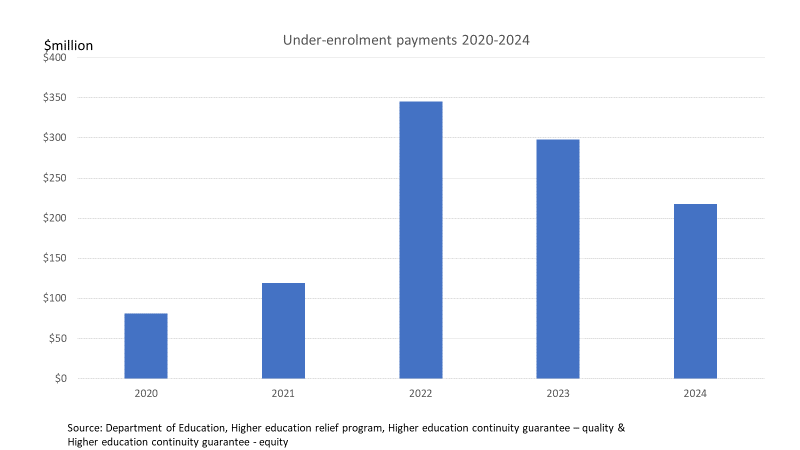
Last year I wrote about payments to universities under the Higher Education Continuity Guarantee, a Morrison-era program to compensate universities for ‘under-enrolment’. I then had data up to 2022. This can now be updated to 2024. Total expenditure on the Guarantee and its 2020 predecessor, the Higher Education Relief Program, now exceeds $1 billion.

How the Higher Education Continuity Guarantee worked

In simplified terms, the Higher Education Continuity Guarantee offset reduced payments to universities from the Commonwealth Grant Scheme.

Under the funding legislation, universities are supposed to receive the lesser of 1) The value of Commonwealth supported places delivered, calculated on a full-time equivalent place multiplied by the relevant Commonwealth contribution amount, or 2) the maximum grant amount that universities were entitled to receive under their funding agreement (how this maximum was calculated varied in the life of the Guarantee).

For universities entitled to receive only the amount calculated in option (1), the Guarantee topped them up to the amount in (2).

This is called ‘under-enrolment’ because universities did not deliver sufficient Commonwealth supported places to receive their maximum grant amount.

The cost of the Higher Education Continuity Guarantee

Guarantee funding peaked in 2022, at $346 million, before dropping to $298 million in 2023 and $218 million in 2024. Total cost since 2020 is $1.056 billion.
Read More »

Political compromise to end the worst of Job-ready Graduates

Late last year the Greens introduced the Higher Education Support Amendment (Reverse Job-Ready Graduates Fee Hikes and End 50k Arts Degrees) Bill  into the Senate. Submissions for the Senate inquiry into this bill close on Friday.

Under the bill, the student contribution for most arts students would go down from $17,399 a year to $8,164, what it would have been if Job-ready Graduates had never happened. For business and law the student contribution would go down from $17,399 to $13,624, similarly what it would have been without Job-ready Graduates. Creative arts students contributions would go down from $9,537 to $8,164.

My submission to the inquiry is here.

Constitutional problems

While I agree with the broad direction of the Reverse Job-ready Graduates bill on student contributions, it cannot fix the JRG problem. Under section 53 of the Australian Constitution, a bill appropriating money cannot originate in the Senate. Offsetting reduced student contributions with higher Commonwealth contributions, as needed to maintain university funding, would require an appropriation. Due to this legal limitation, the bill contains only lower student contributions, without any changes to Commonwealth contributions.

If the bill passed we would be left with JRG Commonwealth contributions and pre-JRG student contributions. Total funding for a full-time arts student would halve, from $18,715 to $9,480.

Ending $50,000 arts degrees by ending arts degrees is too radical a measure.

Read More »