The Australian government is trying, without much success to date, to reduce the number of long-term temporary migrants. For student-related visa holders – people with student visas, temporary graduate visas, or former international students on bridging visas – this is primarily about reducing inflows of new visa holders and increasing outflows of existing visa holders. Another important element, however, is moving former students to permanent visas.
This post looks at recent trends in former international students achieving permanent residence. It concludes with a discussion of the subclass 482 Skills in Demand visa, which is offering a new route to PR.
Permanent visas
My main data source is the Department of Home Affairs Student visa and Temporary Graduate visa program report. It only reports former students transitioning from these visas, and not those with another temporary visa prior to PR. An ABS analysis up to the 2021 Census found that over half the 587,000 former student visa holders with PR had first held three or more temporary visas. This total includes secondary applicants, who made up about a quarter of the total.
The Home Affairs data includes former students moving to visas that are probable sources of PR, which I discuss below. There is no primary/secondary visa holder split. As I showed in an earlier post, secondary visa holders are a significant share of the potential PR population, especially for temporary graduate visa holders.
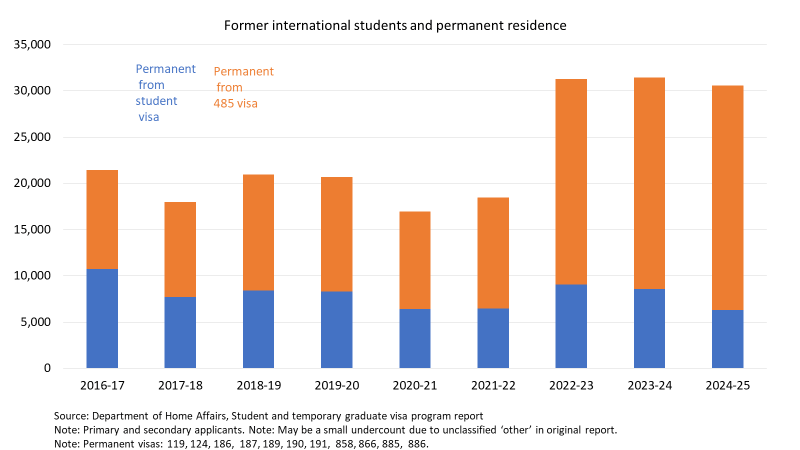
Since 2022-23 the annual number of former international student visa holders getting PR has increased significantly. Before COVID it was around 20,000 a year, after COVID it was around 31,000 a year. These are primarily work-related visas, with the subclass 190 state or territory Skilled Nominated visa the largest category.
One-step moves from a student visa have become less common. Their share of the total halved from 40% of the total in 2019-20 to 20% in 2024-25. The two-step track – student, temporary graduate visa – to PR has become more common.
Pathways to permanent residence
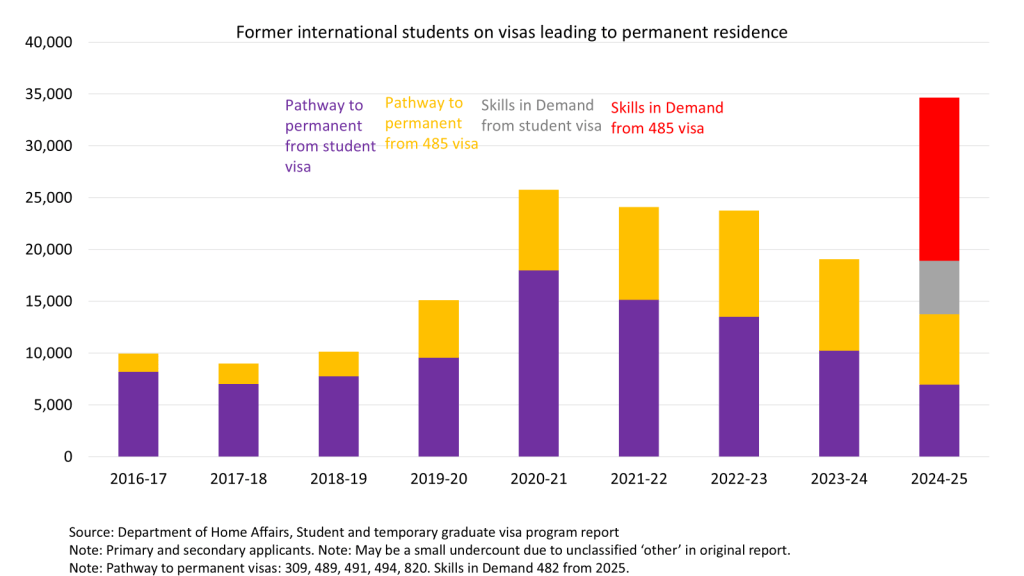
In addition to direct grants of PR some ex-students receive visas with a high chance of PR. These are primarily partner visas and regional work visas. These visas offer transition to PR provided visa conditions are met. Ex-students on subclass 820 partner visas get access to Medicare and English language classes if necessary. If the relationship is found to be genuine then PR is granted. The subclass 491 regional work provisional visa does not offer Medicare but these visa holders can apply for PR after three years.
How we interpret trends in pathways to PR depends on the new subclass 482 Skills in Demand visa, which was introduced in December 2024. This provides access to four years of work rights in Australia with the opportunity to apply for a subclass 186 Employer Nominated PR visa after two years. I discuss the subclass 482 visa below. Without it fewer former students are on pathways to PR, with it there is a significant upward trend. However, the early 2020s figures reflect the government reducing a backlog of partner visa applications while other visa categories were under-utilised due to border closures and reduced employment.
The 482 Skills in Demand visa
The subclass 482 Skills in Demand visa is a general labour market program, not one set up specifically for former international students. But temporary graduate visa holders were mentioned in the policy announcement, with this visa letting them remain in Australia if supported by an employer, while other temporary graduate visa holders are encouraged to return home.
The criteria for the Skills in Demand visa include employer sponsorship, working in an occupation on the core skills occupation list, a salary of at least $79,423 a year and no less than an equivalent Australian worker would be paid, and at least one year of experience in the nominated occupation.
The main obstacle to a subclass 482 visa for someone on a student or temporary graduate visa is labour market testing, intended to give Australian workers a first chance. Broad exemptions apply based on international trade agreements, including major source countries such as China and Vietnam. The broadest exemption is applicant home country membership of the WTO, but that requires prior employment for at least two years – the current length of a bachelor/masters coursework temporary graduate visa. That would produce near misses unless the temporary graduate can start work the day their visa starts.
If labour market testing issues can be managed, the subclass 482 visa means that an employer hiring a former international student can employ them for six years – two on the standard subclass 485 temporary graduate visa for a bachelor or masters graduate and another four on the Skills in Demand visa. A six-year hire is more attractive to employers than the two-year 485 visa.
In the first six-and-a-bit months of the Skills in Demand visa 37,349 visas were granted. Combining this with data from the Student visa and Temporary Graduate visa program report I calculate that 56% of these visas went to former international students.
In the Skills in Demand visa’s first full financial year, 2025-26, 130,970 visas were granted (including primary and secondary applicants). I only have former student visa holder data for the first half of 2025-26. For that period, former international students received 19,852 of 61,039 visas granted, approximately one-third of the total. This may be a more reliable indicator of the longer-term former student share.
Of the 19,852 former student Skills in Demand visas granted in the first half of 2025-26 45% were coming off a student visa. Intuitively that seems high, given that at least a year’s work experience in the nominated occupation is required. It may reflect student visa holders with prior qualifications and work experience that form the foundation of their employer’s sponsorship. Some former temporary graduate visa holders return to student visas to extend their stay, although they must do so from offshore since July 2024.
For former international students with a willing employer the Skills in Demand visa is more attractive than a temporary graduate visa. It is longer and provides a clearer pathway to PR.
The subclass 482 visa is currently subject to visa processing priorities. Law enforcement or defence-related applications get the highest priority whether the applicant is onshore or offshore. The next priority is given to onshore construction, healthcare and teaching applicants, followed by other onshore applicants. This onshore priority is favourable to students completing their studies or former students on subclass 485 visas.
Transition to the 186 Employer Nomination Scheme visa
Within the 186 Employer Nomination Scheme visa there is a Temporary Residence Transition scheme for subclass 482 visa holders.
As subclass 482 visa holders must work for at least two years before using the transition pathway it’s too early for any data. For context, in 2024-25 4,472 former student or temporary graduate visa holders received subclass 186 visas.
The government favours employer-sponsored visas in its PR planning, with 58,040 places for 2026-27 compared to 44,000 in 2025-26.
This is a positive sign for former international students hoping for PR via the subclass 482 visa transition scheme.
But the prospects for former students looking for a points-tested visa to remain in Australia are not so favourable. A subsequent post will explore this issue.
 Andrew Norton