The Universities Accord (Opening the Doors of Opportunity) Bill 2026, in itself, does not do what it says in the cover.
Although the minister’s promotional material focuses on new Commonwealth supported places expected over coming years he could have funded those under the current system – albeit imprecisely, as the current system largely allocates in dollars rather than places. The most we can say in favour of the bill and new places is that it will be more obvious whether or not they have been funded.
Where the bill differs most from the current funding system is in reducing places at the university level. In the previous post I explained how a year of under-enrolment could result in a lower allocation of places two years later. In today’s post I describe proposed new restrictions on over-enrolments, students taken above the allocated level.
All legislative references in the following text are to the Higher Education Support Act 2003 unless otherwise specified, ‘current’ signalling the legislation now in force, ‘new’ signalling the amending bill.
As with the earlier posts, this is one is dealing with complex legislation so I am happy to receive feedback through comments or direct communication.
The current system
Under the current ‘higher education courses’ grant – all CSP categories other than medicine or Indigenous students in demand driven places – there is a maximum basic grant amount. The value of CSPs delivered in this category is calculated as the Commonwealth contribution rate * the number of student places delivered. If the value of these places exceeds the MBGA the university gets the MBGA but no more: current section 33-5(2). In 2024 nine universities delivered student places worth at least 5% more than their MBGA.
For student contributions, however, there is no cap. The provisions on upfront student contributions and HECS-HELP loans give the Commonwealth no power to intervene on these payments: current sections 93-15 and 96-1 respectively.
The proposed system – capped student contributions
There will be a transitional scheme for currently over-enrolled universities, which I cover below. First I will focus on the long-run system under which universities will get an over-enrolment buffer, for which student contributions are paid, but then be penalised student contribution revenue for places in excess of the buffer.
The over-enrolment cap
The starting point for each university will be their ‘domestic student profile’ for higher education courses. As explained in the previous post, this is their ‘core student load’ (historical places) plus their ‘additional growth allocation’ (new places). This excludes medical places and demand driven places.
The bill introduces the new concept of a ‘default deemed allocation’, impliedly of student contribution-eligible places: new section 33-39.
A university’s default deemed allocation will be the lesser of:
a) 105% of the provider’s domestic student profile – so say the provider was allocated 10,000 places their default deemed allocation would be 10,500 places; or
b) the provider’s domestic student profile plus the number of CSPs specified in the Commonwealth Grant Scheme Guidelines.
In documents circulated to universities they have been told that the number set under paragraph (b) will be 750.
This means that universities with 15,000 or more CSPs in their domestic student profile will have an over-enrolment buffer of 750 places above their domestic student profile, while the others will have a lower number equal to 5% of their domestic student profile.
On recent enrolment data about half of universities will be in each category, 5% or 750.
The Commonwealth Grant Scheme Guidelines are made by the minister, subject to disallowance by the House of Representatives or the Senate. The threat of disallowance provides a small amount of protection, but the bill has only a very weak guarantee of student contributions for over-enrolled places. The minister could decide to specify zero or a very low number of places, which would be a significant financial risk for universities.
Implications for one university regions and mergers
The minster’s rationale for the capping policy is to stop what he called ‘desperate competition’ for students. He assumes that students rejected from their first preference university will attend another university instead.
In big capital cities with multiple university options there may well be a similar course available elsewhere if an applicant’s first preference university has hit its cap.
But for aspiring on-campus students in regional areas the one local university may be their only feasible option. If it has reached its cap they miss out.
The capping policy is also something state governments should think about in their strange enthusiasm for university mergers. Thanks to the University of South Australia/University of Adelaide merger the city of Adelaide will have about 620 fewer student places than if the two universities had remained separate. Merging Murdoch University with one of the larger Perth universities would reduce total places for that city.
Calculating the over-enrolment penalty
If a provider delivers more student places than its default deemed allocation it is subject to a reduction in its Commonwealth Grant Scheme payment: new section 33-38(1). The bill calls this an ‘adjustment’ to the CGS amount, but I will dispense with this euphemism and call it a penalty or a fine (formal legal penalties would be subject to judicial review, not favoured by a government that wants few fetters on its discretion).
The penalty is the average student contribution charged multiplied by the number of over-enrolled places: new section 33-38(2).
However the number of over-enrolled places is not a straightforward places delivered minus the default deemed allocation.
The number of ‘over-enrolled places’ is the difference between the number of places delivered and the higher of a) the default deemed allocation or b) the number of higher education courses places delivered in 2025: new section 33-38(3).
This protects universities that were over-enrolled in 2025.
For example, say a university in 2025 had 10,000 places fully funded under its then maximum basic grant amount. It was over-enrolled by 20%, delivering 12,000 places.
Say its allocation in 2028 was 10,500 places. It is a smaller university so it gets a 5% over-enrolment buffer, so a default deemed allocation of 11,025 places.
In 2028 it again delivers 12,000 places. It is over-enrolled by 975 places.
If the default deemed allocation system was applied it would be fined 975 multiplied by the average student contribution.
But because the 12,000 actual 2025 places figure is the higher figure under new section 33-38(3) the university is fined nothing.
The 2025 base was chosen, according to the explanatory memorandum, because it was the last year before universities became aware that over-enrolments were to be restricted (p. 43). This again shows the government’s belief that universities should start complying with government policy before the necessary legislation has been passed by the Parliament.
Commencing student caps for over-enrolled universities
The legislation creates a new category of ‘transitioning Table A provider’. The ‘transitioning’ is to delivering student places within their default deemed allocation.
A Table A provider is ‘transitioning’ if from 2027 it exceeds its default deemed allocation: new section 33-39A(1).
If this happens the university becomes subject to a ‘transitional commencing places limit’ which is set by ATEC: new section 33-39A(2)-(4). In other words, the number of commencing places can be capped.
Some commencing students, however, may be excluded from the count. A new definition of commencing student gives the minister the power to exclude some categories of commencing student: new subclauses 1(1) and 1AA to Schedule 1. I can’t find anything in the explanatory documents about the purpose of this clause. Perhaps FEE-FREE Uni Ready commencing students will be excluded?
The bill does not provide direct guidance as to how ATEC should set this number. Presumably ATEC will aim to bring total enrolments down over time without triggering a crash in commencing enrolments, which would disadvantage applicants to that university and potentially cause future under-enrolment (due to too few continuing students). There are, however, potential legal interactions with the intended core student load floor, to set the minimum number of places for a future year to one of the last two years: new section 30-25(1), but note my earlier discussion of whether this section achieves its purpose.
Due to the need for verified student data, 2027 over-enrolment will not be officially determined until April or May 2028. Yet universities are already on an extra-legal rule-by-email ‘glidepath’ reducing commencing enrolments. I am surprised that this bill does not put the glidepath on a firmer legal footing, something like the determination of core student load that will apply for 2027 (new section 30-25(1)(a)). Possibly this legal authority can come via new section 36-65, which gives the minister broad power to determine conditions which a specified provider must comply with. But that is inconsistent with the overall architecture of the bill, which gives ATEC the responsibility for allocating higher education courses places.
There is no final year specified at which all Table A providers cease to be ‘transitioning’, but this status will end when a university falls below its default deemed allocation.
Student contribution fines for exceeding the commencing student cap
If a university has a transitional commencing places limit, its fine is the lesser of the average student contribution multiplied by:
a) the number calculated in the former section, i.e. over-enrolment against the total default deemed allocation; or
b) the number of places by which the university exceeded the commencing over-enrolment cap in a year, plus if it exceeds the cap in consecutive years those places added: new section 33-38(4).
In other words, fines for exceeding the commencing student cap will accumulate over time. So if a university is 100 places over in year one it will be fined the average student contribution multiplied by 100, but if it is still 100 places over in year 2 the fine is 200 places multiplied by the average student contribution.
Universities will be fined different amounts for over-enrolling the same number of students
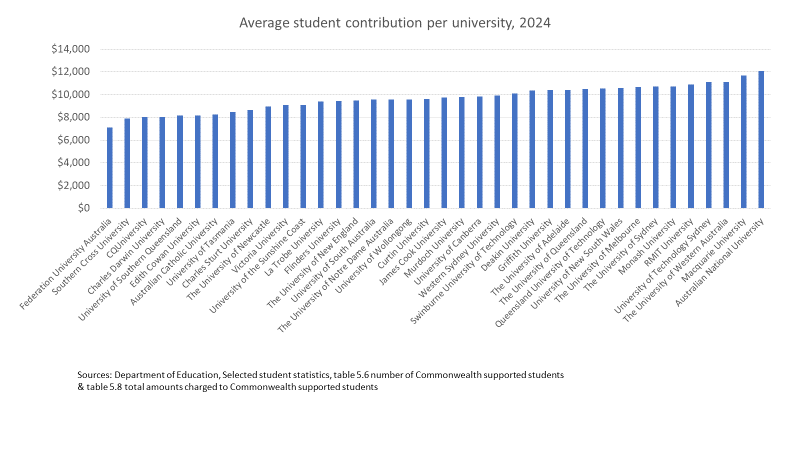
Under Job-ready Graduates universities with high average student contributions – that is, with enrolments skewed to arts, business and law – earn more for over-enrolments than universities with low average student contributions, with enrolments skewed to teaching and nursing.
Under the legislation this will still be true up to the various caps, but for universities that go over their relevant cap the downside is a larger fine per student.
Based on 2024 average student contributions, if Federation University was a thousand places over the relevant cap it would be fined $7.1 million. But if the ANU was a thousand places over it would be fined $12.1 million.
Taking the students’ money
Technically, the fine for exceeding a cap will come out of a university’s Commonwealth Grant Scheme amount. But in practice it confiscates money paid or borrowed by students and reduces the quality of education that an over-enrolled university can afford to provide.
The students are being ripped off.
Over-enrolment and Commonwealth contribution funding
Conceptually, the new and old systems are the same in limiting Commonwealth contribution payments – no money for over-enrolments.
But because the current system allocates in dollars and the new system allocates in places the way over-enrolments are handled will change.
In this case, there are no convoluted calculations of over-enrolment but there are separate calculations for non-designated and designated higher education courses.
The non-designated courses allocation is calculated as the domestic student profile (that is core student load + additional growth allocation) for higher education courses minus designated places: new section 33-5(4).
If the number of non-designated places delivered is equal to or less than the domestic student profile then the payment is the places in each funding cluster multiplied by the relevant Commonwealth contribution: new section 33-5(2).
If the number of non-designated places delivered exceeds the number calculated under section 33-5(4) then an average funding cluster amount needs to be calculated. To get this figure, all the non-designated places delivered are valued according to the same formula as in section 33-5(4) and then divided by the number of student places delivered: new section 33-15.
The average cluster funding rate is then multiplied by the allocated number of places: new section 33-5(3).
For designated places the process is similar except it drills down to the specific kind of course subject to designation rather than grouping them all together: new section 33-5(5). Say teaching, nursing and sub-bachelor courses were all designated at 1,000 places each. The university delivers 900 teaching places, 1,050 nursing places, and 1,050 sub-bachelor places.
While the university is on target for designated places as a whole, 3,000 places, it will not be paid anything for the missing 100 teaching places. For nursing and sub-bachelor places the university won’t be paid for the additional 50 places in each case. The current system allows pooling of designated places for funding purposes, so the new system is less favourable for universities in the event of over-enrolment in sub-categories.
If all nursing student subjects are in the nursing funding cluster the university will be paid the Commonwealth contribution for nursing multiplied by 1000. For sub-bachelor courses the payment will also be for 1000 places only, but likely to be from multiple funding clusters. The payment per place will be the usual average funding cluster rate. This will be multiplied by 1000 to get the total payment: new section 33-5(7).
Although there is a Commonwealth contribution penalty for exceeding a designated course sub-category allocation there is no automatic student contribution penalty. If the total number of delivered higher education courses CSPs (designated + non-designated) remains within whatever buffer applies to the university that year student contribution revenue can be received for over-enrolled designated places.
Capped demand driven funding places
As noted in the first post in this series, the minister can cap the number of demand driven places, creating a ‘demand driven courses profile’.
This stops a university being paid Commonwealth contributions for enrolments in demand driven courses that exceed the profile.
Restrictions on over-enrolments apply only to ‘higher education courses’, and so over-enrolments of capped demand driven courses still result in student contributions going to the university. This preserves an element of the demand driven idea.
Transitioning out of demand driven funding
The ministerial discretion to create new demand driven funding categories (new section 30-60(3)) also creates a discretion to reverse that decision: section 33(3) Acts Interpretation Act 1901.
Without corresponding adjustments to domestic student profiles that could leave universities significantly over-enrolled on the statutory definition.
While hopefully the government/ATEC would exercise common sense if this situation arose it would be better to put the transition arrangements in the legislation.
Capped medical courses
There is no restriction on universities receiving student contributions for medical student places delivered above the ‘medical courses profile’.
Historically, medical student places have been limited by designation and a funding agreement requirement that annual completions do not exceed a specified level.
The later restraint means a major over-enrolment is unlikely and there is no need for a separate cap.
The strategic logic of managing CSP student load
Under the proposed system, there is no financial incentive to over-enrol CSPs beyond the caps. These students will generate costs without any offsetting revenues. There is also a political cost in defying the government’s wishes in a system with high levels of administrative discretion.
But the proposed system is also tougher on under-enrolments. As described in the previous post, under-enrolment automatically flows through to a lower ‘core student load’ two years later; so under-enrolment in 2027 would lead to a lower core student load in 2029 (although it can be topped up with new places).
It is not in this bill, but the government has previously announced a funding floor, in the event of under-enrolment, of 97.5% of the previous year’s grant amount. That’s much less generous than the former Higher Education Continuity Guarantee, which provided 100% of the current year’s MBGA.
The logic of the system, therefore, seems to be to aim for EFTSL somewhere in the middle of whatever over-enrolment buffer zone is relevant, leaving small amounts of room for final student load being slightly lower or higher than anticipated.
For many universities, however, such precise targeting is difficult to achieve. There are too many variables in offer acceptance rates, the share of acceptances making it past the first census date, retention levels after year 1, and divisions between part- and full-time study.
While the over-enrolment caps are intended to protect universities with less reliable enrolment shares, they are also likely to be its principal victims, because they serve students whose enrolment behaviour is harder to predict.


Hi Andrew,
I am stuck on the part of this under your heading “Taking the students’ money” – it seems like there should be more of an uproar over it. Although it will be hidden in a convoluted process of post-hoc reconciliation, in spirit and effect the students will be paying the Commonwealth for… nothing. Or more likely, the Commonwealth will make a loan to the student, who will pay that money back to the Commonwealth, with interest(indexation). The education provider, meanwhile, will provide that education to the student for free. I don’t remember hearing anything from the NUS or other witnesses at the inquiry on this – am I being naive in thinking it’s a significant flaw?
Thanks,
Russell Tassicker
LikeLike
Yes, it is surprising that this did not get more attention from student groups at least. That said, I think the lost student places and opportunities are the bigger problem with the bill.
LikeLiked by 1 person
[…] bill’s limits on student contribution-only over-enrolments are one of its most controversial elements. To recap, universities with fewer than 15,000 students […]
LikeLike