At the AFR higher education conference this week Jason Clare was open to amending his capping student places bill. He subsequently inserted amendments on ministerial conditions and floor numbers of places for public universities.
But the minister remains in denial about the consequences of capping over-enrolments at a low level, to prevent what he calls ‘hunger games’ competition between universities. For universities allocated less than 15,000 Commonwealth supported places the cap is 5% of their total. For larger universities the cap is 750 places, equivalent to 2-3% of their allocation. Above these levels CSPs will be zero-funded, compared to student contribution only funding under the current system.
In response to a journalist’s question about this issue the minister said that ‘if you think that a kid from the western suburbs [of Sydney] is going to design something that makes it harder for kids from the western suburbs to get a chance to go to university, then you’re wrong. This is about doing the opposite.’
But on the available data Sydney is the place where his over-enrolment policy puts higher education opportunities at greatest risk.
ATEC seems to be engaging in bureaucratic manoeuvres to avert this outcome, but as transitional measures in the bill lapse that task will become more difficult.
Sydney over-enrolment
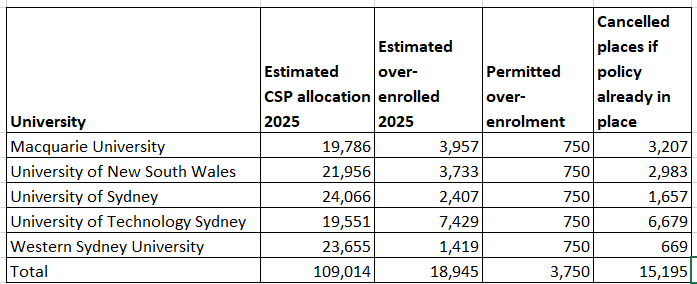
Based on 2025 estimates produced by ATEC (not published but in an appendix to my Senate inquiry submission), Sydney was the only multi-university city where every institution was over-enrolled. In the table below I have added to ATEC’s figures the over-enrolment caps proposed by the government. These caps would not be imposed immediately – more on this below – but if they had been in place for 2025 it would have been disastrous for aspiring Sydney students. It would have cost more than 15,000 places, the equivalent of shutting down a medium size public university (the Sydney universities are all big).
At a national level ACU and Notre Dame, which both have Sydney campuses, had some regulated capacity to take more students. The University of Wollongong also serves parts of Sydney, but it was already over-enrolled in 2025.
What is ATEC doing about this?
ATEC wants to create more fully-funded CSPs rather than abolish existing places. At the AFR conference the minister mentioned converting 20,000 over-enrolled places to fully-funded places. To do this, as I argued last week, ATEC has one accounting trick, holding back 2026 funding to allocate in 2027, and two sources of additional fully-funded places. These are transferring places from universities that cannot use them and JRG funding increases already in the forward estimates. Despite the minister’s promise to provide extra funding over the next decade, there is no new money in the forward estimates and nothing in this bill changes that.
But with ATEC estimating 2026 over-enrolments at 60,000 CSPs, compared with national over-enrolment capacity of about 22,500 under the new system, these 20,000 CSP conversions would still leave the system either reliant on over-enrolments or significantly smaller than it was in 2026.
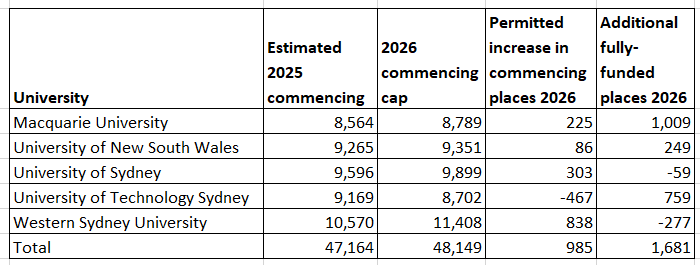
ATEC is devising workarounds to minimise the negative consequences of the poorly thought through policy on over-enrolments. While the commencing student caps for 2026 were an egregious misuse of power, the actual caps as revealed from a Senate estimates question on notice were not the major attack on over-enrolments that I feared. Only three universities were required to reduce places, and the maximum number of commencing places was nearly 5% higher than in 2025.
In the Sydney market, only UTS commencing places were cut (table below). UTS, Macquarie and UNSW all received a share of the $50 million in extra Commonwealth Grant Scheme funding to convert over-enrolled places to fully-funded places. USYD and WSU were allowed to increase their commencing CSPs despite real cuts to their CGS grants when they were already over-enrolled. For 2026 ATEC was encouraging over-enrolment at some universities.
If the capping bill passes, there will be complex transitional provisions for currently over-enrolled universities. These don’t require ATEC to set any precise deadline for universities to be within their over-enrolment cap. It can set university-level ‘transitional commencing places limits’ that, like the USYD and WSU allocations for 2026, effectively prolong over-enrolment.
What’s happening in the Sydney market?
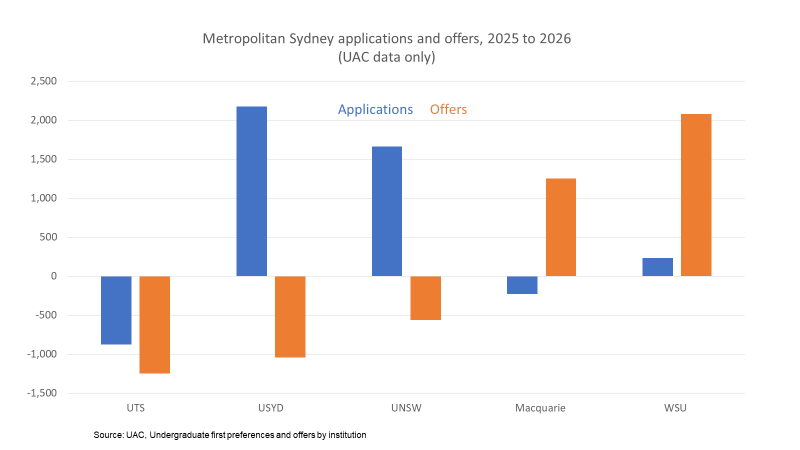
Looking at UAC data, which does not include direct applications, demand for a university place in Sydney for 2026 increased by just under 3,000 applications on 2025 levels, as against an allocation of commencing CSPs that was up by just under 1,000. Not all applications result in offers even with demand driven funding, but the mismatch between these numbers immediately looks unfavourable for prospective students. Total UAC offers went up by 477 in 2026 compared to 2025.
Based on the 2026 commencing student caps ATEC wants to steer places to WSU. But managing students is much harder for ATEC than managing universities. WSU had a small increase in demand for 2026 compared to 2025, but most of the growth in applications went to USYD and UNSW. Despite increased demand, these two universities cut their offers, a conservative approach reducing their future exposure to zero-funded places. UTS also cut offers, reflecting both reduced commencing places and soft demand. Only WSU and Macquarie increased offers.
Enrolment patterns
On current publishing schedules, unfortunately, we are still more than a year away from getting 2026 enrolment data. As a more timely proxy measure of enrolment trends I use student contribution revenue data. This is not perfect, since movements in these dollar amounts can reflect different mixes of high and low student contributions as well as changes in underlying places.
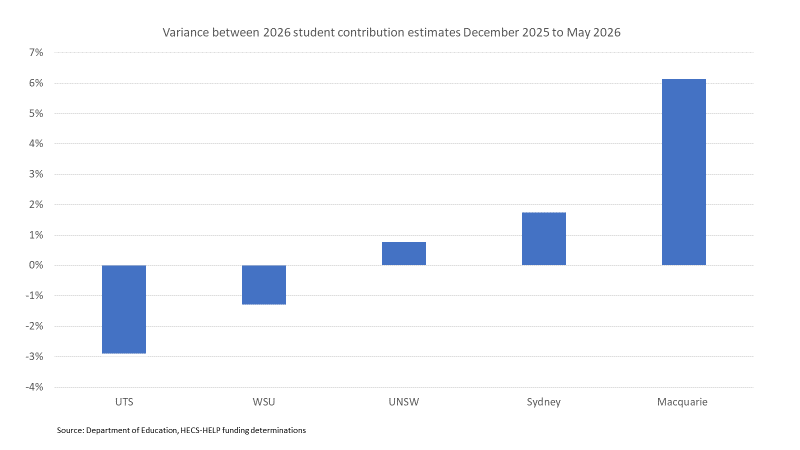
With this caveat, the chart below shows changes in estimated student contribution revenue. It compares figures from late 2025 for calendar 2026, presumably informed by ATEC allocations, with revised figures from May 2026, after the first semester census dates.
As noted, UTS had to cut commencing places and so it reduced offers. Its reduction in student contribution revenue suggests a larger over-enrolment correction than planned.
Despite their reduced offers compared to 2025, UNSW and USYD may have ended up with higher EFTSL than they planned. Macquarie has a substantial spike in student contribution revenue, so large that it almost certainly reflects a non-trivial increase in EFTSL above its planned level. As Macquarie applications were down, higher application rejection rates at USYD and UNSW probably flowed through to lower-preference Macquarie courses.
WSU had a small increase in demand compared to 2025 and significantly increased offers. Its student contribution revenue however is down on original expectations. But it is 8% up on student contribution revenue estimates for the 2025 year, indicating overall enrolment growth even if not at the scale previously expected.
A trial run of the new system
The experience of Sydney universities in 2026 shows difficult it can be to hit precise numbers. I suspect USYD and UNSW were caught by higher acceptances than they expected. Macquarie possibly under-estimated how strongly USYD, UNSW and perhaps UTS demand would flow through to them. Despite its apparent increase in enrolments, Macquarie told the SMH that it had turned domestic students away due to the caps.
It is easy to imagine a scenario in which universities were much more conservative with offers than they were in 2026. For this year universities knew that ATEC had no legal basis for its caps. They might have inferred from the commencing caps allocated that ATEC knew it needed to protect the minister from himself on the over-enrolment issue.
But if the bill passes this flexibility will decline over time as ‘transition’ arrangements come to an end, and the 750 places/5% over-enrolment caps will have real force. Combine this with a tight federal Budget and no new CSPs and we will have an unmet demand crisis.
The Senate should remove the over-enrolment cap. At minimum, it must increase caps to a level that gives both individual universities and the system flexibility to respond to changes in demand. Anything else puts future university applicants at a completely unnecessary risk of missing out. It will also make the government’s own tertiary education attainment targets unachievable.

