Yesterday the Australian Tertiary Education Commission issued an interim statement of strategic priorities. This statement will guide university mission based compacts for 2027. This post covers the legal status of the statement, its apparent approach to management of the sector via compacts, and what it proposes in the areas of skills, First Nations, equity, teaching quality, VET-higher education relations, and research.
Decision-making under the ATEC system
When fully operational the ATEC decision-making process will operate in the sequence shown in the chart below.
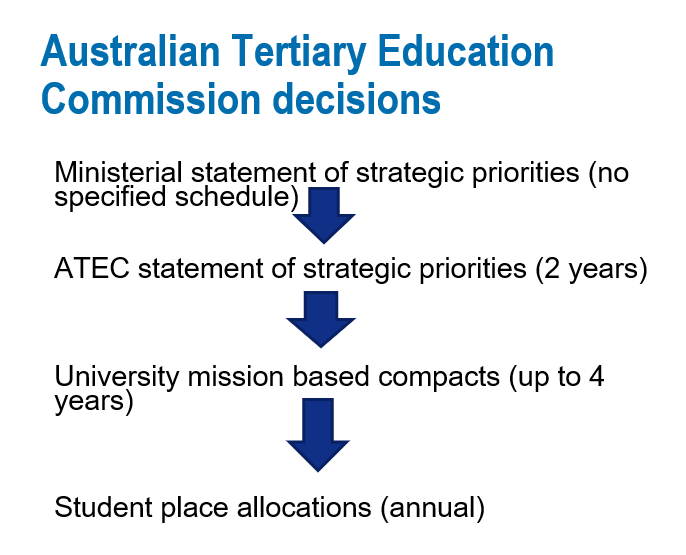
Despite the ATEC Act 2026 officially coming into force on 29 April 2026, ATEC’s interim statement seems to be operating in the legal limbo the organisation has been in since being established as the ‘interim ATEC’ in July 2025.
The minister’s statement
In the preface to its interim statement of strategic priorities ATEC says it received a ‘letter of expectations’ from the education minister, Jason Clare, on 4 March 2026. As I noted in my analysis of the ATEC bill, the minister has persistently referred to his role in issuing a statement of expectations to ATEC. But the ATEC legislation gives him a power to issue statements of short- and long-term strategic ‘priorities’ rather than expectations. Perhaps in practice this distinction won’t matter, but I think the words have different implications. ‘Priorities’ imply things to focus on, while ‘expectations’ imply specific results that should be achieved.
The minister’s statement is supposed to be published on ATEC’s website within four weeks of its receipt: section 15(3) of the ATEC Act 2026. As far as I can see this has not happened. Arguably as a statement of expectations rather than priorities made before the Act’s commencement the section 15(3) rule does not apply. Still, as a significant exercise of ministerial power we should know what is in the letter. I will leave it a week and if it does not appear file a Freedom of Information request [update: no need, it is available].
Status of ATEC’s interim statement
ATEC’s interim statement of strategic priorities, which in future will be required in a non-interim form by section 43 of the ATEC Act 2026, is similarly not the real thing. ATEC’s ‘statutory’ statement of strategic priorities is still to come because it has not yet complied with all the consultation requirements, including inviting public submissions: section 43(3).
It will be interesting to see what changes will occur between the interim and ‘statutory’ statements of strategic priorities. My suspicion is that priority setting is a top-down process with ‘consultation’ just about the implementation detail, which is how consultation processes typically work when the government has already signalled its policy intent – as the government has in its responses to the Accord final report and will in the ‘statutory’ ministerial statements of priorities/expectations.
The statutory statement must be on ATEC’s website by 1 January 2027: section 44(5).
Skills and workforce
One of ATEC’s legislated objects is ensuring that ‘the higher education system has the capacity and capability required to meet Australia’s current and future student, skills and workforce demand’: section 3(c).
The interim statement does not drill down to the details of occupations or skills but lists these priority industries/areas:
- health, aged care and disability support
- education, including early childhood education and care
- sovereign capability and food security, including advanced manufacturing and critical minerals
- digital and technology
- housing and construction
- climate change and Net Zero transformation
The interim statement says that ‘where applicable, providers should consider national skills and workforce priorities as part of their mission based compacts and requests for additional growth in 2027’. The statement specifically mentions the VET-focused National Skills Plan and possible ‘complementary responses’ to it in higher education. Perhaps there is an implied reference to skills shortages. Also, ‘providers should consider relevant state and territory skills priorities as part of their mission based compacts and requests for additional growth in 2027.’
I’m not entirely sure how to read the ‘where applicable’, perhaps this just recognises that universities won’t necessarily have many courses that complement VET skills needs. Maybe providers should map their existing courses against the priority areas and skills. Presumably universities will need to link requests for additional student places to these areas.
The interim statement includes an appendix of state and territory priorities. While sometimes using different terminology these overlap with ATEC’s list but are not identical. South Australia and Western Australia both specifically mention defence, these two and the Northern Territory also mention ‘energy’, while ATEC seems concerned only with clean energy (‘Net Zero transformation’).
Arts academics and students might have assumed that the government, with its highly utilitarian approach to policy and its refusal to reduce high arts students contributions, was content to let arts education just wither away. The interim statement, however, says that the ‘humanities, social sciences and the arts will continue to play an important role in shaping ethical judgement, critical thinking and social understanding.’
But this sentence fragment is prefaced with ‘as the influence of AI continues to expand…’. So the value of an arts education is as a complement to managing technological change rather than as something of value in itself. The broader purposes of higher education are beyond the intellectual horizon of today’s policymakers.
First Nations
According to the interim statement, universities will be ‘expected to demonstrate sustained improvement in First Nations outcomes, supported by evidence of genuine First Nations leadership and self-determination by institutional governance, and within strategic planning, resource allocation and delivery.’
While such actions seem common across the sector, this is the kind of statement that concerns me about ATEC’s approach. They are not just saying improve outcomes on a specified measure, but improve these outcomes through specified methods. This is management more than regulation or incentive setting, the two main historical methods of steering the system. It undermines university autonomy and bypasses the Parliament.
Equity
Similarly in equity ATEC’s approach is not just that universities should improve equity group participation and success rates but ‘expand outreach, strengthen alternative and community-based pathways, collaborate and share best practice, and continue a focus on their preparatory programs.’
Quality teaching
In a section on improving the quality of teaching the interim statement mentions the importance of generic skills and says that over-reliance on casual and fixed-term teaching staff ‘poses risks for the quality of teaching and student experience’. I can see the potential reasons, but it is also true that long-term improvement in the old Course Experience Questionnaire coincided with the casualisation of the teaching workforce, while the more recent trend towards reduced casualisation and more teaching-focused academic positions coincided with a flatlining in Student Experience Survey results (ignoring the COVID dip).
But this interim statement content seems like signalling, with 2027 compact content more restricted. ‘In developing their mission based compacts, providers are expected to be working towards improving the professional recognition of quality teaching within their institutions.’
VET-higher education links
This section has background about work ATEC is already doing a national credit recognition framework for students moving between the vocational and higher education sectors.
For the compacts ‘maximising credit recognition for students will be a key focus for mission based compacts where it is consistent with provider missions’.
Research
The research section of the interim statement references the broader priority setting system for research but does not mention any plan to carry this through to universities.
Instead it says ‘research training, particularly for domestic students, is an area of interest for the ATEC. Through mission based compacts, the ATEC will seek to understand providers’ experience with building their postgraduate research cohorts and increasing Australia’s research training capacity.’
2024 was the first year that international research commencements outnumbered domestic research commencements. I think it will be hard to increase domestic commencements while scholarship stipends remain low. Thanks to Senate amendments to the ATEC bill, ATEC can now advise the minister on this issue.
International education
The ATEC Act 2026 already gives ATEC the power to cap international student commencements by provider ‘at the direction of the minister’: section 11(h). However it does not have a clear enforcement power.
The interim statement’s preface says that ‘subject to decisions of Government and the passage of legislation, future SSPs and compacts may incorporate additional priorities and performance domains, such as international education.’
This is a likely area of tension with the states. For nearly three years now the federal government has been trying to reduce the number of international students. It will try again to legislate enforceable university-level caps.
Victoria’s priorities nod to the scale issue – wanting ‘sustainable’ growth in international education – but it wants to retain ‘Victoria’s position as a leading jurisdiction for international students.’ Western Australia lists international education as one of its nine priority industries. South Australia is ‘committed to international education for attracting talent and contributing to a graduate workforce, creating global linkages, and delivering economic benefits for the state.’ The Northern Territory government ‘views higher education as a vital trade export and a mechanism to address skilled workforce shortages.’
No prizes for correctly guessing which government’s perspective will prevail in the event of competing priorities.
 Andrew Norton