What do Australian governments owe international students?

Gaby Ramia, a University of Sydney academic, has long written about international student issues, including their security and well-being. His latest book, International student policy in Australia: The welfare dimension, accuses successive governments of ‘policy inaction’ on international student welfare.

The book opens with what became an infamous statement by then Prime Minister Scott Morrison. When asked, in the early stages of the COVID-19 pandemic, about the plight of JobKeeper-ineligible international students, Morrison responded that ‘these [student] visas and those who are in Australia under various visa arrangements, they’re obviously not held here compulsorily. If they’re not in a position to be able to support themselves, then there is the alternative for them to return to their home countries.’

A transactional relationship between Australia and international students

As Ramia’s book shows, in itself the prime minister’s statement was unsurprising. While Australia has longstanding consumer protection policies for international students, it has not offered general welfare-state type benefits. International students self-insure against the adversities that welfare states cover. As a visa condition they are supposed to arrive with savings. They are required to take out private health insurance. Education providers must provide information about welfare and other services, but are not obliged to deliver them.

Over the last quarter century the government has, to extents that vary over time, also encouraged international students to meet Australia’s labour market needs. But there was never any intention that the government fund international student related services. The government offered an Australian education and access to Australia’s labour market, not Australian welfare state support.

Ramia, by contrast, thinks that the government should take more responsibility for the welfare of international students. This should start with public transport concessions where these are not already offered and access to Medicare.

Ramia’s book was completed before the government changed its mind on international students, and started trying to cut their numbers. That policy turn creates new issues about the relationship between the government and international students.

Read More »
Temporary graduate visas – trends in applications, grants and populations

As part of its international student policy announcement, the Coalition promised a ‘rapid review into the Temporary Graduate Visas (subclass 485)’. The review would ‘address the misuse of post-study work arrangements as a way to gain access to the Australian labour market and as a pathway to permanent migration.’

While recent polls suggest the Coalition will not form government, net overseas migration will remain an important political issue. It is worth understanding trends in major migration categories such as the 485 visa.

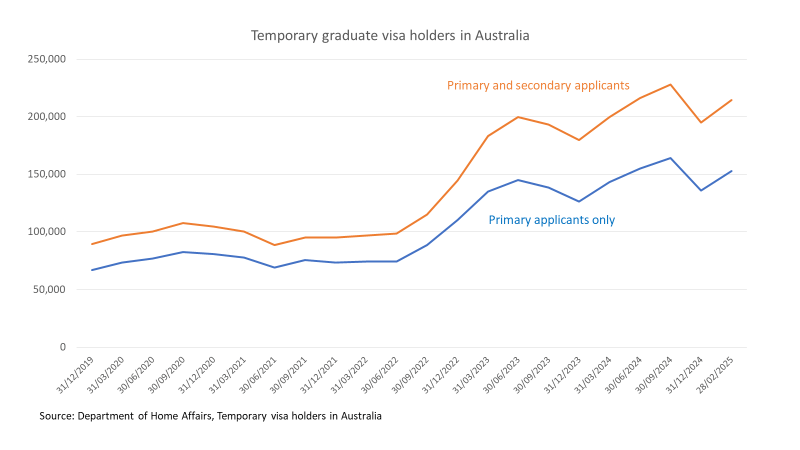
This post summarises the available 485 visa data. A key point is that although applications for new 485 visas in 2024-25 to date are lower than in previous years, in the coming years there is the potential for significant increases in total 485 visa holder numbers.

Purpose of the 485 temporary graduate visa

Today’s temporary graduate visa is descended from an early 2010s policy that was designed to make Australia more competitive in the international education market. It does this by letting former international students access the labour market, so doing this is not ‘misuse’ according to the policy’s intent. The pathway element is more contentious. The 485 visa can be a pathway to permanent residence but it offers no guarantees. Government and student expectations proably differ on this matter.

In any case, as the numbers reported below show, there is no way all 485 visa holders in Australia in early 2025 could transition to a permanent migration program of 185,000 people for 2024-25.

Trends in the number of temporary graduate visa holders

The Department of Home Affairs does not publish how many people hold a 485 visa. The closest we get to a stock figure is a monthly count of temporary migrants in Australia. As at 28 February 2025, 214,714 people were in Australia on 485 visas. This was about 14,000 down on the 30 September 2024 peak. The monthly in-country totals undercount visa holders as some are temporarily overseas.

Since 2022 the primary visa holder share of the total – that is, the former student with the relevant qualification – has decreased from 75-80% of the total to 70-72%. There has been greater growth in secondary visa holders, the partners and children of primary visa holders.

Country of origin of 485 visa holders

Read More »

The Coalition’s plan to reduce international student numbers – some first thoughts

As rumoured in recent months, the Coalition has decided, if it wins office on 3 May, to cap commencing international student enrolments at a percentage of all commencing enrolments. The precise number is yet to be settled, but is expected to be around 25% and will only apply to public universities.

Student experience as well as migration concerns

A key conceptual difference with the government’s policy is that the Coalition wants to improve the domestic student experience as well as take pressure off accommodation markets. That’s why they chose a % of enrolments rather than, as under Labor, formulas driven by past enrolment patterns – although Labor did include a penalty for institutions with high concentrations of international students.

So far as I know, no careful research examines whether high concentrations of international students adversely affect domestic students in measurable ways. There are many anecdotal complaints, especially around group assignments. Is it a coincidence that computing, engineering and business courses, which have high concentrations of international students, have relatively low student satisfaction (chart below)?

Perhaps international students have nothing to do with it. Long ago, looking at the old CEQ results, I observed that students in vocational courses seem less satisfied than other students. Speculatively they have more instrumental motivations, and so enjoy study less. They study in fields where universities compete with industry and the professions for staff. Academic salaries might not attract the best possible teachers.

Questions about the domestic student experience are at least worth asking and answering as best we can. Universities are too conflicted to do it or release the results if they do. It’s another argument for making higher education data available to researchers inside and outside the academy (e61 is doing a great job on this kind of research).

Read More »

Mapping Australian higher education 2023 – data update March 2025

Update 20/12/2025: More recent data here.

—————————————————————————————————

I won’t have the capacity to produce another edition of my Mapping Australian higher education report in the foreseeable future, but I am extending the life of the October 2023 edition by updating the data behind the charts.

Mapping‘s chart data is the only publicly-available source of long-term time series data on many higher education topics, especially on financial matters.

I had been waiting on the 2023 university finances report before releasing another chart data update. That finally happened yesterday. Despite a record 27 universities reporting deficits, in the aggregate there was a small surplus, after a loss overall in 2022.

2023 had some weak numbers for the two main Commonwealth student programs, the Commonwealth Grant Scheme and HELP. Several factors were behind this: temporary COVID places coming out of the system, Job-ready Graduates reductions in total funding rates for some courses, and weak domestic demand. These programs trended up in 2024 and 2025, as seen in the chart below, although high CPI-driven indexation was a significant factor.

The updated chart data is available here.

Student visa applications withdrawn

The Department of Home Affairs does not routinely report statistics on withdrawn student visa applications. At my request, they supplied me with student visa applications withdrawn data for 2019, 2023 and 2024. 2019 is my pre-COVID, pre-migration policy change, comparison year.

As I expected, with a stable market and policy framework the proportion of visa applications that are withdrawn is quite low – equivalent to around 1% of applications lodged in 2019. I don’t know of any research into these withdrawn applicants, but perhaps their circumstances changed or they received a better offer from another country.

My hypothesis in making my data request was that the period of rapid change in international education policy from the later months of 2023 created new incentives to withdraw student visa applications.

Read More »

Are the government’s policies working to reduce international student numbers? Part 2, student visas granted

A previous post looked at demand from international students, as measured by student visa applications. By July 2024 all student deterrent policies announced to date were in place, so the last six months of 2024 could be used to assess initial policy impact.

That analysis found that demand for vocational education declined significantly, whether compared to 2023 or the more normal pre-COVID year of 2019. For higher education, demand was down on 2023. Compared to 2019, higher education demand in 2024 from migration-sensitive countries like India or Pakistan was well down, but demand from other important source countries increased or decreased only slightly.

Visa applications of course must be assessed by the Department of Home Affairs. Visas granted depend on visa processing levels and visa grant rates.

The visa grant analysis below is broadly consistent the first post’s applications analysis. Visa applications and grants in 2024 were both down on 2023. However, 2024 visa applications were up on 2019 but visa grants were down, reflecting fewer applications being processed and lower approval rates.

For both visa applications and grants vocational education has been hit hard. Higher education is more resilient overall, with visa applications and grants both up on 2019.

Due to unprocessed applications and unresolved appeals against visa application rejections, not all 2024 applications have been finalised. These could result in 2025 visa grants that exceed expectations created by recent application levels.

Less clear links between cause and effect

Drawing straightish lines between policy changes and policy consequences is harder for visa grants than applications. Delays between visa applications and processing complicate the analysis. By mid-2024 Home Affairs had a huge backlog – over 113,000 unprocessed applications – including many received prior to 23 March 2024 when significant rule changes came into effect. Because some old rules apply to applications received before policy change dates, different criteria can be used in the same processing month.

Read More »

Are the government’s policies working to reduce international student numbers? Part 1, student demand

From late 2023 to July 2024 the federal government implemented at least nine policies to reduce international student numbers. With full 2024 student visa data released late last week this is a good time to assess how well (or how badly, depending on your point of view) these policies are going.

This post looks at the demand side, how many student visa applications have been lodged. A subsequent post will look at the supply side, visas granted.

The main findings are that the government’s policies have worked to substantially reduce demand for vocational education overall and from migration-sensitive countries in higher education, such as India and Pakistan. However 2024 Chinese higher education applications were down only slightly on 2023 and remain up on 2019. The impact on other traditional higher education source countries such as Malaysia, Singapore and Hong Kong was also muted (all slightly up or down).

Overall demand

As can be seen in the chart below, in 2024 the Department of Home Affairs received 429,691 student visa applications. This was down 20% on 2023, but still above 2019, the last full year before COVID migration restrictions distorted supply and demand.

Read More »

Mapping Australian higher education 2023 – October 2024 data update

Update 20/12/2025: More recent data here.

An updated version of Mapping Australian higher education is not on the horizon, but to extend the life of the 2023 version I have updated the data behind the charts and some tables. An Excel file with these and the two further updates mentioned below is here.

Further update 6/11/2024: The 2023 Student Experience Survey results have been released. Some question changes have broken the time series but the replacement question results are recorded.

Further update 12/11/2024: A careful reader has identified the missing higher education provider mentioned below and identified other errors in my institutes of higher education appendix. Hopefully the list is now correct and complete. This update also includes 2024 bachelor and above attainment data.

The original pdf with explanatory text is here.

Some noteworthy changes since its publication:

  • We now know that domestic enrolments fell in both 2022 and 2023; enrolments last declined in 2004 (figure 3)
  • International students – although no regular reader of this blog needs this pointed out – recovered strongly from the COVID period (figure 10)
  • The source country skew of international students means that a top 15 source country does not necessarily send a lot of students, but for the first time an African country made it to the list, Kenya with 6,538 students in 2023 (figure 11) (and 7,330 onshore YTD July in 2024).
  • Higher education student income support recipient numbers continued to fall, to 156,710 in mid-2023, the lowest figure since 2009 (figure 18). While since 2022 falling income support recipients is partly due to fewer students, except for a COVID spike the number has been in structural decline since 2017.
  • Staff numbers recovered strongly in 2023 to be roughly what they were in March 2020 (figure 19)
  • HELP repayments increased increased significantly, from $5.56 billion in respect of 2021-22 to $7.8 billion in respect of 2022-23 (figure 31B). Most of this was due to voluntary repayments increasing from $780 million to $2.9 billion, as debtors sought to evade high indexation (some of which will be refunded if the indexation reduction bill passes).
  • Short-term graduate full-time employment rates improved, in 2023 reaching the best level since 2009 (figure 40)
  • The number of higher education providers continued to increase, from 198 in mid-2023 to 211 in October 2024 (appendix A and appendix B).

The Department of Education’s failure to release the 2023 Finance or Student Experience Survey publications means that the update is not as full as I would like.

Visa processing and international student policy

Some universities and vocational education providers would prefer enrolment caps to ministerial direction 107, which consigned their offshore student visa applications to the end of the visa processing queue. 107 tells the Department of Home Affairs to give processing priority to applications for schools, postgraduate research, and higher education institutions with a low immigration risk rating.

The education minister has said that ministerial direction 107 will go if the caps bill passes.

While 107 should be repealed, as it unfairly penalises some student visa applicants and education providers, like Claire Field I think the sector over-rates the benefits that would follow. 107 is blamed for other things that happened around the same time that would not be affected if it went.

These other things include the resources Home Affairs allocates to student visa processing, changed practices in applying visa eligibility criteria, and new visa rules.

Student visa processing levels

From November 2022 to July 2023, Home Affairs put significant effort into clearing a student visa backlog. On my calculations, in those nine months they processed – counting both grants and rejections – 483,199 visa applications (primary visa holders only). That is 54% more than the equivalent number pre-COVID, between 2018 and 2019.

In the second half of 2023, shown in green in the chart below, monthly visa processing dropped back to levels that were similar to 2019. Ministerial direction 107 was announced in December 2023, but that was the fourth month of more normal pre-COVID visa processing volumes.

Read More »

Making the international student caps bill less bad

Today is the likely final day of public hearings for the international student caps bill, ahead of a report due on 8 October.

Despite the strong campaign against this bill the political reality is that the Opposition supports provider-level caps. This gives scope for a compromise that will see the bill pass in some form.

In my final submission to the Senate inquiry I focused on ways to make the bill less bad, while still letting the government and alternative government achieve their migration-related policy objectives.

Remove the course caps provision

80%+ of international students do not stay in Australia permanently. In this context, the government’s position that international students should be stopped from taking courses that don’t align with Australia’s skills needs borders on the absurd.

With over 25,000 courses registered on CRICOS regulating at the course level is also beyond the government’s administrative capacity. As Claire Field has been reporting, there are numerous errors in the much smaller task of imposing about 1,150 provider-level caps.

Read More »