I have a paper coming out soon, co-authored with Ren-Hao Xu, on the rise of Commonwealth supported places in postgraduate coursework degrees. It is another in our series on university decision-making under Job-ready Graduates. This post provides more general background on domestic postgraduate coursework trends.
Key points:
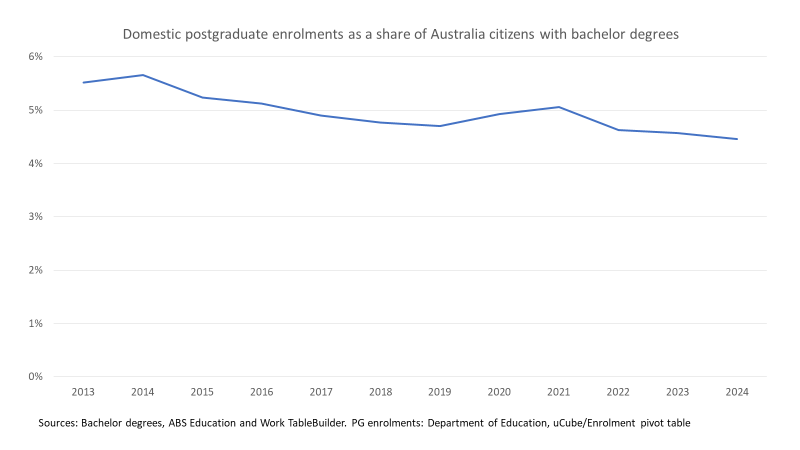
- Despite a return to headcount growth following a mid-to-late 2010s stall, domestic PG coursework enrolments are declining as a % of the main potential market, the bachelor-degree holding population.
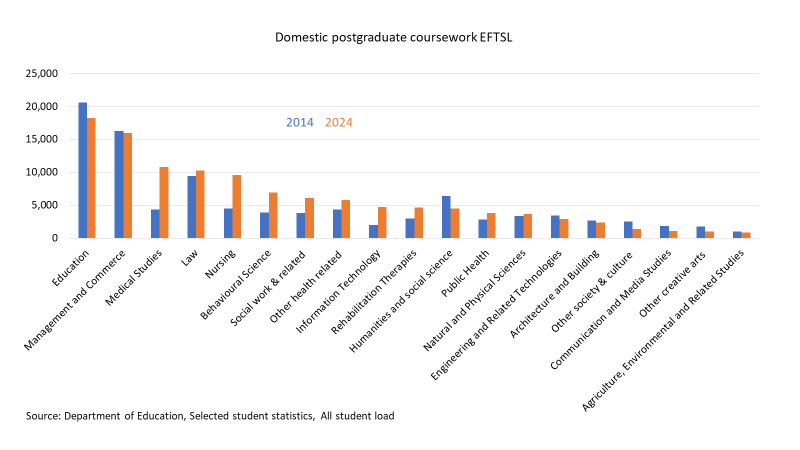
- On a full-time equivalent student basis the largest domestic PG coursework enrolments by field are in education, business and health. Growth over the last decade is concentrated in health, social work and IT.
- PG coursework had a 63.6% female enrolment share in 2024. The large health and education fields are highly feminised. The female enrolment share is increasing in most other broad fields of education.
- Two-step bachelor/masters entry to professional occupations is making the PG coursework population younger.
- More PG coursework is being delivered online, a likely cause of increased rates of part-time study.
- In line with 2020s enrolment trends, course completions are increasing. Many migrants also have postgraduate qualifications. As a result the postgraduate share of the workforce is increasing.
Why do students enrol in postgraduate coursework degrees?
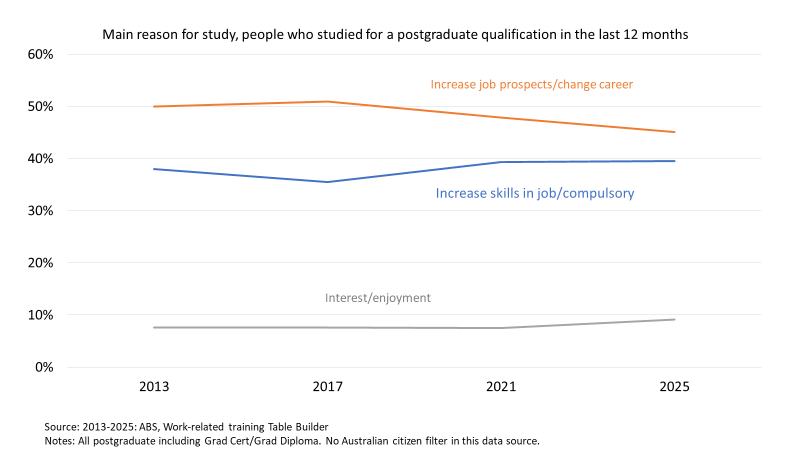
In the ABS work-related training survey students mainly give job-related reasons for taking a postgraduate coursework degree. Since 2017 more students take degrees for reasons relating to their current job, compared to seeking a career change or a better job.
Trends in overall domestic postgraduate enrolments
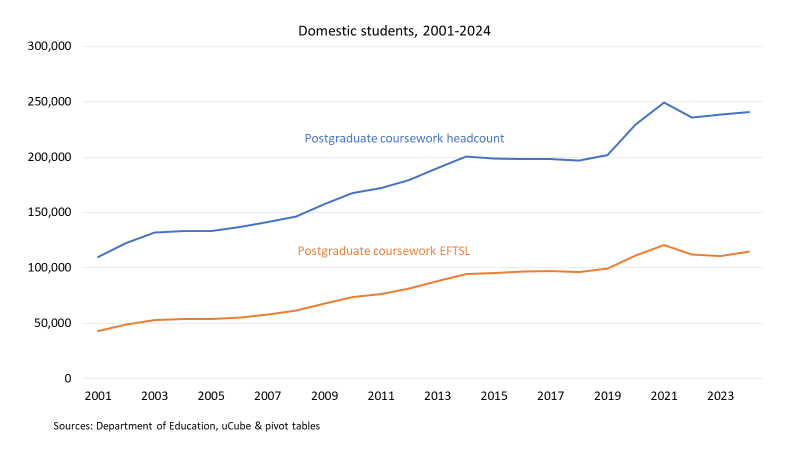
In the mid-to-late 2010s we saw a multi-year plateau in postgraduate coursework enrolments, at around 200,000. Then, in a likely example of higher education’s counter-cyclical relationship with the labour market, enrolments increased significantly in 2020 and 2021. As jobs returned enrolments eased off, but remained above 2019 levels.
While headcount enrolments are up over time, as a share of the main pool of potential students – people with bachelor degrees – the trend is down except for a COVID spike.
Domestic postgraduate EFTSL by field
To look at trends by discipline I switch to counting by EFTSL, which has more detailed data. In the 2014 to 2024 comparison below, education and business remain large enrolment fields despite declines over the decade. Health-related fields including behavioural science have grown significantly, as has IT and to a lesser extent social work.
Initial professional entry postgraduate courses
One factor supporting enrolment growth is initial professional entry postgraduate degrees, in a general way by the ‘Melbourne Model’ from the late 2000s and more specifically in teaching, law, and many health fields.
Trends in these postgraduate initial professional entry courses are not easily identifiable in the enrolment data, except for ‘special courses’ – teaching, nursing, medicine, dentistry, veterinary studies, clinical psychology and more recently aviation.
The standout PG coursework growth among these is medicine. In 2015, the earliest data I can find, 3,786 domestic students were enrolled in PG initial professional entry medical courses. That had more than doubled to 8,093 by 2024.
Nursing PG initial professional entry went from 602 to 1,036 domestic enrolments. That’s too few to explain the growth in PG coursework nursing EFTSL. Most additional nursing EFTSL supported skills enhancement rather than moving professional entry from undergraduate to postgraduate.
All the other ‘special course’ PG enrolments increased but by smaller percentages.
Student income support and initial professional entry
A policy by-product of the Melbourne Model was that masters courses leading to initial professional admission were made eligible for student income support. This should have made these masters courses more accessible.
Masters courses are approved individually for eligibility. At the end of 2025 919 masters courses were approved. This is less than the 955 courses approved as of late 2015 but more than the 633 approved as of late 2010.
Unfortunately student income support data is not published by qualification level.
Domestic postgraduate coursework enrolments age profile
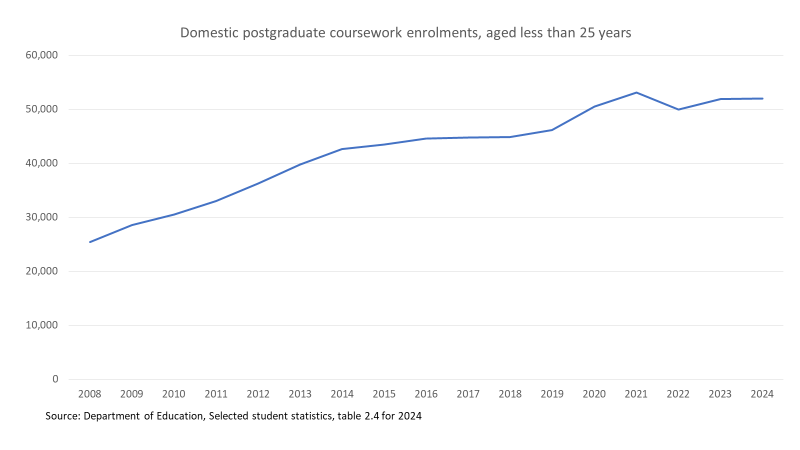
Less direct educational paths to professional occupations is one reason why the young postgraduate student population has increased, although they are currently off their peak. Under 25s were 17% of all domestic postgraduate coursework students in 2008, peaked at nearly 23% in 2018 and 2019, before settling into the 21-22% range since 2020.
This development creates financial risks for students and taxpayers, since young postgraduate students acquire more HELP debt before paying off their undergraduate debt. On finally starting full-time work they could be on a debt treadmill, owing so much that repayments do not cover indexation let alone reduce the debt.
Delivery method
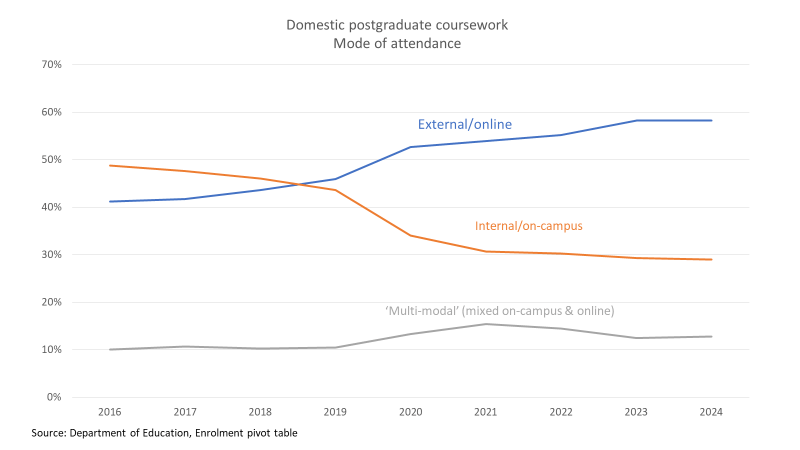
Domestic students overall have become more reluctant to turn up to campus, postgraduate coursework students even more so. In 2024 less than 30% were enrolled for on-campus education.
Part-time study
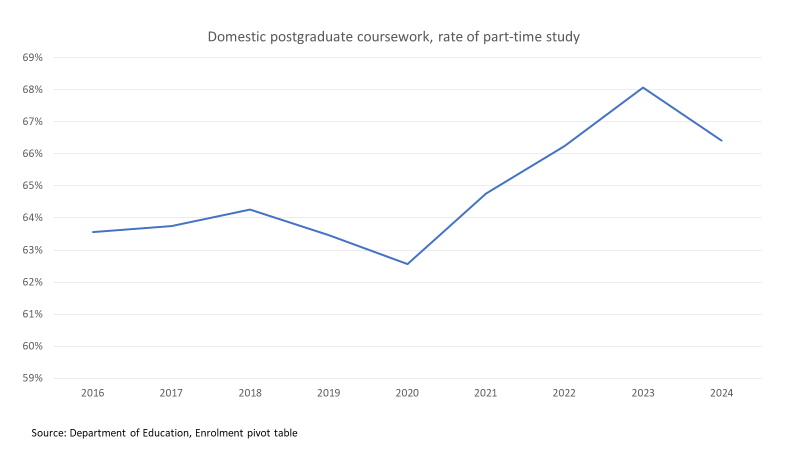
Consistent with a large share of postgraduates studying to increase skills in their current job part-time study is normal, at about two-thirds of enrolments. The increase in courses offered online probably contributed to this trend.
Gender
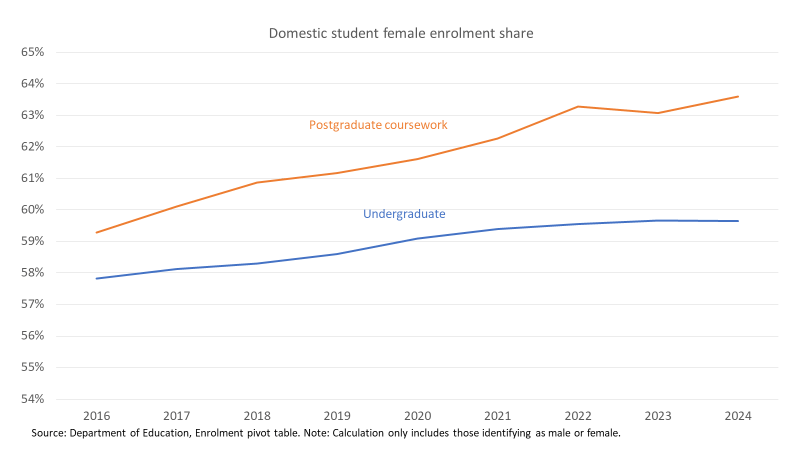
The higher education gender enrolment imbalance is more extreme in postgraduate coursework than in undergraduate courses, 63.6% female in 2024. Two big broad postgraduate fields, education and health, were each 74% female in 2024. Between 2021 and 2024 every broad field except architecture and building became more feminised.
Completions
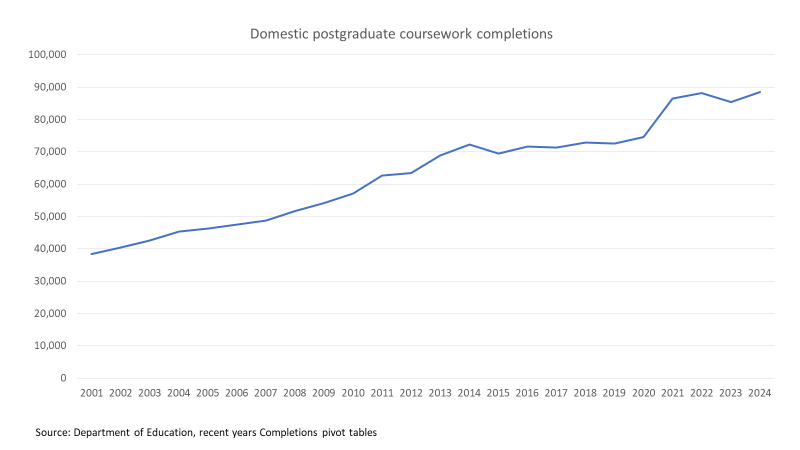
Unsurprisingly the postgraduate coursework completions figures broadly track enrolments, with the 2010s growth interruption and later return to increasing numbers.
Postgraduate population
According to ABS Education and Work, 2.5 million people had a postgraduate qualification in 2025. This number is influenced by migration. 22% of this group earned their qualification overseas. Another 11% qualified in Australia but are not citizens.
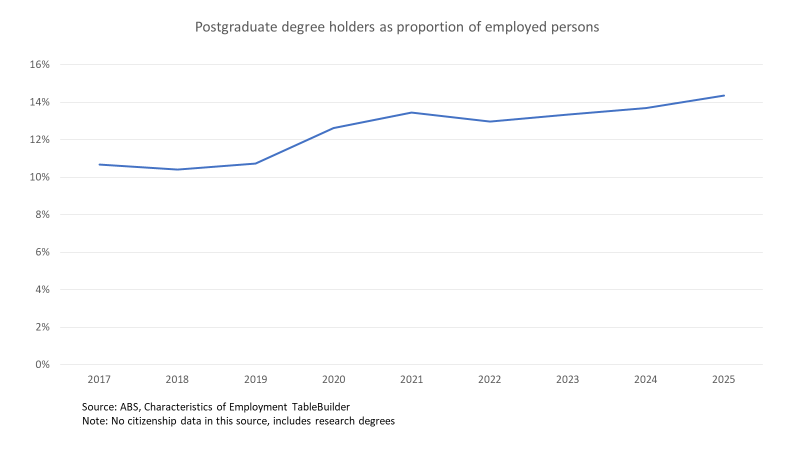
Migration and local completions have increased the share of employed persons with a postgraduate degree from 10-11% in the late 2010s to 14% in 2025.
END
 Andrew Norton