The government has released ‘implementation consultation’ papers on the Australian Tertiary Education Commission (ATEC) and how its system of managed growth in Commonwealth supported places would work. This post looks at some features of the ATEC paper. A subsequent post looks at how ATEC would distribute student places between universities.
ATEC legislation
ATEC would have its own legislation. A new funding act would replace the current Higher Education Support Act 2003. Its suggested name is the Higher Education Funding Act, the same name the funding legislation had between 1989 and 2004 (HESA 2003 started in 2005).
A performance metric for the government: keep the HEFA 2 legislation below the 592 pages of the latest HESA 2003. The original HESA 2003 was only 220 pages.
ATEC organisation and appointments
To save money, ATEC would be physically located in the Department of Education in Canberra. Many of its day one staff will presumably be current Department employees with a new email signature.
With a limited supply of people with higher education system knowledge – a significant short-to-medium term feasibility issue for ATEC – hiring current Department of Education staff neither can, nor should be, entirely avoided. On the other hand, the Department’s poor advice, with further examples in these consultation papers, is partly responsible for the often low quality higher education policymaking of recent years. Many higher education policy proposals and decisions coming from government show little understanding of their practical implications. The Department is largely responsible for the inadequate state of higher education data. A full transfer of staff from the Department to ATEC risks importing problems.
The consultation paper understates the expertise challenge facing ATEC. Its author(s) seem more worried about the ATEC Chief Commissioner, two Deputy Commissioners and First Nations Commissioner not being able to ‘demonstrate an ability to work in the national interest and retain sufficient distance from narrow, sectoral views’ than having the right mix of experience and skills. Tertiary education experience is seen as optional – the appointments can have expertise in the ‘tertiary, industry or government sectors’.
Proposals for a ‘national interest’ over a ‘sectional interest’ sound good. But the national interest is a highly contested concept (that’s why we have politics). And even when the goal is agreed, achieving it at least cost and with minimal unintended consequences typically requires deep subject-matter knowledge.
From the top down, ATEC hiring needs to be opened up to people with experience of the day-to-day running of higher education institutions. To ensure experienced people are hired the consultation paper’s stipulation that potential commissioners can ‘demonstrate their independence from the tertiary sector, for example by not having worked in a leadership position in the tertiary sector within a set number of years’ should be dropped. Any professional knows that they must do their current rather than previous job. Only concurrent appointments should be prohibited.
Relationship between the minister and ATEC
The minister would determine an ‘annual statement of expectations’ for ATEC.
The minister would have ‘statutory powers to direct the ATEC on particular matters’. I’m not exactly sure what ‘particular’ means here – only matters as specified in the ATEC legislation, or the particular details of ATEC decisions?
It would be good if the Senate could insert a provision similar to this one from the TEQSA Act 2011:
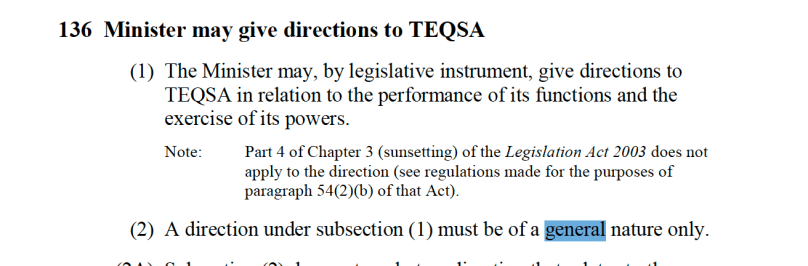
Once ATEC is established the practice of the minister/department deciding the micro-details of specific university actions should stop.
ATEC functions
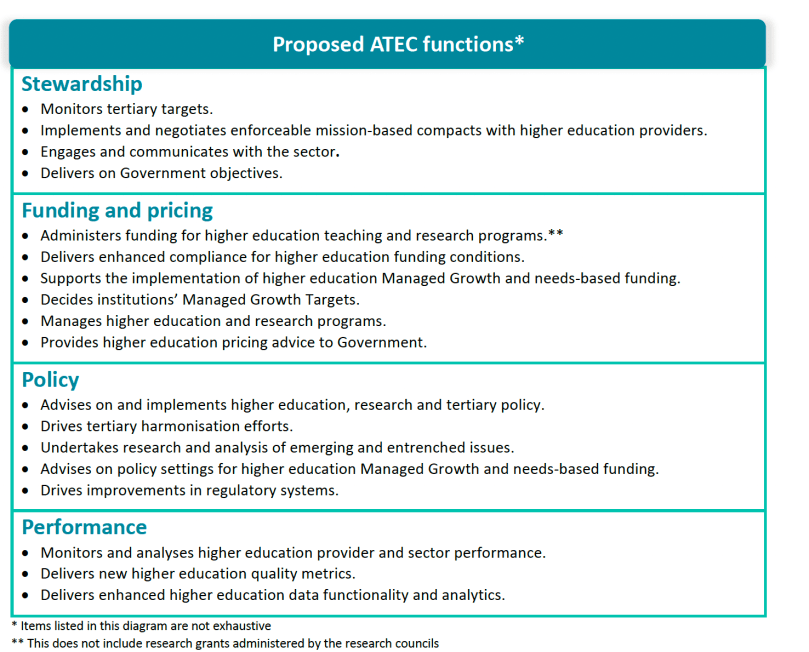
ATEC’s proposed functions are listed in the chart below. I like the data functions. But there is nothing in the consultation papers on the state of the TCSI data system. Unless it can deliver timely enrolment data ATEC as outlined is not feasibile.
In the next post I discuss the consultation paper on how student places will be distributed in the new system.
 Andrew Norton
Thanks Andrew
The state of HE staff data is very poor. Not sure if it is me wrongly interpreting data, poor data provision by universities or lack of understanding in the Department which results in not picking up obvious errors before posting. Do you know how much checking they do? Liz
LikeLike
I’m not sure of current practices re staff, but unis do get sent their enrolment data for checking. But the CGS and HELP implications of the enrolment data make it more important to get it right than is the case for staff data.
LikeLike
Thanx very much for this.
As I recall the chairs of the former Commonwealth Tertiary Education Commission and its constituent councils were expert in tertiary education, often by having senior experience in one of the sectors.
While some were concerned that chairs were too sympathetic to their sector of origin, I don’t recall this being more of a problem than one gets by appointing people with no experience of tertiary education. For example, a person from business, government or one of the professions would be equally vulnerable to criticism for being too sympathetic to their sector of origin.
LikeLike