More detail on international student caps

This week the government announced the overall international student cap for 2025, of 270,000 new commencing students, with some student types not counted towards the cap. I have a high-level summary in The Conversation. This post explores the capping announcement in more detail, noting additional problems with this deeply flawed policy.

The power – or lack thereof – to exempt particular types of students

On Tuesday the government announced three new exemption categories:

  • students who are part of “twinning” arrangements, taking some of their course offshore before coming to Australia
  • students with Australian government or “key partner” foreign government scholarships
  • students from the Pacific and Timor-Leste.

On my reading of the bill, the last two exemptions are not supported by its current wording and the twinning exemption is probably not within the bill’s existing scope.

Read More »
The underexplained and insecure Commonwealth Prac Payment

The planned Commonwealth Prac Payment aims to help students finance mandatory practical training, such as clinical training or teaching rounds. Initially teaching, nursing and midwifery, and social work students in higher education and VET will be eligible.

According to the government, the Prac payment will be means-tested and is ‘intended to support learning outcomes, where the financial impacts of placements may have otherwise influenced students to defer or withdraw from study‘ (emphasis added).

The payment will be matched to the single Austudy rate, $319.50 a week as of today.

The policy is due to start on 1 July 2025, with part of the legal framework in a bill introduced into the House of Representatives last week.

Bureaucratic and intrusive eligibility criteria

Read More »

How attractive will the FEE-FREE Uni Ready places be to universities?

Last week the government introduced legislation that would, among other things, create a new funding category for what we now call enabling courses, which will be redesigned and rebadged as FEE-FREE Uni Ready places. These courses help prepare students for higher education study.

The current system

Under the current system, Commonwealth supported enabling places are funded at the Commonwealth contribution rate for the relevant discipline.

Enabling places are not capped but the financial incentives to enrol enabling CSP students are weak because no student contribution can be charged.

An enabling loading is paid in lieu for universities with an allocation of enabling funding, but many universities have no enabling loading or a low amount.

The government does not seem to update the enabling loading in a public place, but indexing a previous rate I think it is $3,886 per EFTSL in 2024.

Job-ready Graduates affected the financing of enabling places in fields with Commonwealth contribution cuts. Nearly 40% of enabling places are in the lowest Commonwealth contribution field, $1,236 for 2024. That plus the enabling loading = $5,122 per place.

Read More »

Will the ‘Costello baby boom’ have a weaker demographic effect on higher education than expected?

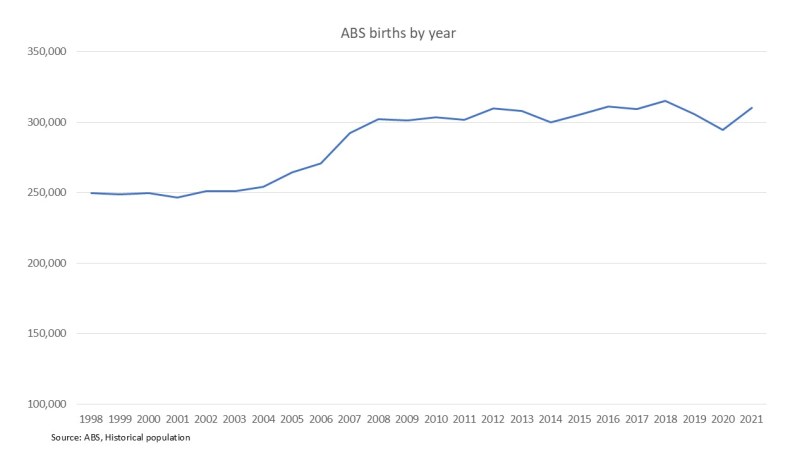
Since the late 2010s I have promoted the idea that the so-called ‘Costello baby boom’ cohorts will arrive at university age from the mid-2020s, increasing school leaver demand for higher education. As the chart below shows, annual births go from around 250,000 in the early 2000s to around 300,000 later in the decade.

Demographers are sceptical of how much effect mid-2000s pro-family policies had, but former Treasurer Peter Costello’s line that ‘if you can have children it’s a good thing to do – you should have one for the father, one for the mother and one for the country..’ was sufficiently memorable that this baby boom has his name attached to it.

As these cohorts approach university age this post takes another look at the data.

Read More »

Counting international students – the method is critical to what effects caps have

The debate on international student caps is mostly at the level of principle. But the capping bill‘s wording is also critical to its effects. A key issue is whether the cap is based on a cumulative total of enrolled international students through a year or the total on specific dates during the year. A cumulative count will have much more serious effects on students and education providers.

The cumulative count wording of the bill

The most natural meaning of the current bill, copied in below, is that the count is cumulative – ‘a limit’ (singular) on the ‘total’ number of overseas students enrolled in one or more years. This means that the cap is driven by the peak number during the year.

Read More »

Can migration policy alone manage international student numbers?

My paper on international student policy – new migration controls and proposed enrolment caps – is published by the ANU Migration Hub today. Some key points appear in The Conversation.

Compared to what I have already written on caps – how actual enrolments will fall below the caps and why even the government’s own agencies doubt the policy’s feasibility and fear its consequences – this paper explores the cumulative consequences to date of migration policy changes.

These consequences are already significant for vocational education and some higher education providers. This raises the question of how necessary the caps are to achieve the government’s policy goal of bringing down net overseas migration.

The policy timeline

Since October 2023 we have witnessed one of the great policy backflips of Australian political history. The Albanese government has turned from supporting the revival of international education – granting a record number of student visas in 2022-2023, extending the temporary graduate visa – to pulling almost every policy lever short of shutting the industry down to reduce international student numbers. International education now keeps political company with live sheep exports, fossil fuels, and vapes retailing.

Read More »