Last week the government introduced legislation that would, among other things, create a new funding category for what we now call enabling courses, which will be redesigned and rebadged as FEE-FREE Uni Ready places. These courses help prepare students for higher education study.
The current system
Under the current system, Commonwealth supported enabling places are funded at the Commonwealth contribution rate for the relevant discipline.
Enabling places are not capped but the financial incentives to enrol enabling CSP students are weak because no student contribution can be charged.
An enabling loading is paid in lieu for universities with an allocation of enabling funding, but many universities have no enabling loading or a low amount.
The government does not seem to update the enabling loading in a public place, but indexing a previous rate I think it is $3,886 per EFTSL in 2024.
Job-ready Graduates affected the financing of enabling places in fields with Commonwealth contribution cuts. Nearly 40% of enabling places are in the lowest Commonwealth contribution field, $1,236 for 2024. That plus the enabling loading = $5,122 per place.
Even for the subjects with favourable Commonwealth contributions, the loading is less than the lowest actual student contribution this year of $4,445. Enabling ‘over-enrolments’ are funded at $0, because there is no student contribution. There are good financial reasons why a university would not want to offer enabling courses.
While I think soft mature age demand is significant here as well as supply-side incentives, enrolments have crashed since the funding system changed.

FEE-FREE Uni Ready funding rate
By contrast, the FEE-FREE Uni Ready places will be funded at a uniform $18,278 Commonwealth contribution rate from next year – more than triple the previous rate for subjects in the lowest Commonwealth contribution cluster. This rate is equivalent to the total funding rate, Commonwealth plus student contribution, in arts, business, law and mixed field subjects (mixed field is significant for enabling courses, with 14% of enrolments in 2022).
Universities may, however, still be cautious about the FEE-FREE Uni Ready places.
Lower revenue for other fields
While universities get the same total revenue for a FEE-FREE Uni Ready place as a place in an award course in arts, business or law, for other courses a FEE-FREE Uni Ready place is less financially attractive.
This needs two comparison points, an enabling course under the current loading system and an award course in the same field, for which a student contribution could be charged.
Enabling versus FEE-FREE Uni Ready
Compared to the current loading system, the FEE-FREE Uni Ready places would, on 2022 EFTSL, significantly increase revenue for 38.5% of places, significantly reduce revenue in 30.2% of places (mainly science) and slightly reduce revenue in the remaining 31.3% of places.
The University of Newcastle, the largest current provider of enabling courses, would on 2022 EFTSL lose $3 million in funding for science enabling courses in the move to FEE-FREE Uni Ready places.
Because the increase in revenue is so large for arts, business, law and mixed field units of study the average payment per FEE-FREE Uni Ready place is 20% higher than now, even though most EFTSL will be paid less than now for a university with an enabling loading allocation.
In Newcastle’s case, the university as a whole would gain $2.2 million over previous enabling rates due to higher rates for arts and business courses. How university internal funding models pass on Commonwealth funding to teaching organisational units will be significant to how this policy works.
FEE-FREE Uni Ready versus award course with a student contribution
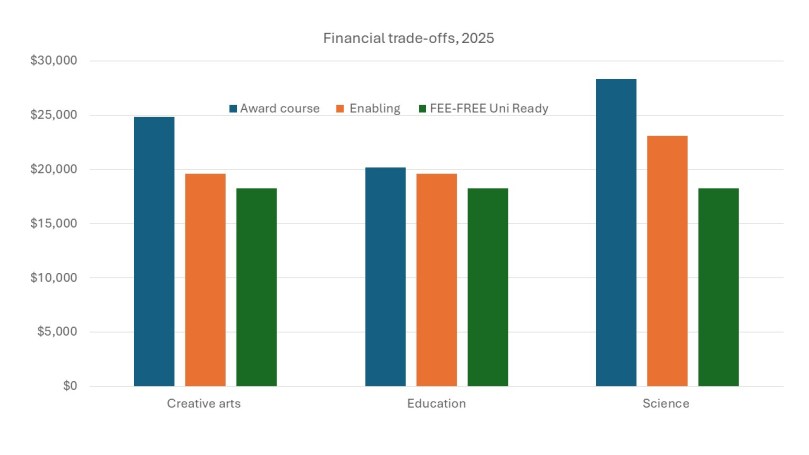
The chart below shows the three fields with the highest enabling enrolment share in 2022 where unis will be worse off under the new system compared to the current enabling loading system: creative arts (16%), education (13%) and science (29%).
For education, the $18,278 rate is only slightly below the 2025 indexed enabling loading rate ($19,571) and only modestly below the full funding rate ($20,153).
However in creative arts and science the $18,278 rate is significantly below what the university could get for a student enrolled in an award course (Commonwealth + student contribution).
Impact on maximum basic grant amount consumption
Under the current funding system, the enabling loading is separate from the Commonwealth Grant Scheme. Is is not part of a university’s maximum basic grant amount (MBGA). Only Commonwealth contributions for enabling places are included in the MBGA.
In 2025 the $18,278 Commonwealth contribution will count towards the MBGA, so FEE-FREE Uni Ready places in arts, business, law and mixed field units will consume more of the available MBGA funding than enabling places do now.
However for enabling places in engineering and science FEE-FREE Uni Ready places will consume less of the available MBGA funding than enabling places do now.
Whether a university’s capacity to enrol other students in 2025 is affected by the FEE-FREE Uni Ready places depends on their enabling place discipline profile and whether or not they expect to be ‘under-enrolled’ (i.e. not use all their MBGA).
From 2026, as I understand the proposed new funding system, this will matter less as the caps will be expressed in EFTSL rather than $$$.
Universities with no current enabling loading
The best thing about the FEE-FREE Uni Ready places idea is that it ends the current enabling loading, which is based on historical and political factors, and replaces it with a system that is neutral between providers. It will be a rare case, perhaps the only case, of reduced bureaucratic control over universities in the Accord system.
While there will still be financial disadvantages in many fields to offering FEE-FREE Uni Ready places, as outlined above, the reform makes it more feasible for universities to offer non-award preparatory courses in the numbers they think are necessary to meet the needs of their students.
More generic courses
The government says that it will ‘work with providers to professionalise and increase the quality and consistency of FEE-FREE Uni Ready courses, and seek to increase portability of credentials for students.’
Aside from this being a potential further intrusion of government into academic matters, it may make the FEE-FREE Uni Ready courses less tailored to the specific needs of students or the target courses the students want to enter.
Universities that were willing to put up with bad funding rates as ‘loss leaders’, bringing in students they could convert to fully-funded CSPs when they transitioned to an award course, might not be willing to do so if the students end up going somewhere else.
Conclusion
For a significant minority of existing enabling places the new funding rate will be much more attractive to universities than the old one.
But there are downsides for universities in these reforms, and perhaps for students too if they would prefer a course tailored to their needs and goals over one that was portable between universities.
The government’s claim that ‘funding for additional student places will increase the number of students taking part in these courses by 40 per cent by 2030’ may turn out to be an over-estimate.
 Andrew Norton
How attractive will FEE-FREE Uni Ready places be to students? If there are no fees that will be an attraction, but for students who will receive a loan, repayment is a long way off. If the student would otherwise not be admitted to university can get into a preparatory course, that wou7ld be attractive. But otherwise would a student want to spend time on this when they could be doing courses which lead to a qualification?
LikeLike
What might the impact be on
(a) Unis making 3rd party contracts for such teaching, and
(b) examples of uni linked ‘colleges’ that offer domestic students [fee for service] ‘foundation’ studies with some academic status e.g. a diploma or even accelerated entry to 2nd year Bachelor programs? see as example
https://college.adelaide.edu.au/admissions/fees/#1691639601193-357e4201-2a25
LikeLike
Unis can outsource teaching while enrolling the student. It probably would not have been viable on the old enabling funding system, but might be for arts or business related courses on the new rate. Standardised courses offer an opportunity to spread curriculum costs over a larger number of students.
It is still possible to offer full-fee enabling, which some may unis may do if the new Uni Ready product does not suit them.
A diploma is a different product not directly affected by this change.
LikeLike
Thanks
LikeLike
Is there any public data on attrition or non completion rates for ‘foundation’ courses,
the numbers of students who may start and then discontinue?
There is some evidence that ‘fee-free’ VET courses have higher attrition/non completions that courses where students/employers part fund the course.
What is the experience of ‘foundation’ courses or prospectively for FEE-FREE Uni?
LikeLike
In the demand driven review a decade ago we cited data of 40-50% non-completion of enabling courses.
However this can partly be seen as enabling courses doing their job in screening out people who are unlikely to succeed in higher education.
These days without better monitoring of student activity more of them will be screened out prior to the census date, which would reduce the recorded attrition rates.
LikeLike