Where are the young people who are not at university?

Earlier this month I wrote a post showing that higher education enrolments at age 19 years, and the domestic participation rate at age 19, were down in 2023 compared to 2022.

This post explores possible reasons for this downward trend.

The teenage job market

One explanation of declining enrolments at age 19 is higher education’s counter-cyclical relationship with the labour market. At the margins, some people prefer work to study, but study when work is not available. The higher education participation and full-time employment rates in the chart below match this theory. Higher education participation increased after COVID-related full-time job losses in 2020 and then decreased as job opportunities returned.
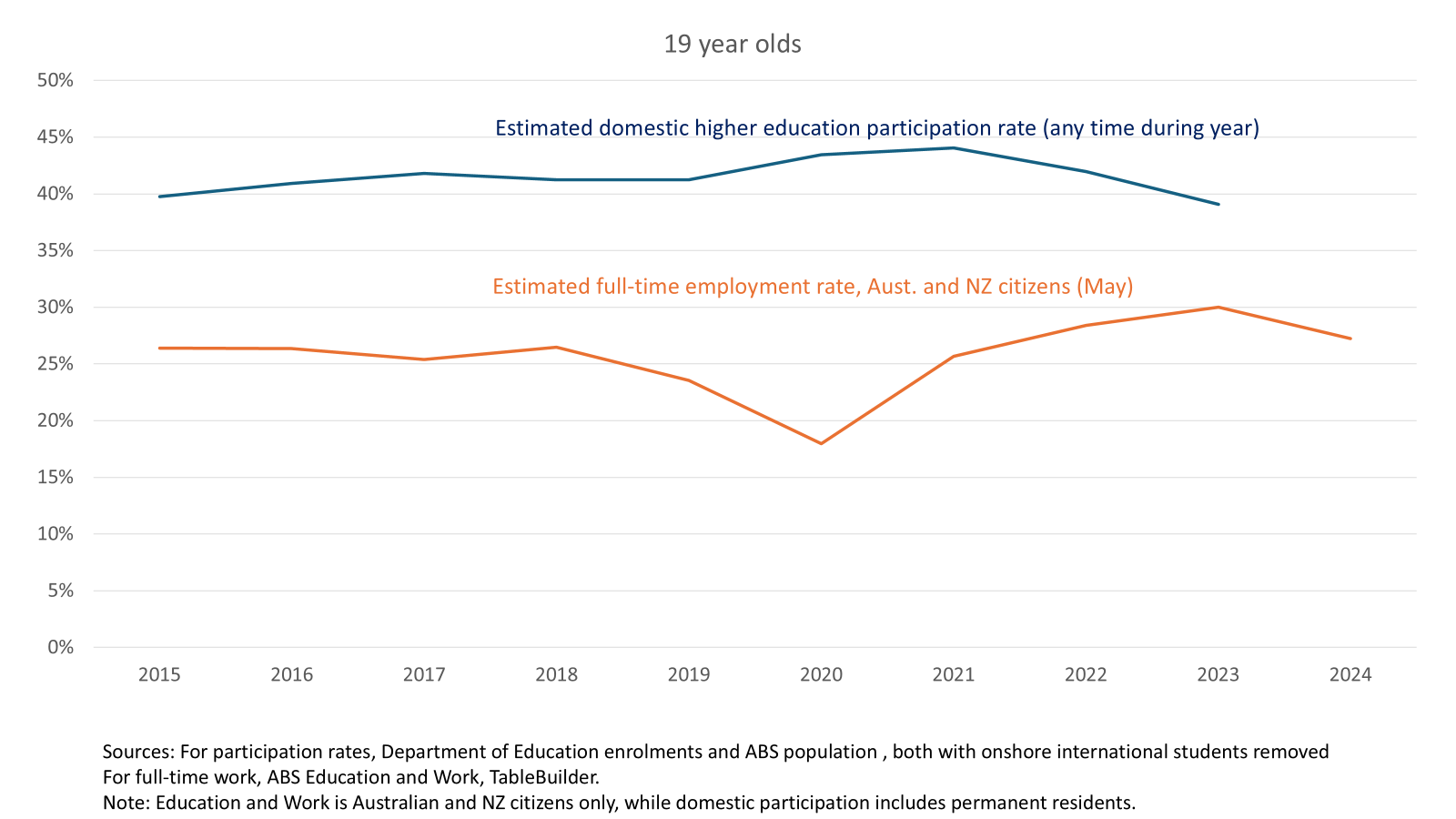
Education and Work TableBuilder supports analysis of smaller sub-groups than the standard ABS data releases, but with an increased risk of rogue results. Broader 15-19 year old statistics, however, confirm 2023 as a very strong year for full-time teenage employment. Both sources show that teenage full-time jobs grew strongly post-COVID and then softened in 2024, while remaining good compared to the 2010s.

Read More »

The higher education participation rate at age 19 almost certainly fell in 2023 – but an exact rate cannot be calculated

Despite significant policy interest in higher education attainment rates, the preceding participation rates are rarely reported. The most readily available time series is in Mapping Australian higher education, at figure 5 of the 2023 edition. It reports the participation rate at age 19 years, the modal university student age. For the first time in decades, the Department of Education recorded a participation rate in their recent 2023 statistics release.

Unfortunately data issues mean participation figures are only estimates. This post discusses these data problems and compares participation rates using two different methodologies. Both point to participation in 2023 being lower than in all recent years.

Read More »

Budget treatment of student debt policy announcements

One criticism of the weekend’s big proposed changes to student debt – a new repayment system and a 20% cut to student debt balances – is that they are ‘off budget’, concealing their true cost.

The Budget includes several different takes on the government’s annual finances, including fiscal balance, headline cash and underlying cash. The Budget papers also report the value of government assets, including student debt.

The ‘underlying cash balance’ is the most commonly used Commonwealth’s Budget metric. When the Treasurer boasts about the government’s fiscal performance he uses an underlying cash measure. Unfortunately from a ‘Budget honesty’ perspective underlying cash is the weakest measure of student loan costs and of the financial impact of proposed changes to student loan policies.

Read More »

Big proposed changes to the HELP repayment system – a higher first income threshold & a marginal rate of repayment

Today the government announced big changes to the HELP repayment system. Its proposal involves several interconnected conceptual and practical considerations.

The first issue is where to set the first repayment threshold – how much should a HELP debtor earn before they start repaying? The government proposal is for a higher first threshold.

The second issue is annual repayment amounts, which affect the disposable income of debtors and how long it takes them to repay their debt. The government proposal is for most debtors to repay less HELP debt each year, increasing their annual disposable income but also their repayment time.

The third issue is the method of repayment. Should it be – as we have had since 1989 – a system which levies a % of all income when income reaches a threshold, or should we have a marginal rate system, which is a levy on income above the threshold (like the current income tax system). The government has decided on a marginal rate system.

All three issues intersect with the public finance element of HELP – the cash flow implications of the changes for the Commonwealth, and the costs in interest subsidies and bad debt. These will all be negative for the government.

In this post, I will look at the annual repayment implications for debtors, effective marginal rates of repayment, and make some initial comments about selling this reform to debtors and voters.

What the government proposes

The first threshold for repayment will go to $67,000, from $54,435 for 2024-25, and approximately $56,000 after CPI indexation for 2025-26 (I have assumed 3% indexation, which seems to be around what the government has estimated).

From this first threshold of $67,000 we will move to a marginal rate of repayment, at two levels – 15% from $67,000 to $124,999 and 17% from $125,000. These rates would replace the current whole-of-income rates ranging from 1% to 10%.

Read More »