Despite significant policy interest in higher education attainment rates, the preceding participation rates are rarely reported. The most readily available time series is in Mapping Australian higher education, at figure 5 of the 2023 edition. It reports the participation rate at age 19 years, the modal university student age. For the first time in decades, the Department of Education recorded a participation rate in their recent 2023 statistics release.
Unfortunately data issues mean participation figures are only estimates. This post discusses these data problems and compares participation rates using two different methodologies. Both point to participation in 2023 being lower than in all recent years.
Student numbers issues
The participation rate is for domestic students only. A domestic student is a citizen, a permanent resident (including permanent humanitarian visas) or a New Zealand citizen
Student numbers are based on Department of Education enrolments. These figures only include students in institutions registered for FEE-HELP loans. About 60 higher education providers are registered with TEQSA but not for government support. I assume their students are mostly ineligible international students or domestic students who don’t need a loan (e.g. students employed by the provider’s parent entity or professionals who can afford the fees).
Consequently I assume few 19 year old domestic students are enrolled in these providers, but 19 year old international students create more of an issue, for reasons described below.
Students are counted if they are enrolled at any census date during the year. The implications of this are discussed in the next section.
In the enrolment data, the student’s age is as at 31 December in the prior year. So for 2023 in the enrolment data a person is counted as being 19 if they had turned 19 by 31 December 2022.
Population issues
To calculate a participation rate, we need to know the population age 19 who are citizens, permanent residents or New Zealand citizens. Although these are critical categories for running Australia’s welfare state, there is no publicly available count of them other than what can be derived from the Census.
The Census is only conducted at five year intervals. Annual participation rates must use ABS population figures as at 30 June each year. This means that enrolment and population 19 year olds overlap but are not the exactly the same group. In years of demographic stability this probably does not matter much, but as we move into a population growth phase it has greater potential to cause errors.
The ABS population figure includes everyone who meets, or is expected to meet, the 12/16 rule – that is, they will be in Australia for at least 12 months in a 16 month period. That means migrants who are not eligible for Commonwealth supported places, including international students, are included in the population.
To get a ‘domestic’ population, the imperfect solution in the Mapping data is taking out 19 y.o. onshore higher education international students, using higher education enrolment data. As noted above, however, this is not a full count of higher education international students. It also does not count international students taking non-higher education courses, although due to their shorter courses durations fewer students would satisfy the 12/16 rule. And the population deduction does not count other 19 year old temporary migrants such as working holiday visa holders (again, with many unlikely to satisfy the 12/19 rule – but 16,451 visa grants at age 18 or 19 in 2023-24) and the children of other temporary migrants.
The data timing issue means that I am deducting total 2023 19 y.o. international students from a 30 June 2023 figure. Some of these students would not have arrived in Australia until the second half of 2023.
Participation estimates with different methodologies
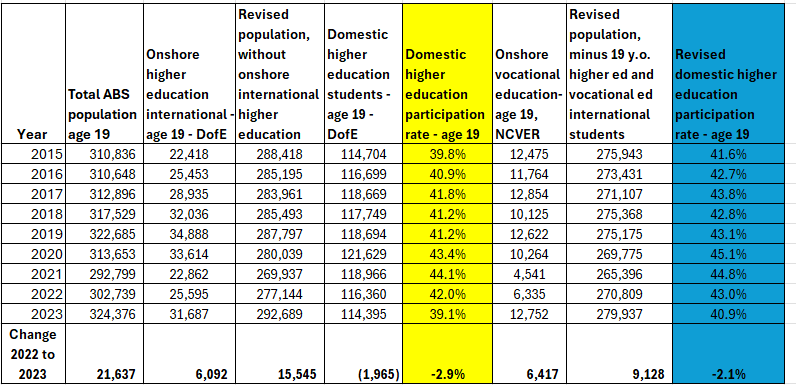
The table below reports estimated participation rates first with just onshore higher education students removed (in yellow, consistent with the historical methodology in Mapping), and then with international onshore higher education and vocational education students removed (in blue).
Either way, however, participation rates fell between 2022 and 2023 because enrolments are falling while the assumed domestic population is increasing. The Department’s estimate was 41% domestic 19 y.o. participation in 2023, with rounding the same as my blue estimate, but above the yellow estimate of 39%.
Conclusion
The methodological issues with calculating participation rates means that little should be read into small year-to-year changes.
But the absolute decline in 19 year old domestic students – down nearly 2,000 between 2022 and 2023 – supports a conclusion that the participation rate has trended down, and is at the lowest overall figure since 2014 using the original Mapping methodology.
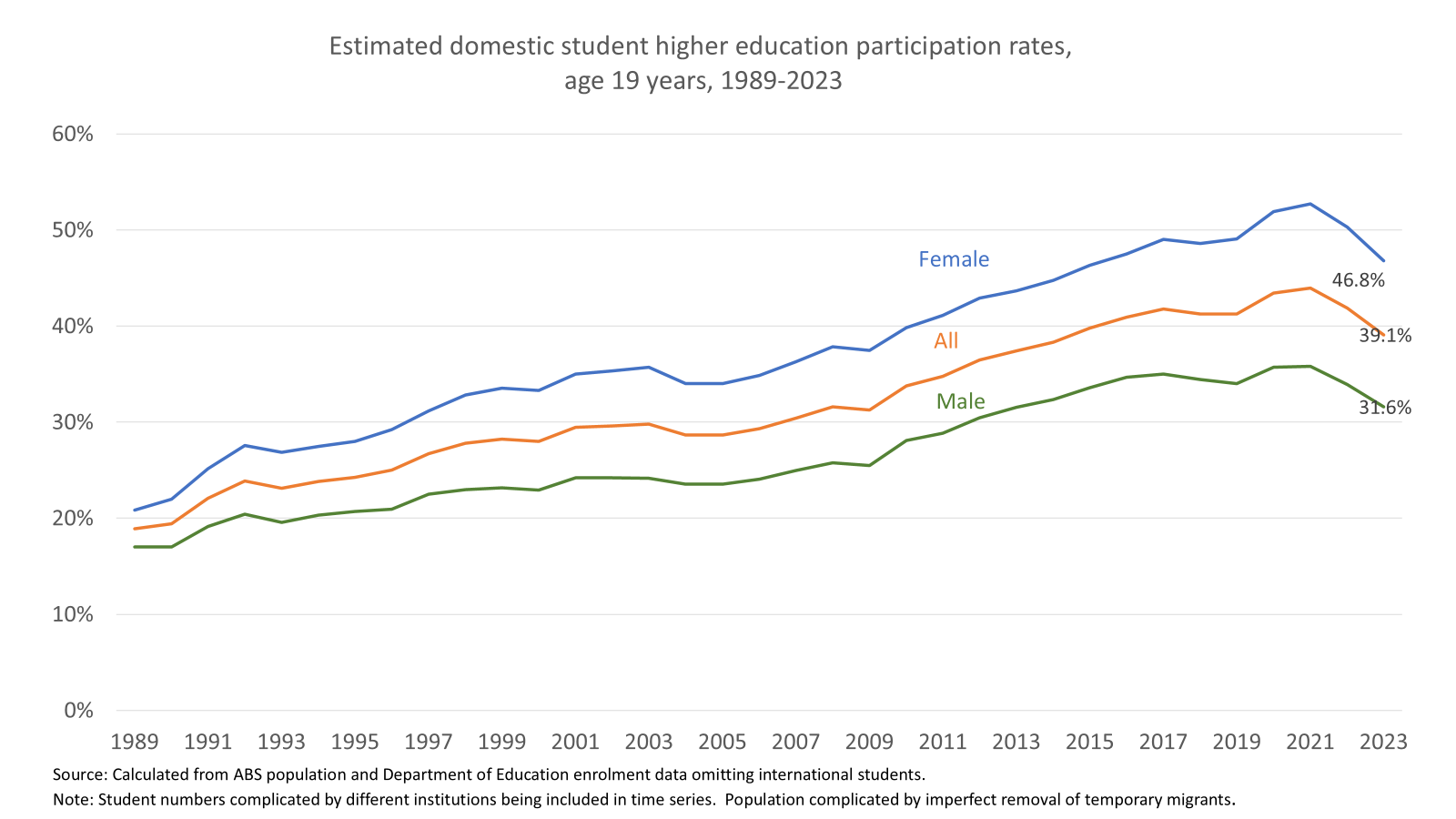
Whether this will translate into future lower degree attainment rates remains to be seen. The recent time series may just show high sensitivity to short-term labour market signals – spiking during COVID, falling during a period of plentiful jobs – rather than any long-term structural change in higher education participation and attainment.
 Andrew Norton