As part of its international student policy announcement, the Coalition promised a ‘rapid review into the Temporary Graduate Visas (subclass 485)’. The review would ‘address the misuse of post-study work arrangements as a way to gain access to the Australian labour market and as a pathway to permanent migration.’
While recent polls suggest the Coalition will not form government, net overseas migration will remain an important political issue. It is worth understanding trends in major migration categories such as the 485 visa.
This post summarises the available 485 visa data. A key point is that although applications for new 485 visas in 2024-25 to date are lower than in previous years, in the coming years there is the potential for significant increases in total 485 visa holder numbers.
Purpose of the 485 temporary graduate visa
Today’s temporary graduate visa is descended from an early 2010s policy that was designed to make Australia more competitive in the international education market. It does this by letting former international students access the labour market, so doing this is not ‘misuse’ according to the policy’s intent. The pathway element is more contentious. The 485 visa can be a pathway to permanent residence but it offers no guarantees. Government and student expectations proably differ on this matter.
In any case, as the numbers reported below show, there is no way all 485 visa holders in Australia in early 2025 could transition to a permanent migration program of 185,000 people for 2024-25.
Trends in the number of temporary graduate visa holders
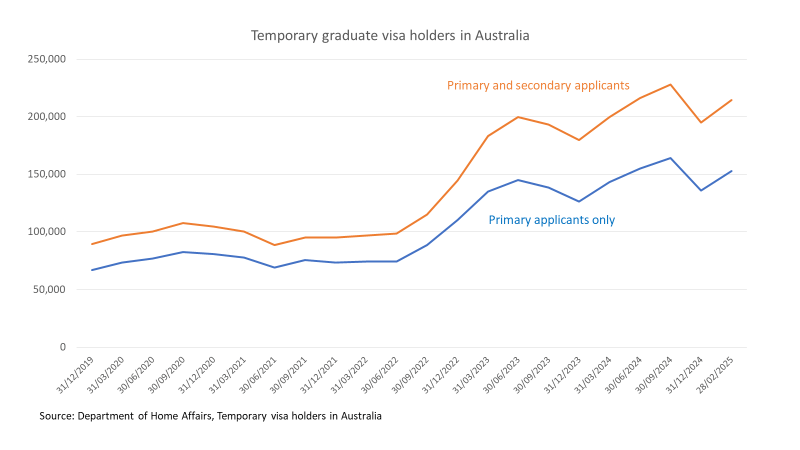
The Department of Home Affairs does not publish how many people hold a 485 visa. The closest we get to a stock figure is a monthly count of temporary migrants in Australia. As at 28 February 2025, 214,714 people were in Australia on 485 visas. This was about 14,000 down on the 30 September 2024 peak. The monthly in-country totals undercount visa holders as some are temporarily overseas.
Since 2022 the primary visa holder share of the total – that is, the former student with the relevant qualification – has decreased from 75-80% of the total to 70-72%. There has been greater growth in secondary visa holders, the partners and children of primary visa holders.
Country of origin of 485 visa holders
Read More »
 Andrew Norton