Recently the Department of Education published 2021-2022 data on payments under the Higher Education Continuity Guarantee, a 2021-23 Coalition program to compensate universities for under-enrolments. It has previously released data on a predecessor program, the 2020 Higher Education Relief Program.
It shows that over the 2020 to 2022 period under-enrolments cost the Commonwealth nearly $550 million. On my estimates the sector under-enrolled by approximately 47,000 places. Eight universities were under-enrolled in each of 2020, 2021 and 2022. Only four universities received nothing under the HECG or HERP, showing that enrolment shortfalls were widespread across the sector.
What is under-enrolment?
Under the Higher Education Support Act 2003 universities get paid their maximum basic grant amount (MBGA) – see my funding agreement posts for more detail on this – or the value of their Commonwealth supported places delivered (on a relevant Commonwealth contribution * EFTSL basis), whichever is lower.
During the COVID period the Coalition decided that it would let universities keep their MBGA even if they had not enrolled enough students to justify it. This was called the Higher Education Relief Program in 2020 and the Higher Education Continuity Guarantee 2021-2023. The purpose was to provide stability for universities during COVID and post-COVID enrolment turbulence.
There is a 2024-2025 program called the HECG, but it is a redirect of money to equity programs and has nothing to do with the original purpose of the HECG.
The institutional pattern of under-enrolment
Three universities – James Cook, Tasmania, and Federation – made substantial HERP/HECG claims in all three years 2020-2022, totalling $181.7 million between them. Sunshine Coast, RMIT, UWA, La Trobe, and Southern Queensland all cumulatively received over $20 million each over the three years.
The four universities with no claims were Macquarie, UTS, Charles Darwin and ANU. (Although no HERP/HECG claims did not signal long-term strength – in 2025 three of these four are in the news for job cuts. Perhaps they disadvantaged themselves financially by teaching students instead of pocketing money for nothing).
In 2021 and 2022, UNSW and UWA had multi-million dollar under-enrolments in ‘designated’ courses, i.e. medicine. As demand massively exceeds supply for medicine that is surprising. Looking at domestic enrolments their headcount was down in 2021 but looking normal in 2022, so perhaps partly an issue with reduced EFTSL through part-time study.

For public universities the Commonwealth payouts were $73.4 million in 2020, $109.8 million in 2021, and $333.2 million in 2022, total $516.4 million.
Adding in $29.6 million for NUHEPs over 2020-2022 the total expenditure was $546.1 million.
Estimated EFTSL under-enrolment
To estimate EFTSL under-enrolment I calculated an average Commonwealth contribution amount using sector-level CSPs delivered and CGS payments minus HERP or HECG.
This gives me estimated under-enrolments of 6,976 in 2020, 10,038 in 2021 and 30,320 in 2022. Total = 47,334.
A better method would be to calculate average Commonwealth contributions for each institution, but too much work for my purposes here.
Policy lessons
The three biggest under-enrollers were all regional institutions. Under JRG policies they received larger annual increases in their MBGAs than metro universities, increases that could not be used. These are still there in the 2025 funding agreements. At least in the school leaver age group it was clear that demographic growth was mainly in urban areas.
It is another warning that supply-led policies, reflecting where politicians and bureaucrats think students should enrol, can lead to under-used funding. Although in 2022 only four universities could potentially have used the money better.
2023
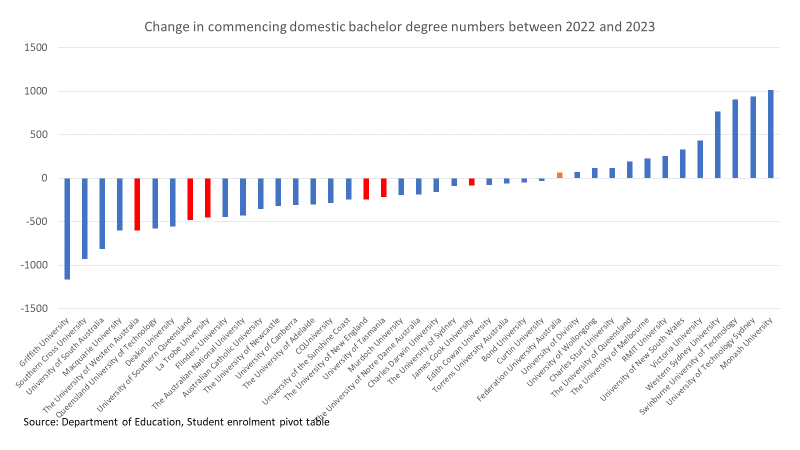
On a CSP EFTSL delivered basis 2023 was even worse than 2022 so it looks like the HECG is headed for another big payout.
Of the universities that were struggling to reach their MBGA in 2022 only Federation showed an increase in domestic commencing bachelor degree numbers in 2023, and that was very small.
2024
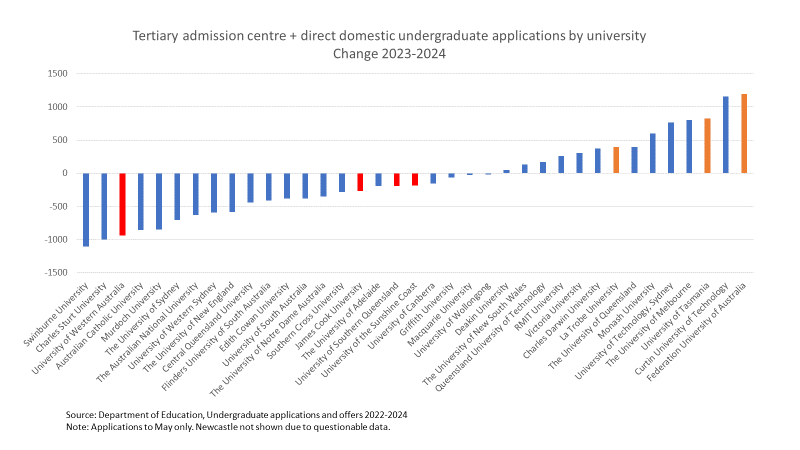
Applications data suggests that three of the under-enrolled universities enjoyed increased demand in 2024 which we can hope flowed through into EFTSL.
Under-enrolments in the future
From 2027, universities will receive up to 97.5% of their previous year’s funding if they under-enrol. I have not cross-checked that against recent experience, but this would not protect the major under-enrollers from significant losses.
Conclusion
That so many universities benefited from the HECG forces a modest revision of the previous government’s record. While the JRG funding rate reset has contributed to medium-term structural funding issues, on emergency measures the Coalition is looking a lot better, with the HECG and the $1 billion boost to research funding. For all the complaining about how the previous government handled JobKeeper, few universities would have qualified even on more generous rules.
By contrast, the current government has been much tougher on universities. As noted, the supposed continuation of the HECG is just a funding redirect to other activities, not money to keep staff on the payroll through tough times. Future ‘continuity’ money will be much less generous than the Coalition’s HECG. I don’t disagree with the 97.5% policy – if we are going to have bureaucratic allocation then to be efficient we need bureaucratic mechanisms for reallocation – I am just noting the comparison.
 Andrew Norton