The last university over-enrolment crackdown – some possible lessons

As announced last year, the government plans to crack down on so-called ‘over-enrolments’ – enrolling additional students on a student-contribution only basis once all a university’s Commonwealth Grant Scheme allocation has been used.

When a proposed new funding system is in place, from 2027, student contribution-only places will only be possible in a buffer zone above a university’s Australian Tertiary Education Commission allocation. 2% and 5% buffers have both been suggested. Currently over-enrolled universities will receive some additional funding to bring over-enrolments within their official allocation of places. However, this will not in all cases reduce over-enrolments to the permitted range. Significantly over-enrolled universities need to moderate student intakes in 2026 to bring their medium-term enrolments down.

Not many current Department of Education staff were there the last time a minister thought reducing over-enrolments might be a good idea. The story is worth telling.

Brendan Nelson and over-enrolment

From November 2001 to January 2006 the education minister was Brendan Nelson, a Liberal. Nelson was worried about the quality implications of significant over-enrolments. The first reference I can find to Nelson’s concern is in a media release from December 2001, a month into his term.

Read More »
2024 graduate employment outcomes and early 2025 trends

The 2024 Graduate Outcomes Survey finally came out this week. As recently as 2021 the GOS came out in the year it covered, not September the following year. The government’s inability/refusal to release data in a timely way means that we need alternative sources of information for sector-relevant trends. This post reports on the GOS and brings in job advertisement and ABS data.

2024 graduate employment results

What I found in alternative sources for 2024 graduate outcomes made me concerned. The ABS labour force survey showed a downward trend in employment for young graduates. If this was right, was it cyclical or something more structural, such as AI reducing entry-level employment? A couple of recent US studies, one specifically looking at recent graduates, suggested an AI impact.

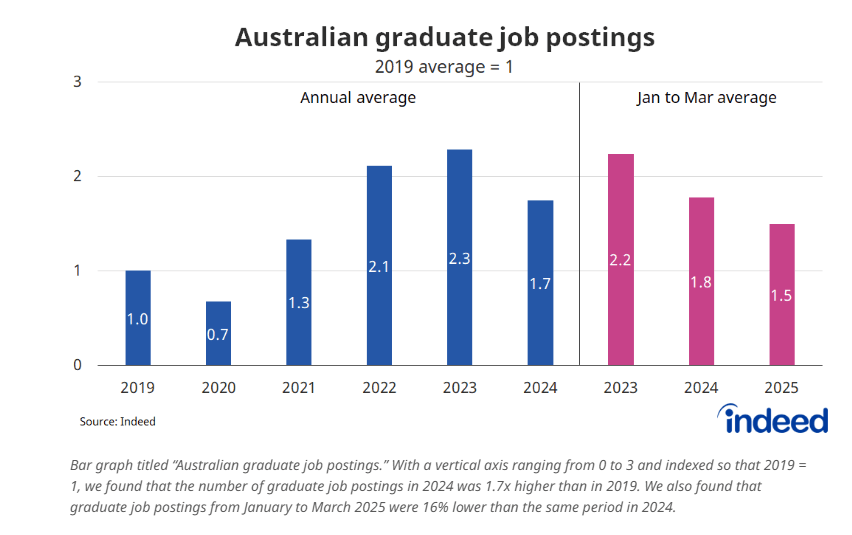
In May 2025, Callam Pickering looked at online job ads for graduates. He found that ads mentioning graduates declined in 2024 compared to 2023 – although they still exceeded 2019 levels. At least to March, ads for graduates in 2025 were tracking below the same months in 2024.

Fewer job ads targeting graduates cannot be good news, but I am not sure how important these are to the overall graduate labour market. There would be jobs typically taken by recent graduates that are not part of graduate programs or exclusively marketed to graduates. As work-integrated learning becomes more common, are firms increasingly hiring people they already know, recruiting graduates but not using advertising to find them? In analysis based on the 2023 GOS, but only graduates from institutions that had paid extra for WIL questions, 19% of people with new undergraduate qualifications said they had secured employment with a WIL employer and another 10% through a network contact made during their WIL experience.

Read More »

The future of voluntary HELP repayments

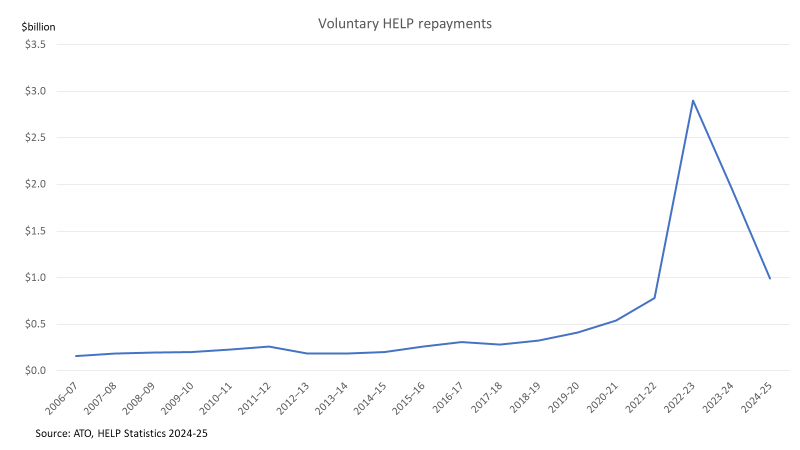
In recent years voluntary HELP repayments increased significantly, peaking at $2.9 billion in 2022-23, before dropping back to $992 million in 2024-25 (according to data released last week). This post looks at why voluntary repayments spiked and what we can expect for future years.

The spike in repayments – indexation

The 2022-23 and 2023-24 big repayment spikes in the chart above are primarily due to people repaying early to avoid high CPI indexation.

With CPI now back to normal levels this should be much less of a factor in the foreseeable future. That said, to reduce indexation costs HELP debtors considering a voluntary repayment should still make it prior to the 1 June indexation date.

Read More »