Mapping Australian higher education – December 2025 data update

To prolong the life of Mapping Australian higher education 2023 I have been updating a spreadsheet which contains the data behind the charts and tables.

The December 2025 Mapping data update is here.

Since the last update in March 2025 the changes include the 2024 enrolment data, the 2024 university financial information, and graduate employment outcomes.

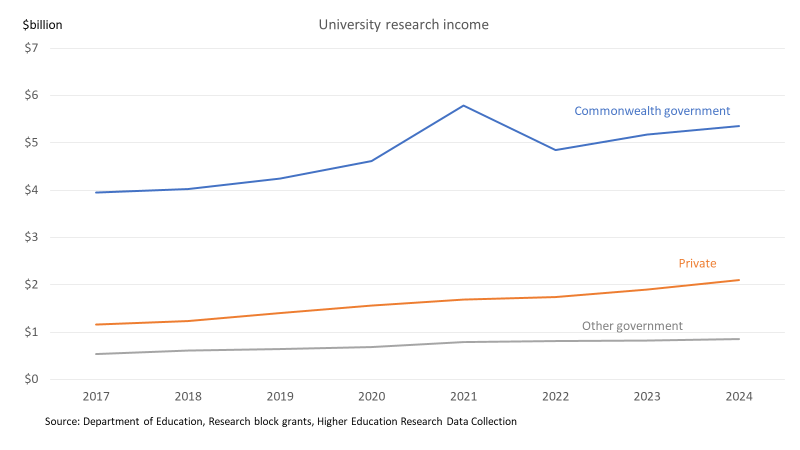
Research income has been the most recent significant data release, including research block grant funding for 2026 and the HERDC data used to calculate it, which goes up to 2024. The chart below shows the research-specific income sources 2017-2024.

I will next update the spreadsheet when we have projected 2026 spending on Commonwealth supported places in the first quarter of 2026. I hope by then the 2025 staff data will also be available.

The Australian Tertiary Education Commission legislation, Part 5, ATEC, TEQSA and the Threshold Standards

Under the legislation to establish the Australian Tertiary Education Commission, introduced into Parliament late last month, ATEC would advise the minister on the Higher Education Threshold Standards. All higher education providers must meet these standards as a condition of registration. The enforcement agency is the Tertiary Education Quality and Standards Agency.

This post compares the current system for setting the Threshold Standards with how this would happen if the ATEC legislation passes unamended.

Current process for setting the Threshold Standards

The Threshold Standards are a legislative instrument – and so disallowable by either the Senate or the House of Representatives – made by the education minister: section 58 of the Tertiary Education Quality and Standards Agency Act 2011. Under the same provision the minister can make other quality-related standards, as part of a Higher Education Standards Framework.

The minister must not make a standard unless a draft has been developed by the Higher Education Standards Panel (discussed shortly): section 58(3)(a) TEQSA Act 2011.

The minister must consult with the state and territory education ministers: section 58(3(b)(i) TEQSA Act 2011.

The minister must consult with the research minister if that is a separate role (not currently): section 58(3(b)(ii) TEQSA Act 2011.

The minister must consult with TEQSA: section 58(3(b)(iii) TEQSA Act 2011.

The minister must have regard to any advice or recommendations given by the Panel or the consultation parties: section 58(4) TEQSA Act 2011.

Read More »

The Australian Tertiary Education Commission legislation, Part 4, ATEC’s independence from the government

The Universities Accord Final Report recommended that ATEC be an ‘independent statutory authority … to enable it to provide robust advice and support evidence-based decision making and planning’ (p. 234). This post explores the relationship between ATEC and the government, as set out in the ATEC bill introduced into Parliament last week.

I should say at the start that unelected bodies with significant powers (‘independent’) are not necessarily good things. Government agencies should work within clear goals and rules established by democratic processes.

But independence can be beneficial in ensuring that government (and the broader public) get honest data – the ABS is a model here. Independent bodies can also help governments avoid the temptation to do things that are politically beneficial in the short run but detrimental in the long run – the RBA is a model here. Both the ABS and the RBA make mistakes, but their overall approach is better than letting the government decide whether or not to release vital data or to set interest rates with public opinion in mind.

All legislative references, unless otherwise specified, are to the Universities Accord (Australian Tertiary Education Commission) Bill 2025.

Administration of mission based compacts

The most important ATEC function will be to administer mission based compacts. As noted in a previous post, the content of mission based compacts will be driven by a ministerial statement of short-term and long-term strategic priorities: section 15. However this is not a legislative instrument: section 15(6). This means that neither the Senate nor the House of Representatives can disallow it. I take this as a democratic negative compared to the current system, under which key spending programs, such as equity and research block grants, have their own legislative instruments.

ATEC must prepare its own statement of strategic priorities: section 43. ATEC must take the minister’s priorities into account when performing its functions: section 15(4). Within the limitations of the new framework, this is appropriate in putting ATEC’s direction under the broad control of a person who can be subject to parliamentary questions, even if the ministerial statement of priorities cannot itself be vetoed. ATEC itself will appear before Senate Estimates.

Importantly, the minister will not give directions to ATEC in relation to decisions ATEC makes or in relation to ‘a higher education provider or a class or classes of higher education providers’: section 71(2)(b) & (c). This compares favourably to the current funding agreement system, under which the minister can effectively determine the content: section 30-25 of the Higher Education Support Act 2003. It is also better than the wide power to cancel course registration for international students, including on the basis of the ‘kind of provider’, which was approved by Parliament with modest improvements the same week the ATEC bill was introduced.

Section 71(2) reduces the risk of ministerial discretion being misused to penalise a university or universities in an arbitratry way.

The strongest guard against the misuse of power, however, is having rule-driven programs. On that the ATEC model would be worse than what we have now.

Read More »
The Australian Tertiary Education Commission legislation – Part 3, Per student funding and student contributions

Since it came to office, Labor has deferred dealing with Job-ready Graduates student contributions. First it added student contributions to the Universities Accord list of issues. In February 2024 the Accord Final Report suggested basing student contributions on lifetime earnings. Subsequently the minister said the new Australian Tertiary Education Commission would provide advice. Now we have ATEC’s legislation, but how student contributions will be handled is less clear than I expected.

All legislative references, unless otherwise specified, are to the Universities Accord (Australian Tertiary Education Commission) Bill 2025.

The ATEC bill and per student funding

The ATEC bill does not mention student contributions at all. One of ATEC’s functions, however, will be to advise the minister on:

“The efficient cost of higher education across disciplines and student cohorts and in relation to the Commonwealth contribution amounts for places in funding clusters.”: section 11(d)(ii), section labelled “Functions of the ATEC”.

In different words, in a later section on “Advice and recommendations”, a topic of advice is:

“The costs of teaching and learning in higher education and overall higher education funding amounts, including on a per student basis.”: section 41(1)(b).

Read More »