This post examines the regional campus component of needs based funding, which starts this year. I looked at the low SES and Indigenous component last week.
The regional component funds students at regional campuses rather than regional students. It assumes higher average costs at regional campuses. A longstanding ‘regional loading’ served a similar purpose. Just under $90 million was spent on the regional loading in 2025. Universities have been notified of their needs based funding amounts, but as of 23 February 2026 I cannot find a public record of them.
The research on cost by campus
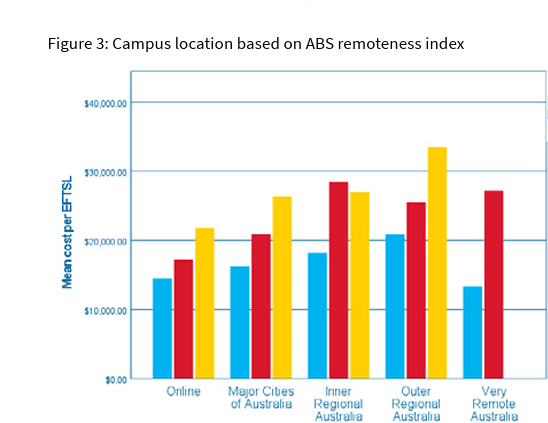
The Deloitte Access Economics costing work used by the Morrison government to reset funding rates found that regional universities had higher costs per EFTSL after controlling for other factors affecting costs, such as discipline.
Later work by the U of M’s Centre for the Study of Higher Education, using Pilbara Group data, also found that regional campuses had higher average costs per EFTSL (chart below). This partly reflects a general feature of university costs – higher education is an economies of scale enterprise, but regional campuses on average have lower enrolments than major city campuses. However, higher regional costs were found to be still present after controlling for subject size.
Assuming that higher education should, ideally, be taken to where the students are – a proposition I agree with – the basic policy idea behind the regional loading/regional component of needs based funding is sound.
The legal framework
As with the low SES and Indigenous component of needs based funding, the legal basis of the regional component is a step backwards from the previous regional loading.
Under the old system an indexed regional loading amount was specified in the other grants guidelines. The loading was divided up between universities according to a formula. For needs based funding that legal guarantee is gone. The relevant legislative instrument creates no legal obligation to pay anything extra for regional campuses. As explained in the earlier post, the minister decides how much to spend. A document called Needs-based Funding Guidance v1.0 December 2025 states how the minister intends to calculate regional component amounts, but this is only advisory and lacks legal force.
Mode of delivery matters
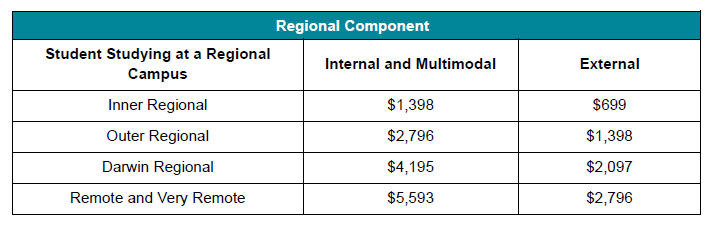
While equity needs based funding is neutral on mode of delivery, the regional funding component is not. There are lower rates for ‘external’ (i.e. mainly online) students compared to ‘internal’ (on-campus) and ‘multi-modal’ (mix of delivery formats) students: p. 7, Funding guidance document.
Which campuses are regional?
The policy primarily uses the ABS regional classifications, which are based on distances to services. The exception is the category of ‘Darwin regional’, with Darwin otherwise classified by the ABS as a major urban area: legislative instrument section 52A(2)(b).
However, a campus is not eligible for the needs based funding regional component if it enrols fewer than 50 internal or multi-modal Commonwealth supported places EFTSL: p. 15, Funding guidance document.
External students at regional campuses are only funded if the university’s main campus – defined as the campus with the largest number of internal and multi-modal students – meets the regional definition: p. 7, Funding guidance document.
Which courses are included?
The regional component has broader course eligibility than the equity component: enabling/FEE-FREE Uni Ready, undergraduate and postgraduate: p. 15, Funding guidance document.
As with the equity component, potential confusion is created by stating that students need to be in CSPs but also including, in the list of eligible course codes, research degrees funded under the Research Training Program.
Commencing and continuing students
As for equity needs based funding, each commencing student is counted as 1, regardless of EFTSL, while continuing students are counted by EFTSL: p. 6, Funding guidance document.
Demand driven?
As with the equity component of needs based funding, the regional component is not genuinely demand driven. It will be based on 2024 enrolment data: p. 6, Funding guidance document.
The funding rates
The table below from p. 7 of the Funding guidance document provides the regional component funding rates. As can be seen there is a 50% discount for external/online enrolments.
A university can receive equity and regional needs based funding for the same student: p. 5, Funding guidance document.
Funding hypotheticals
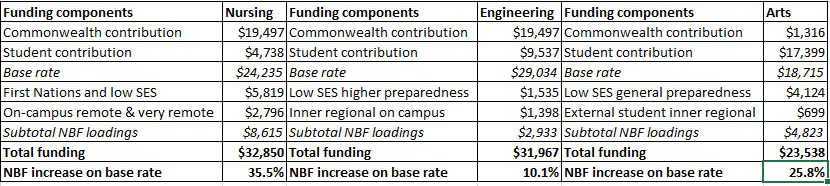
It is not clear whether needs based funding will ever be genuinely demand driven. But if it was the table below shows a few scenarios about how it would affect total 2026 EFTSL rates for varying disciplines and students. For commencing students, with full needs based funding for part-time enrolments, the percentage increases would be larger.
What can the regional component be used to support?
The regional component must be used to ‘offset the higher costs associated with operating regional campuses and support high-quality education in regional and remote Australia’: section 52E(7), needs based funding legislative instrument.
There is some confusion created by the Funding guidance document (p. 10) when it discusses what needs based funding can cover, with a section headed ”Ineligible activities’ saying that the ‘NBF’ must not be used for’… maintenance of buildings and activities not primarily aimed at low SES and First Nations students.
I think this is intended just to cover the equity component, but in any case section 52E(7) over-rules it. The cost of maintaining physical infrastructure is, I assume, a key element of why regional campuses cost more, due to fewer students over which to spread fixed costs. Therefore infrastructure maintenance should be included in what the regional component supports.
Expenditure acquittal
The expenditure acquittal needs to include a summary of how the funding was used and a breakdown of total expenditure: section 52E(8).
The former regional loading legislative instrument did not include an acquittal requirement, although I am not sure what reporting requirements the Department of Education may have devised.
I doubt that this acquittal is a worthwhile exercise. The money is not funding additional programs, as the equity component is supposed to do. Universities don’t receive invoices labelled ‘premium for regional campus’. The costs of regional campuses are just higher, as the program assumes. This compliance exercise looks like an unnecessary additional cost to running a regional campus that could be safely avoided.
END
 Andrew Norton
Thanx very much for this. I agree that that ‘higher education should ideally be taken to where the students are’. The UK has had a far lower proportion of students who commute to campus, and builds into its financing system the substantial extra costs of students’ relocating to study. This is one of the reasons why student loans are much higher in England, which is eroding confidence in England’s fees and loans system.
I am not sure how university study hubs are developing – the government continues to increase their number, which suggests that it believes they are successful, at least politically. But if they develop into substantial provision I wonder whether they might in time be eligible for the ‘regional’ campus loading.
LikeLike