Low SES students in a capped higher education system

A reader of this COVID-19 series of posts asked me about its implications for low socio-economic status (SES) students in higher education.

I doubt the COVID-19 recession will reduce demand for post-school education from potential low SES students. The same economic logic applies for everyone who might consider further study: education is more attractive than unemployment.  Local vocational education policies and opportunities may affect the regional higher education-vocational education divide, but interest in study should increase.

While low SES demand should hold or increase, I nevertheless think that low SES enrolments will probably decline without policy change. Increased total demand for university places in 2021 will intensify academic competition for entry if funding caps remain. And that, in turn, will disadvantage low SES applicants.

Read More »

International students and the COVID-19 recession

For Australian higher education the situation of international students in the COVID-19 crisis is especially concerning. They lack the local family and social security back-ups of domestic students. It leaves them particularly vulnerable as large parts of the student labour market collapse.

And if international students have to go home or cannot pay their fees, that is the most likely trigger for a broader higher education sector crisis. At best, thousands of higher education workers will lose their jobs. At worst, many universities will need government intervention to survive.

This morning the government issued a summary statement on the situation of international students during the COVID-19 disruption.

International students working in nursing and aged care have had their 40 hour per fortnight cap on working eased, as have students working in supermarkets until 1 May. While that is helpful for some students, as of 2016 the majority work in other occupations, as the chart below shows. Read More »

What could the government do to stabilise university finances?

There are some pretty high figures circulating about possible university losses due to COVID-19. I have seen no supporting evidence to justify the estimates, and the top-of-the-range numbers are implausible. Nevertheless, 2018 financial data shows many institutions with thin operating margins. We have grounds for concern about how they would manage a major hit to their finances.

On the revenue side, we have actual or potential losses from international students who never arrived, international students who may have gone home, domestic students withdrawing prior to the census date, and domestic students claiming student contribution refunds and HELP remissions because their course delivery methods changed.

On the cost side, universities have had to finance quick transitions to online education for students and working at home for staff, as well as some universities offering students financial support.

This post summarises things that the government can do within existing or announced legislation to stabilise university finances. I have blogged about some of them before and will note them concisely here. Of course, other policies supported by new legislation are also possible. Read More »

COVID-19 means that universities should not be held to performance funding targets

Update 6/4/20: Since this post was written, the minister has indicated that performance funding is being reconsidered due to COVID-19.

The government’s university performance funding scheme was always based on  questionable assumptions. Among them is the belief that we can reliably distinguish a university’s contribution to various outcome indicators from the other influences on those same numbers.

I’m sceptical enough of this in normal times. But COVID-19 means that, despite the extraordinary efforts of academics and other university staff to provide continuity of education and student support, three of the four performance indicators – graduate employment, student satisfaction, and equity group enrolment share – will or are likely to worsen compared to recent years. The fourth – attrition – will probably show a positive trend that also has little to do with university performance.

Due to the total amount of performance funding being linked to population growth, COVID-19 driven changes to migration levels will also reduce how much performance money is on offer.

Graduate employment

Let’s start with graduate employment, which has a 40 per cent weighting in the performance funding formula. As I argued in a blog post on Monday, previous record-bad employment results in 2014 will be significantly exceeded. Read More »

Will university staff receive the JobKeeper payment?

Update 9/4/20: Since this post was written there was, briefly, some expectation that the revenue loss required for universities would be lower for 15 per cent. That is not happening. 

Update 24/4/20: This story keeps evolving. Due to a loophole in the legislative instrument, which sets the revenue base at GST turnover rather than total income, some universities look like they have a basis for receiving JobKeeper.

Update 25/4/20: Cancel yesterday’s update, the government is moving to block that one. But there may still be other ways that universities can get JobKeeper. A new post updates the story.


Last night there was some Twitter discussion about whether university casuals would receive the new JobKeeper payment of $1,500 a fortnight. It is to be paid via employers, but casual staff are not eligible unless they have been employed on a regular basis for the last 12 months. Given the on-gain, off-again nature of casual teaching many probably would not be eligible.

But the first issue is whether universities are eligible employers. To qualify, they need to have suffered a significant loss of revenue:

Employers (including not-for-profits) will be eligible for the subsidy if:
• their business has a turnover of less than $1 billion and their turnover will be reduced by more than 30 per cent relative to a comparable period a year ago (of at least a month); or
• their business has a turnover of $1 billion or more and their turnover will be reduced by more than 50 per cent relative to a comparable period a year ago (of at least a month).  (emphasis added)

In 2018 eleven universities had annual revenues exceeding $1 billion. They therefore have the higher 50 per cent drop in revenue requirement, rather than the 30 per cent drop for smaller universities. Read More »
Graduate employment prospects during the COVID-19 recession

This post looks at the history of economic downturns and graduate employment since the early 1980s – specifically the early 1980s recession, the early 1990s recession and the end of the mining boom in 2013 – to draw out potential implications for the COVID-19 recession.

Historically, each downturn peaks at worse graduate employment outcomes than the previous one. The COVID-19 recession is likely to fit this pattern and deliver record high graduate unemployment. Not only is it likely to be the most severe recession in living memory, but it has already caused massive job losses in industries that are significant graduate employers.

Past recessions

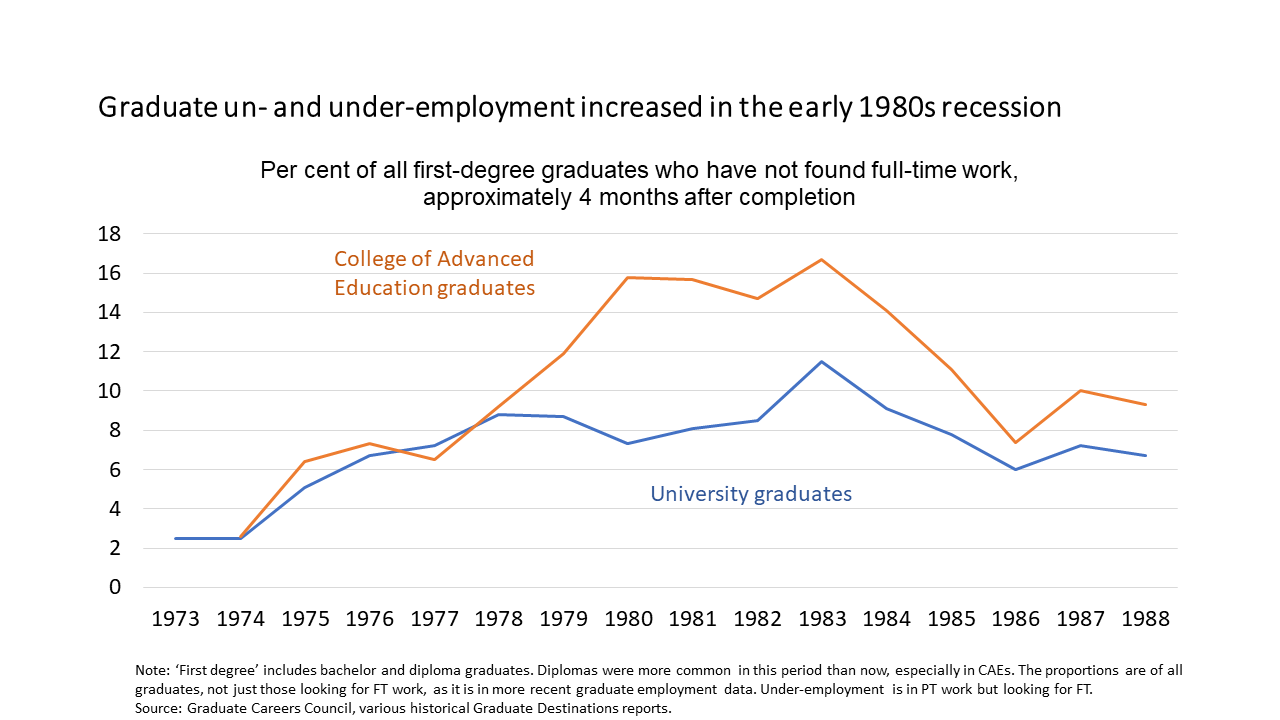
Thanks to old graduate destination survey reports being put online (scroll down here),  the employment effects of past recessions are easier to examine. The early 1980s recession triggered a four percentage point increase, on the best recent outcome in 1980, in university graduates still looking for full-time work four months after completion. But the negative effects were short-lived. By the mid-1980s employment outcomes were better than they had been in the late 1970s (chart below). Graduates of Colleges of Advanced Education had higher proportions looking for full-time work, but this appears to be mostly due to trends that started before the recession. Their results also recovered quickly.

1980s recessions

Read More »

Sitting out the recession at university: postgraduate courses

In previous posts, I looked at whether demand for undergraduate education would increase during the COVID-19 recession. In this post, I examine potential demand for postgraduate education.

As with initial undergraduate qualifications, theory suggests that a recession is a good time for postgraduate study. The opportunity cost of time spent out of the workforce is lower or non-existent. Studying is a relatively productive and interesting way of sitting out a recession.

In examining what happened in previous recessions I have been helped by a project that has put all the old graduate destination surveys online (scroll down to the bottom of the page here). Recessions aside, the trends are interesting.Read More »

Predicting student numbers during the COVID-19 recession: 2021 could be an unexpected peak year

In two recent posts, I argued that although higher education demand increased during the early 1990s recession, this may not happen on the same scale during the COVID-19 recession. We start this time from a much higher base of educational participation and attainment. The pool of people interested in higher education, but who have not yet enrolled or acquired a degree, is smaller than it was 30 years ago.

However, to predict that total applications may not increase very much is not the same as saying that total short-term demand will not increase substantially. Applications will be a weaker proxy than usual for how many people will want to be enrolled.Read More »

Will the COVID-19 recession increase mature-age applications for higher education?

In an earlier post, I looked at how the COVID-19 recession might affect school-leaver applications for undergraduate education. I concluded that although the lack of job opportunities would favour continued education over unemployment, the scope for applications growth was lower now than during the early 1990s recession.

School retention is much higher now than 30 years ago, and a much larger proportion of the cohort with a potential interest in university already attends. With the age cohort’s size not changing much in the short term there is less room to move.

Interpreting historical application numbers from older university applicants is complicated. It includes relatively young people, did not until the last decade count direct applications to universities (which are mostly from older applicants), and does not distinguish between applicants who are already students but hoping to change courses and those seeking to enter higher education.

With these caveats, the chart below shows a large increase in applications from non-school leavers in the early 1990s. In percentage terms it is larger than the school leaver increase. It is consistent with the recessions drive up higher education demand hypothesis. The scope for growth is high because it is not constrained by the size of recent Year 12 classes.Read More »

HELP remissions and COVID-19 university course changes

Last week I published a blog post on the financial dangers posed by the COVID-19 crisis starting prior to the census date for each subject. It is a critical date for universities. They get no Commonwealth or student contributions for subjects dropped prior to the census date.

As Stephen Matchett reported in Campus Morning Mail yesterday, social media talk about dropping subjects is still at high levels. One of the reasons, that unemployment income support benefits would be more generous than student benefits, seems to have been fixed in Parliament yesterday. Although I think students are better off finishing their course on schedule if they can, we should expect higher drop-outs than usual prior to the census date.

I am also hearing reports of international students heading home before the census date because of family pressure. They might also leave because they can no longer support themselves due to the collapse of the student labour market. Due to an extraordinary new power to widen social security eligibility some international students might temporarily receive benefits, but I think entitlements are too unclear to change short-term behaviour.

If these drop-outs are happening at any scale then, except for the universities on trimesters that are already past their first census date, then serious higher education financial problems are very close, as universities will have to scale back their expected Commonwealth-supported student revenue and international student fee income for the year.Read More »