Will the COVID-19 recession increase school-leaver applications for higher education?

Due to COVID-19 Australia faces the worst recession in living memory. This post is the first of a series looking at how this might influence demand for higher education. But to pre-empt future posts, applications are just one of several factors affecting how many students end up enrolled. Acceptance rates, deferrals, and attrition rates could all change, affecting student numbers.

I will start with the school leaver market. As I have noted previously, in recent years higher education applicant numbers have softened. For school leavers, demography will continue to cap numbers. But within the constraints of age cohort size, could the recession affect applicant numbers?

Recessions change the economics of choosing between higher education and work. If there are no jobs a university student does not forgo pay and work experience. Higher education’s opportunity cost falls. Further study might be the second-best option, but it is better than unemployment.Read More »
Denise Bradley, 1942-2020

Denise Bradley, one of the big influences on Australian higher education over the last 40 years, has passed away after a long illness.

She was a university leader, including as vice-chancellor of the University of South Australia from 1997 to 2007. Prior to that she was an important figure in forming the University during the Dawkins era of amalgamations, principally from the previous South Australian Institute of Technology and South Australian College of Advanced Education. For a brief statement of her University of South Australia role see the citation for her honorary doctorate from the University, and in more detail this history of the University in the Dawkins period.

Through this time she was active in broader public policy. She served on the Commonwealth Tertiary Education Commission in the 1980s, a body which used to advise the government on funding and other things. There was depth and detail in that era that we have lost – CTEC used to regularly produce hundreds of pages of detailed analysis. After CTEC was abolished, she served on other government advisory councils, boards and committees.

Professor Bradley was best known in more recent times for chairing the Julia Gillard-commissioned Review of Australian Higher Education, better known as the Bradley review leading in 2008 to the Bradley report.Read More »

University finances, the census date and COVID-19

On Facebook I have seen undergraduate petitions calling for university classes to be suspended.  One person claimed that their institution was stalling until after the census date. This is the day when students became liable to pay their student contributions and the university becomes entitled to receive Commonwealth contributions, their government tuition subsidy.

In the Grattan report on dropping out I co-wrote a couple of years ago, we argued that the census date is an interesting and unusual feature of Australia’s higher education system. Effectively, it gives students a free try-before-you-buy option for every subject they take.

By law this period is at least 20 per cent of the semester, but on our analysis the median period before the census date was a quarter of the semester. Four weeks is common, with a census date at the end of March for first semester (earlier for universities with trimester systems).

In the other English-speaking countries we looked at students usually only have one to two weeks to change their minds without financial cost.

The late Australian date for dropping subjects or courses without cost transfers some enrolment risk from students to universities, who end up teaching students who never generate any revenue. Overall I think that is a good thing, as it creates pro-student incentives that would otherwise be lacking.Read More »

The student workforce and COVID-19

According to ABS statistics, about 60 per cent of students in full-time tertiary education have jobs (this includes vocational and higher education). Their major occupations put them at elevated risk of catching infectious diseases and of losing hours or jobs due to the COVID-19 recession.

Exposure to disease

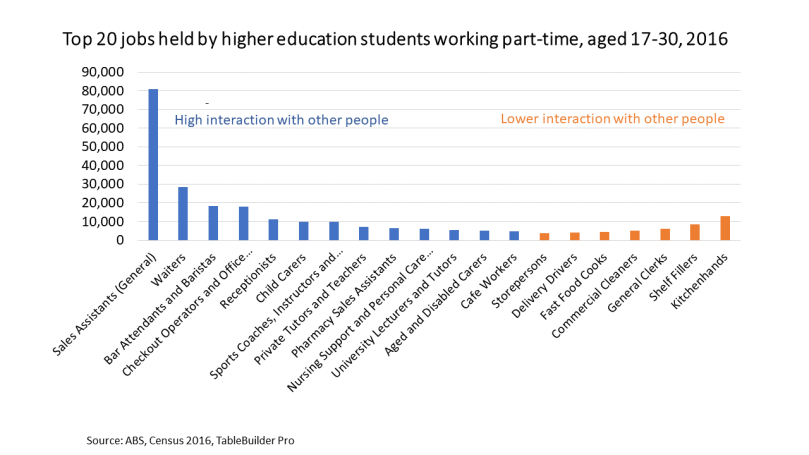
Because the census has detailed occupational information I am using it as my data source for jobs, even though it is now nearly four years old. The chart below shows the top 20 jobs for higher education students aged 30 or less who work part-time. The top 20 includes just over two-thirds of all employed students in this group.

As expected, student employment has a strong skew to occupations with large amounts of routine interaction with other people. Sales assistants are by far the largest single group. Waiters, bar attendants and baristas make up the next two largest groups. People in these occupations are all relatively likely to interact with someone with COVID-19, although if self-quarantine works not while that person is showing symptoms. job interaction with public

Read More »

Is grade inflation a problem in Australian universities?

In his multifaceted critique of higher education in The Australian yesterday, Adam Creighton makes one infrequently-made claim: that ‘grade inflation is rife’.

In Australia we often worry about soft marking at the pass-fail point, which Adam also mentions. But grade inflation controversies overseas are about too many students receiving high marks. In England, an increase in the proportion of students receiving first-class degrees from 16% in 2010-11 to 29% by 2017-18 has attracted the regulator’s attention. In the United States, critics complain that ‘A’ is the most popular grade.

Australian universities are not required to report student marks, and so we cannot conclusively confirm or reject the grade inflation hypothesis. But the figures we have do not look overly-skewed to the top.

In a paper looking at the relationship between ATAR and socioeconomic status, the NSW Universities Admission Centre earlier this year reported on first-year university grade point averages (GPA). They used a 7 point scale for their GPA.

The UAC’s main point is that ATAR rather than SES best predicts GPA. But it is striking that even the most able first-year students, coming into universities with ATARs of 90 or above, averaged less than a credit grade.Read More »

What happens if a university needs bailing out?

University finances have been in the news this year. As the travel ban on Chinese students was announced some very big financial costs were estimated – since moderated due to the third-country quarantine exception, but still estimated to be well over $1 billion, at least in temporary cash flow issues.

In worst-case COVID-19 scenarios there would be travel bans from many international student source countries, along with campus closures that could require refunds or compensating classes for affected domestic and international students.

While I doubt the worst-case scenario will become reality, the ‘rivers of gold’ era (as Simon Birmingham once described it) for university revenue is over.

Even before COVID-19 international student demand seemed to be softening, while remaining high by historical standards.

On top of this, all public universities are dealing with a decline in the real value of their bachelor-degree student funding, and some are struggling to maintain domestic student numbers due to soft demand.

Cutbacks have been reported at many universities including Wollongong, La Trobe, Sydney, Macquarie, Monash, and in the last day the University of Tasmania.

Fortunately, the universities that are most exposed to the China market are relatively wealthy. They should be able to deal with short-term liquidity issues from a mix of reduced and delayed spending, drawing on reserves and perhaps bank borrowing. But what if a university faces more serious difficulties?Read More »

Do 75 per cent of the fastest growing jobs require STEM skills?

In promoting the government’s international women’s day STEM announcement, science minister Karen Andrews is reported as stressing that ’75 per cent of the jobs in the fastest-growing industries need STEM skills’. This is a variant on a common claim. In the same article, it also appears as 75 per cent of all occupations, as it has here, here, here, here, here and in many other places. The industries version is less common but still a regular claim, for example here, here, and here.

The original source of this 75 per cent claim has always been hard to find. Some government documents cite this 2015 PwC report. But it does not have any data supporting this number, giving this 2011 article in the Journal of STEM Education as its source. Unfortunately the article does not substantiate the claim either, other than by pointing to this 2007 US Department of Education report. But the report does not mention the 75 per cent statistic at all, and so the trail goes cold.*

Even without checking the claim’s provenance it sounds suspect. How do we define fastest? Top 10, top 20, top half? It would be easy to manipulate the list to produce the desired result. And then there is the distinction between fastest growing (as a percentage of previous levels) and greatest growth (absolute numbers of jobs). Occupations can easily have very high percentage growth rates if they start from a low base, while in absolute terms adding many fewer jobs than larger occupations growing by a smaller annual percentage. Read More »

How should we measure SES for research students?

Last week the Department of Education issued a report on equity students enrolled in research higher degree programs. As those who have read my work over the years know, I think we have significant conceptual and empirical problems in measuring socioeconomic status in higher education. And these are even more significant for higher degree students than they are for undergraduates.

What this means is that even though the report’s overall conclusion, that high SES students are ‘over-represented’ in research degrees, must be true based on other empirical evidence and theory, its statement that ‘this data should … be used with caution’ is a warning that should be heeded.

Problem One: We are only using a geographic proxy indicator for SES, the ABS Index of Education and Occupation. A person is classified as low SES if they live in an area in which the population has relatively low levels of education and relatively high levels of people who are unemployed or work in lower-skill occupations.  But people with high levels of education and with high skill jobs live in otherwise low SES areas, and vice-versa.

Problem Two: We define as low SES people living in the lowest 25 per cent of areas by the Index of Education and Occupation. That is too small a share – the next quartile up is sociologically similar.

Problem Three: For research students, are we interested in their current socioeconomic status or their background? Regardless of their background, if they already have a degree (which they almost certainly do if they are in a research degree) and work in a professional job, as is quite likely to to be the case, then they are not going to be classed as low SES by the standard bureaucratic measures. And if they have moved to study and/or to be closer to professional job markets, then they will probably live in high SES areas.Read More »

Teaching public funding is skewed to STEM and health-related courses

With the government now publishing data on students by funding cluster we can get a clearer idea of where Commonwealth Grant Scheme money goes.

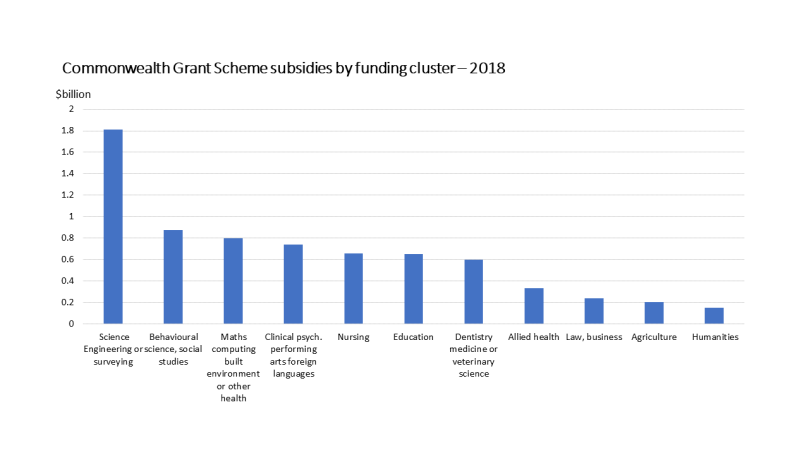
My calculations are for 2018, and based on multiplying equivalent full-time student numbers in Commonwealth supported places by the relevant funding cluster rate. Due to the demand driven funding freeze and some universities over-enrolling allocated places the overall total exceeds what universities were actually paid. However, as it is usually not possible to specifically identify ‘over-enrolled’ students I am going to assume that this does not affect relativities between the clusters.

As the chart below shows the science, engineering and surveying funding cluster is by far the biggest recipient of Commonwealth funds, at $1.8 billion in 2018 (and this is missing the maths and statistics buried in another cluster). The health-related clusters between them received $1.6 billion, and this is also an under-count due to some health courses being in other clusters.

funding cluster spend 2018 (all)

As is the case with public research spending, public tuition subsidies are skewed to STEM and health clusters. They have 32 per cent of EFTSL but 48 per cent of funding. The humanities, which are the subject of much of the controversy around higher education, received the least money of any cluster, $151 million in 2018. This is 2.1 per cent of the total.

However, it should be noted that other subjects typically taught in Arts faculties are in other funding clusters. For example, fields such as politics and sociology are in the second largest funding cluster by dollars (which also includes psychology, social work, and similar fields) and in the fourth largest funding cluster by dollars, which includes foreign languages and media and communications, which despite a recent downward trend has grown significantly over the last decade.

(Last paragraph added after original publication after Twitter commentary.)

How much did the demand driven funding freeze save the government in 2018 (and cost the unis)?

When the funding freeze on university bachelor-degree places was announced in December 2017 there were some big claims made about both how much it would cost the universities and save the government.

But at least in its first year, 2018, its effects were probably smaller than many people (myself included) expected.

I have to first put some caveats around my data, because I am trying to reconstruct what went on from multiple sources. As is often the case, there are discrepancies between the sources on what should be the same number,  such as equivalent full-time student load (EFTSL) or money paid. The main reason for this is that they are revised during the year in question and afterwards. Read More »