The Department of Home Affairs does not routinely report statistics on withdrawn student visa applications. At my request, they supplied me with student visa applications withdrawn data for 2019, 2023 and 2024. 2019 is my pre-COVID, pre-migration policy change, comparison year.
As I expected, with a stable market and policy framework the proportion of visa applications that are withdrawn is quite low – equivalent to around 1% of applications lodged in 2019. I don’t know of any research into these withdrawn applicants, but perhaps their circumstances changed or they received a better offer from another country.
Due to the Department of Education’s under-reporting of higher education funding, last year I consolidated institution-level information into a spreadsheet. There were about 250 downloads each for the original and a subsequent updated spreadsheet, so I decided it was worth doing again this year. The data sources are the funding determinations for the various funding categories.
I emphasised ‘preliminary’ in the post title because the FEE-FREE Uni Ready funding is not yet included. While this is a little frustrating, the upside is that when it is added the amounts involved will be more transparent than might otherwise have been the case. [Update 28/2/25: In Senate estimates yesterday the Department said that FEE-FREE Uni Ready funding equivalent to historical enabling places as of 2022 were included in the funding agreements. Funding for new FEE-FREE Uni Ready places is yet to be released.]
The headline figures to date are Commonwealth Grant Scheme (CGS) – $8.2 billion, estimated HECS-HELP lending of $5.9 billion, and estimated upfront student contributions of $700 million. Overall, about $14.8 billion, with 95% coming from the Commonwealth in cash flow terms. That percentage will go up when we get the FEE-FREE Uni Ready information.
That analysis found that demand for vocational education declined significantly, whether compared to 2023 or the more normal pre-COVID year of 2019. For higher education, demand was down on 2023. Compared to 2019, higher education demand in 2024 from migration-sensitive countries like India or Pakistan was well down, but demand from other important source countries increased or decreased only slightly.
Visa applications of course must be assessed by the Department of Home Affairs. Visas granted depend on visa processing levels and visa grant rates.
The visa grant analysis below is broadly consistent the first post’s applications analysis. Visa applications and grants in 2024 were both down on 2023. However, 2024 visa applications were up on 2019 but visa grants were down, reflecting fewer applications being processed and lower approval rates.
For both visa applications and grants vocational education has been hit hard. Higher education is more resilient overall, with visa applications and grants both up on 2019.
Due to unprocessed applications and unresolved appeals against visa application rejections, not all 2024 applications have been finalised. These could result in 2025 visa grants that exceed expectations created by recent application levels.
Less clear links between cause and effect
Drawing straightish lines between policy changes and policy consequences is harder for visa grants than applications. Delays between visa applications and processing complicate the analysis. By mid-2024 Home Affairs had a huge backlog – over 113,000 unprocessed applications – including many received prior to 23 March 2024 when significant rule changes came into effect. Because some old rules apply to applications received before policy change dates, different criteria can be used in the same processing month.
This post looks at the demand side, how many student visa applications have been lodged. A subsequent post will look at the supply side, visas granted.
The main findings are that the government’s policies have worked to substantially reduce demand for vocational education overall and from migration-sensitive countries in higher education, such as India and Pakistan. However 2024 Chinese higher education applications were down only slightly on 2023 and remain up on 2019. The impact on other traditional higher education source countries such as Malaysia, Singapore and Hong Kong was also muted (all slightly up or down).
Overall demand
As can be seen in the chart below, in 2024 the Department of Home Affairs received 429,691 student visa applications. This was down 20% on 2023, but still above 2019, the last full year before COVID migration restrictions distorted supply and demand.
With a break between jobs and other things going on I did not comment in December on the Accord-related MYEFO student funding announcements. Compared to last year’s consultation papers, the announcements included a policy change on over-enrolments, more detail on how under-enrolments will be handled, and funding amounts.
Over-enrolments
One of the worst ideas in the June 2024 managed growth consultation paper was a hard cap on Commonwealth supported places. Currently the main CSP category has a soft cap – once a university enrols CSPs valued at its maximum basic grant amount it gets only the student contribution for additional students. These student contribution-only places are known as ‘over-enrolments’. Under a hard capped system over-enrolments would receive zero funding. I explained why hard caps are a bad idea in this post.
In its MYEFO summary the government backed off a little from the hard cap idea. Now universities ‘will continue to receive student contribution amounts for a small proportion of additional students’. The reason given was the practical difficulty of hitting a precise enrolment target. [Update: At a Senate estimates hearing on 27/2/25 the Department said that ‘the overenrolment buffer will be between two per cent and five per cent’.]
An earlier post looked at Robert Menzies and higher education, first as Opposition leader and then as Prime Minister, from 1945 to 1956. Despite important structural changes in the early 1950s, with the Commonwealth commencing grants to universities via the states and directly financing Commonwealth scholarships, the university sector remained small and financially weak.
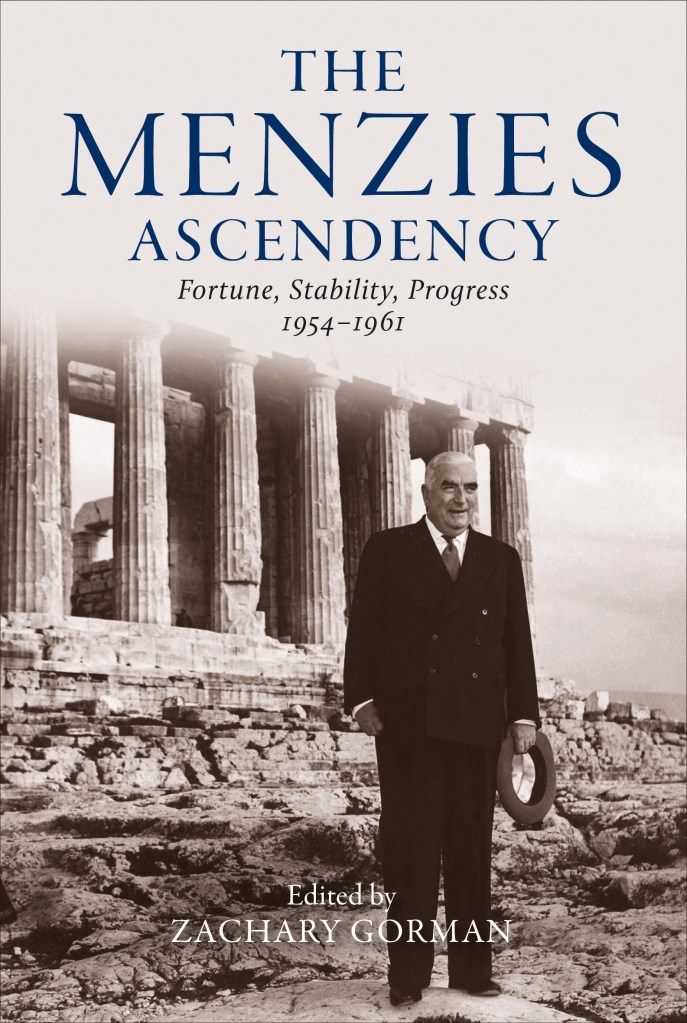
In March 1956, Menzies agreed to a university policy review, what became the Murray report. This post draws on my chapter on the Murray report in The Menzies Ascendancy: Fortune, Stability, Progress 1954–1961, edited by Zachary Gorman and published last month.
The appointment of Keith Murray to review universities
By the time Menzies agreed to the review he had already decided that major changes to university policy were needed.
In his book The Measure of the Years, Menzies says that prior to his trip to England in 1956, where he first met Keith Murray in person, he told Treasurer Artie Fadden that he was initiating an enterprise that could not fail to be ‘vastly expensive’.
In December 1956 Murray was appointed as chairman. The four other members included CSIRO Chairman Ian Clunies-Ross, believed to be the subsequent report’s main author.
As well as describing events surrounding the Murray report I tried some counter-factual history, in an attempt to understand the distinctive contribution of Menzies to Australian higher education policy. The post-WW2 period saw higher education expand in all the countries with which Australia compared itself. With or without Menzies, Australia’s pre-WW2 model of one impoverished, low-enrolment university in each capital city was not a plausible long-term system.
But what would have happened if Labor had remained in power after 1949, or won the close 1954 election? What would have happened if someone other than Menzies had led the Liberal Party (or the main non-Labor party, given Menzies’ role in creating the Liberal Party)?
This post looks at what happened up to 1956. A subsequent post examines the Murray report and its consequences.
Earlier this month I wrote a post showing that higher education enrolments at age 19 years, and the domestic participation rate at age 19, were down in 2023 compared to 2022.
This post explores possible reasons for this downward trend.
The teenage job market
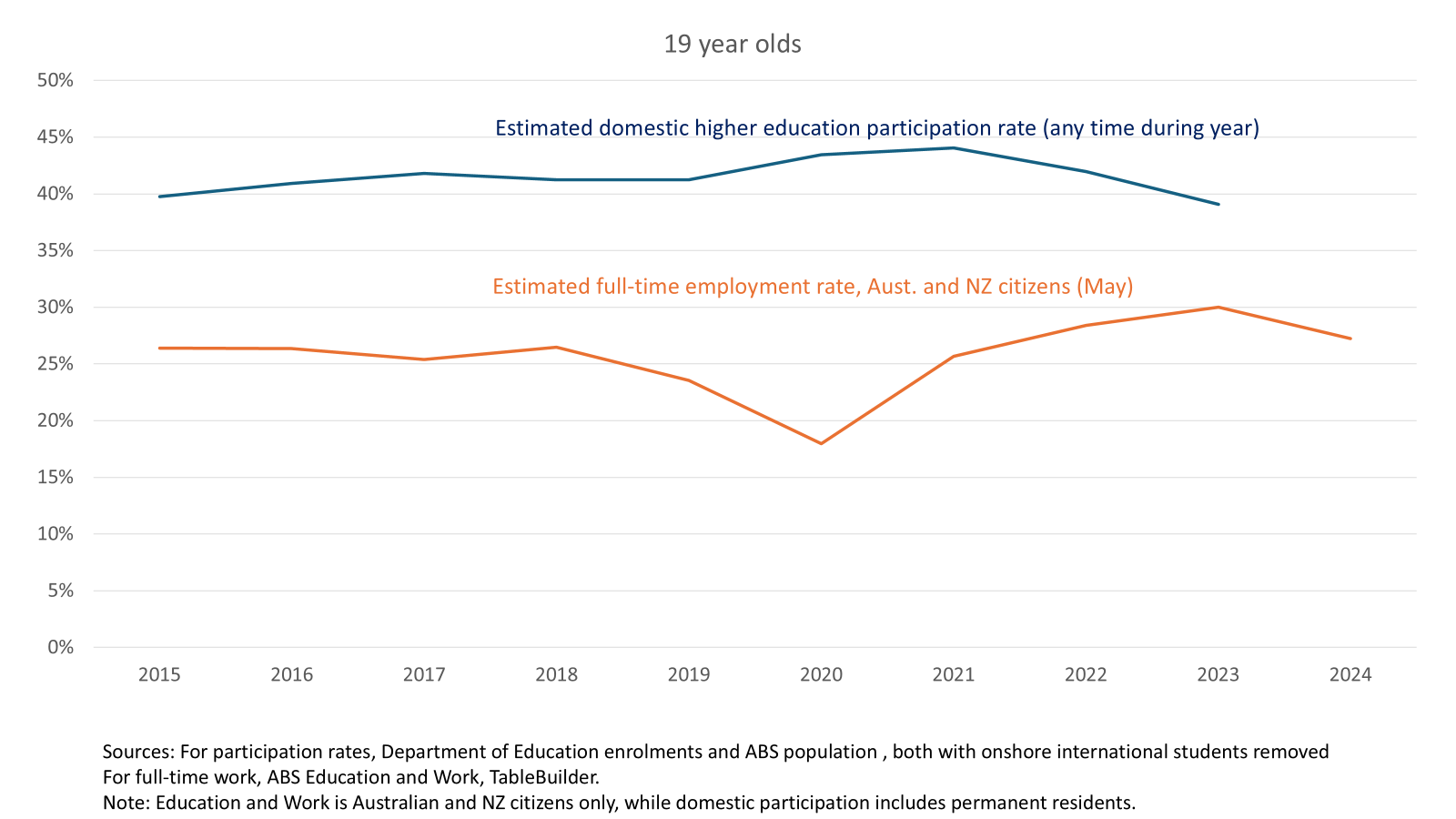
One explanation of declining enrolments at age 19 is higher education’s counter-cyclical relationship with the labour market. At the margins, some people prefer work to study, but study when work is not available. The higher education participation and full-time employment rates in the chart below match this theory. Higher education participation increased after COVID-related full-time job losses in 2020 and then decreased as job opportunities returned.
Education and Work TableBuilder supports analysis of smaller sub-groups than the standard ABS data releases, but with an increased risk of rogue results. Broader 15-19 year old statistics, however, confirm 2023 as a very strong year for full-time teenage employment. Both sources show that teenage full-time jobs grew strongly post-COVID and then softened in 2024, while remaining good compared to the 2010s.
Despite significant policy interest in higher education attainment rates, the preceding participation rates are rarely reported. The most readily available time series is in Mapping Australian higher education, at figure 5 of the 2023 edition. It reports the participation rate at age 19 years, the modal university student age. For the first time in decades, the Department of Education recorded a participation rate in their recent 2023 statistics release.
Unfortunately data issues mean participation figures are only estimates. This post discusses these data problems and compares participation rates using two different methodologies. Both point to participation in 2023 being lower than in all recent years.

 Andrew Norton