The last university over-enrolment crackdown – some possible lessons

As announced last year, the government plans to crack down on so-called ‘over-enrolments’ – enrolling additional students on a student-contribution only basis once all a university’s Commonwealth Grant Scheme allocation has been used.

When a proposed new funding system is in place, from 2027, student contribution-only places will only be possible in a buffer zone above a university’s Australian Tertiary Education Commission allocation. 2% and 5% buffers have both been suggested. Currently over-enrolled universities will receive some additional funding to bring over-enrolments within their official allocation of places. However, this will not in all cases reduce over-enrolments to the permitted range. Significantly over-enrolled universities need to moderate student intakes in 2026 to bring their medium-term enrolments down.

Not many current Department of Education staff were there the last time a minister thought reducing over-enrolments might be a good idea. The story is worth telling.

Brendan Nelson and over-enrolment

From November 2001 to January 2006 the education minister was Brendan Nelson, a Liberal. Nelson was worried about the quality implications of significant over-enrolments. The first reference I can find to Nelson’s concern is in a media release from December 2001, a month into his term.

Read More »

The new HELP repayment system and lifetimes of student debt

The prime minister says that a degree should not come with a lifetime of debt. For that goal, the government’s HELP legislation introduced last week is contradictory. It will cut all debt owed as of 1 June 2025 by 20%, which will shorten repayment times for current debtors. But it will also cut annual debt repayments for 99% of debtors, which will lengthen compulsory repayment times for many and push others into the PM’s lifetime of debt.

In the analysis below, female debtors owing $25,000 or more with incomes in the lowest 40% of graduate earnings face an increased risk of a lifetime of student debt. However, what percentage of female debtors actually face a lifetime of debt will depend on initial debt levels and how much their incomes vary through their careers. Voluntary repayments can also affect repayment times.

How the repayment system will change

My previous post on the initial threshold summarised how the repayment system will change. The key elements are that 1) repayment exempt incomes will include everyone on $67,000 or less compared to less than $56,156 now and 2) a marginal rather than total income repayment system will reduce what most debtors repay, particularly at lower income levels.

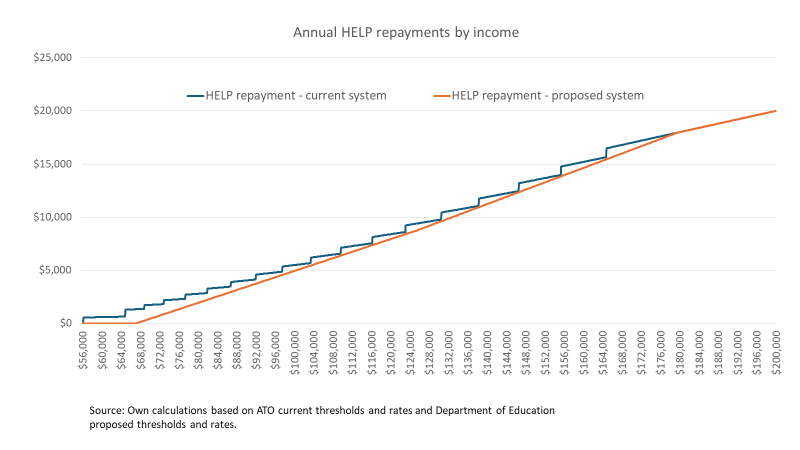
The chart below shows how this will affect HELP debtors at different annual income levels. Based on 2022-23 ATO data I estimate that 99% of debtors repaying under current thresholds will repay less per year than under the current system. The other 1%, all high income earners, will repay the same amount per year as now.

Read More »

Mapping Australian higher education 2023 – data update March 2025

Update 20/12/2025: More recent data here.

—————————————————————————————————

I won’t have the capacity to produce another edition of my Mapping Australian higher education report in the foreseeable future, but I am extending the life of the October 2023 edition by updating the data behind the charts.

Mapping‘s chart data is the only publicly-available source of long-term time series data on many higher education topics, especially on financial matters.

I had been waiting on the 2023 university finances report before releasing another chart data update. That finally happened yesterday. Despite a record 27 universities reporting deficits, in the aggregate there was a small surplus, after a loss overall in 2022.

2023 had some weak numbers for the two main Commonwealth student programs, the Commonwealth Grant Scheme and HELP. Several factors were behind this: temporary COVID places coming out of the system, Job-ready Graduates reductions in total funding rates for some courses, and weak domestic demand. These programs trended up in 2024 and 2025, as seen in the chart below, although high CPI-driven indexation was a significant factor.

The updated chart data is available here.

Will the ‘Costello baby boom’ have a weaker demographic effect on higher education than expected?

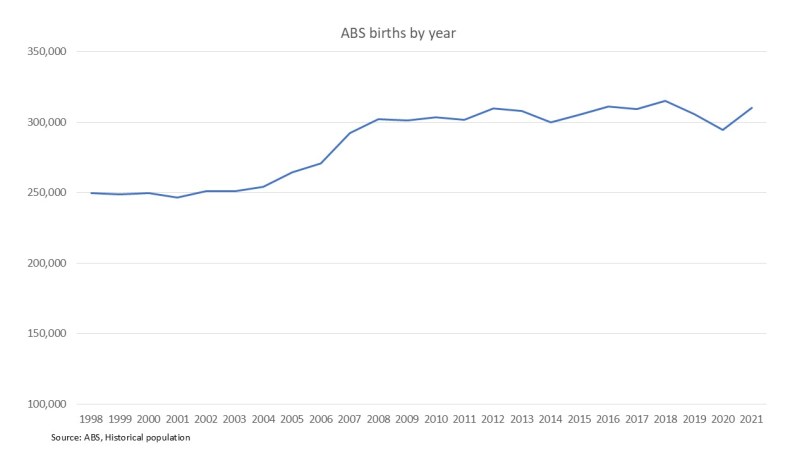
Since the late 2010s I have promoted the idea that the so-called ‘Costello baby boom’ cohorts will arrive at university age from the mid-2020s, increasing school leaver demand for higher education. As the chart below shows, annual births go from around 250,000 in the early 2000s to around 300,000 later in the decade.

Demographers are sceptical of how much effect mid-2000s pro-family policies had, but former Treasurer Peter Costello’s line that ‘if you can have children it’s a good thing to do – you should have one for the father, one for the mother and one for the country..’ was sufficiently memorable that this baby boom has his name attached to it.

As these cohorts approach university age this post takes another look at the data.

Read More »

How reliable are Census educational attainment numbers?

I am a big user of ABS data, including for calculating educational participation and attainment rates. Recently I have been using Census longitudinal data, which links records from a 5% sample of the Australian Census between different Census dates.

Due to respondent inattention to questions, or mistakes by family members answering for others, I would expect some inconsistent answers between censuses. But inconsistency rates for education-related questions are alarmingly high.

For the highest year of school education the ABS-reported inconsistency rate between 2016 and 2021 was 6.8%. For highest non-school qualification the inconsistency rate was 8.9% – meaning that a lower highest education qualification was reported in 2021 than 2016.

Read More »

Mapping Australian higher education 2023 – official release

Update 20/12/2025: More recent data here.

Mapping Australian higher education 2023 is now available from the ANU Centre for Social Research and Methods website.

Update 30/10/2024: There is a later version of Mapping 2023’s data here.

Update 26/10/23: A reader has pointed out that list of FEE-HELP NUHEPs is incomplete. A column of names from the original Excel file was omitted during production. The full list is available here. This list also includes three non-FEE-HELP providers registered by TEQSA since the pdf version was finalised. A corrected version of Mapping with the full list of NUHEPs, as of mid-2023, is here.

If anyone has noticed other errors please let me know.

Will demand driven funding for all Indigenous students make much of a difference?

Yesterday the government introduced legislation to extend demand driven funding from regional and remote to all Indigenous students. Currently Indigenous students from major cities are funded from within each university’s capped maximum basic grant amount for higher education courses. If the legislation passes universities will get the full Commonwealth contribution value of all enrolled Indigenous students in demand driven funding eligible courses, with no funding cap.

What are current Indigenous enrolments by geographic category?

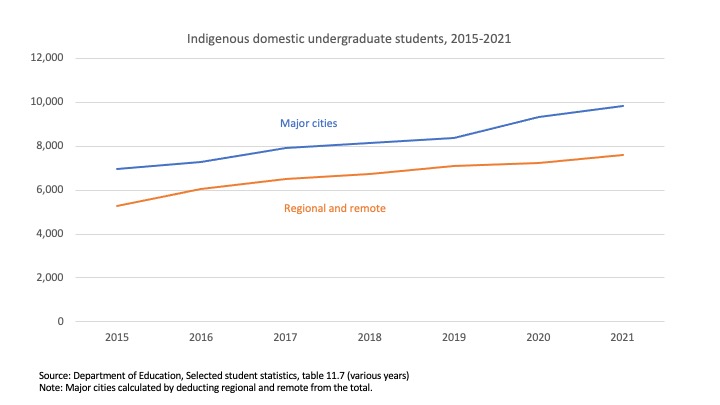
Demand driven funding only applies to bachelor degree students – of which more later – which makes it a funding category that is not also a publicly-reported statistics category. However a table in the annual equity statistics lets us calculate the number of undergraduate (ie bachelor + diploma + associate degree) Indigenous students by home geographic location. It shows that Indigenous students from the major cities outnumber regional and remote students. Enrolments from both groups have increased in recent years.

Read More »

Urban prospective students and regional student places: the Job-ready Graduates growth mismatch

In an earlier post I looked at how Job-ready Graduates could produce fewer total student places than originally forecast. This post examines the geographic distribution of those places. Both posts draw on my first submission to the Universities Accord review.

Job-ready Graduates ‘growth’ funding is based on campus location (‘growth’ in quotation marks because it is off a reduced base). Regional campuses get 3.5 per cent annual funding growth, with 2.5 per cent for metropolitan campuses in high growth areas, and 1 per cent for other campuses. Higher growth rates for regional campuses reflect concern about lower university participation rates for people from regional areas.

Growth funding is for coming increases in the school leaver population, which will translate into increased demand for higher education. My submission uses 2021 Census data to see where the school leavers of the mid-2020s to 2030 are located, and how this aligns with higher education policy.

City/rest of state growth rates

Full regional classifications are not yet included in the publicly available 2021 Census data, so the chart below uses a greater capital city/rest of state classification. The age groups cover the young people who will finish Year 12 and seek university entry from mid-decade through to 2030. It compares their numbers to those of people the same age at the 2016 Census, who reached/will reach university age in the first half of the 2020s.

Overall the population of 9 to 16 year olds was in 2021 13.5 per cent higher than in 2016 in the greater capital city areas and 7.8 per cent higher in rest of state areas. Population growth is significant in both categories, but larger in the cities that will get a smaller funding increment.

The chart also shows variations by specific year of age, with growth rates most aligned in the 11-to-14-years age groups.

Note: Citizens only. Source: ABS Census 2016 and 2021, TableBuilder Pro
Read More »

Higher education participation rates by time of migration and language spoken at home

Some 2021 Census is now available on the ABS TableBuilder site, allowing additional analysis of the social and personal characteristics of higher education students. This posts looks at migration status and language spoken at home, previous strong predictors of higher education participation rates.

Year of arrival

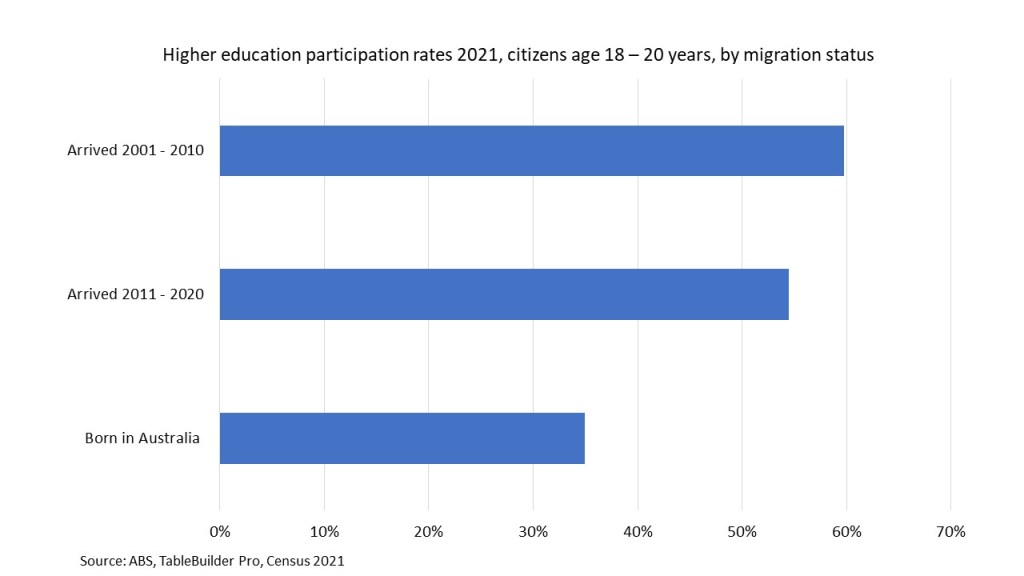
In 2021 migrants who had taken out citizenship were significantly more likely than people born in Australia to be enrolled in university in the post-school 18 to 20 years old age bracket. The participation gap was 19 percentage points for migrants in the decade prior to the 2021 census, 54 per cent participation compared to 35 per cent for young adults who were born in Australia. Migrants who arrived as younger children have a higher participation rate again, at 59 per cent.

Language spoken at home

Read More »