Gender-based violence legislation: Part 1, Definitions and requirements for all higher education providers, staff and students

Legislation on ‘gender-based violence’ in higher education is back in Parliament. Its principal purpose is to provide a legal foundation for a National Higher Education Code to Prevent and Respond to Gender-based Violence. This will be a legislative instrument made after the legislation is passed, but the minister has released its expected contents.

The code is scheduled to start on 1 January 2026 for universities and 1 January 2027 for other providers.

This post looks at the definition of gender-based violence, extension of the policy beyond higher education providers, and policies that will affect all staff and students. A second post looks at procedures for victims and perpetrators of sexual harassment or assault. A third post looks at reporting and penalties for higher education providers (apologies, but this is all much briefer than the 75-page original; 45 pages in the bill and 30 in the code).

Update 20/10/2025: The enacted legislation is here. The enacted code is here.

What is gender-based violence?

According to the bill, ‘gender‑based violence means any form of physical or non‑physical violence, harassment, abuse or threats, based on gender, that results in, or is likely to result in, harm, coercion, control, fear or deprivation of liberty or autonomy’: section 5 (legislative references, unless otherwise specified, are to the Universities Accord (National Higher Education Code to Prevent and Respond to Gender‑based Violence) Bill 2025).

Read More »

A National Student Ombudsman – how would this new student complaints mechanism work?

Last week the government introduced legislation for a National Student Ombudsman.

This post outlines key provisions of the bill. A government summary is here. A subsequent post looks at the potential impact of the bill on academic life.

Statutory references are to the Universities Accord (National Student Ombudsman) Bill, using the sections as they would appear in the Ombudsman Act 1976 if the bill passes.

Which students can complain?

All students of higher education providers, except those enrolled in VET courses, can complain to the National Student Ombudsman (abbreviated to Ombudsman from now). Apart from the VET exception, non-higher education students are included. Enabling, microcredential and professional development course students will be covered. In some cases prospective or former students can also make complaints: sections 3(1) and 21AD(1)(a).

Another person can make a complaint on behalf of the student: section 21AD(1)(b).

Read More »

The legal detail of the government’s plans to cap international student numbers

In an earlier post I criticised the government’s plans to cap international students by education provider and course.

This post goes through the capping legal detail of the Education Services for Overseas Students Amendment (Quality and Integrity) Bill 2024, which if passed would amend the Education Services for Overseas Students Act 2000.

The amending bill contains other provisions on education agents and education providers designed to limit misconduct in the international student market. This post does not cover these provisions, but Tracy Harris discusses them here.

In this summary, unless specified otherwise, the sections mentioned refer to the amending bill but use the section number as it would appear, if passed, in a revised compilation of the ESOS Act 2000. I also refer to the bill’s explanatory memorandum, which explains the intent behind some provisions. It can be downloaded from the bill’s webpage. The Parliamentary Library’s bills digest is also helpful.

Italicised phrases other than section headings highlight powers that give the minister wide discretion. I see this as a significant problem over-and-above the direct consequences of capping.

On what can international student enrolment limits be imposed?

Read More »

Mapping Australian higher education 2023 – official release

Update 20/12/2025: More recent data here.

Mapping Australian higher education 2023 is now available from the ANU Centre for Social Research and Methods website.

Update 30/10/2024: There is a later version of Mapping 2023’s data here.

Update 26/10/23: A reader has pointed out that list of FEE-HELP NUHEPs is incomplete. A column of names from the original Excel file was omitted during production. The full list is available here. This list also includes three non-FEE-HELP providers registered by TEQSA since the pdf version was finalised. A corrected version of Mapping with the full list of NUHEPs, as of mid-2023, is here.

If anyone has noticed other errors please let me know.

The proposed law against commercial cheating and the Constitution

Successive Commonwealth governments have been creative in finding ways to by-pass the Constitution. That has been very necessary in education, which was originally intended to remain a State responsibility.  The Commonwealth has no direct power to legislate on an education topic other than in the territories. This creates legal issues for the Commonwealth’s attempts to ban commercial cheating. Draft legislation was released at the weekend.

The Commonwealth’s main vehicles for education policy have been section 96 tied grants to the States (no longer used for higher education, but still used for school and vocational education), the section 51(xx) power to legislate on foreign, trading and financial corporations (which relies on universities being trading corporations; this power could collapse if they went back to full public funding) and section 51 (xxiiiA), the ‘benefits to students’ power, which is the main legal basis of Youth Allowance, the Commonwealth Grant Scheme, and HELP.

Because the Commonwealth can fully legislate for the territories, the draft bill would be effective in the ACT and the Northern Territory. But in the states the legal situation is more difficult.

Read More »

Is HECS a tax?

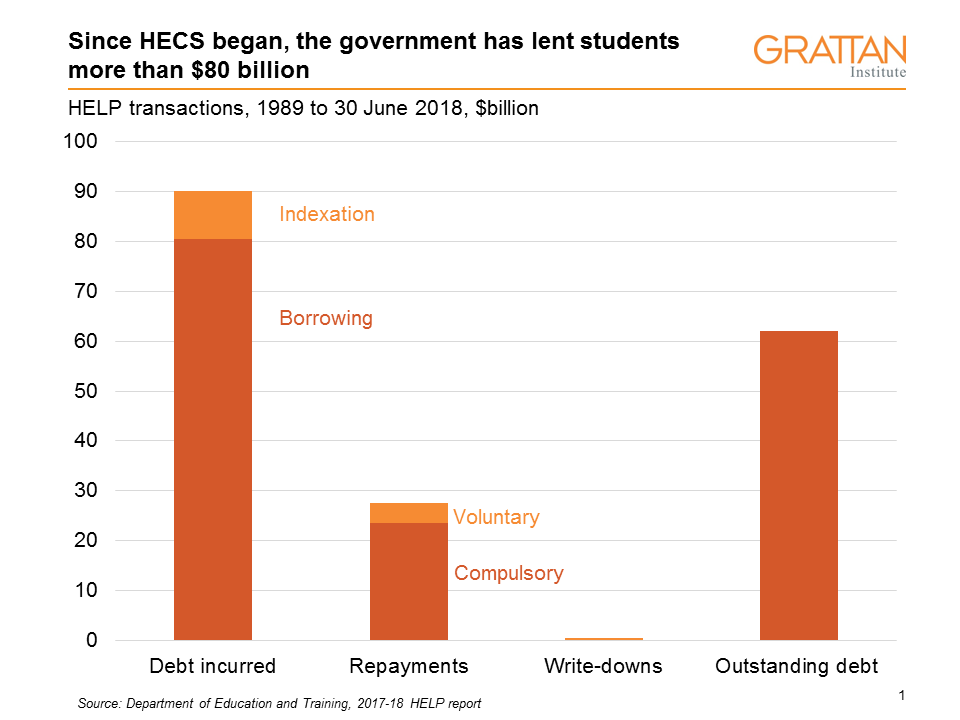
My use of the word ‘lent’ in the chart below was disputed on Twitter, on the grounds that payments of HECS or HELP are tax levies. Although not spelled out in the Twitter comment, this point is often more than just a semantic one. It is part of a larger argument about how student/graduate-sourced funding of higher education should work.HELP total debt

One potential system for funding higher education is a graduate tax. The idea here is that graduates pay a proportion of their income above a threshold for a period of time after they complete their degree. With a graduate tax,  higher education is free but extra taxes are paid by financially successful graduates. The revenue could go into general government funds or be set to recover what the government thinks should be the student contribution to total higher education expenditure. But there are no specific charges for subjects or courses and there is no loan. The language of ‘lent’, ‘borrowed’ or ‘debt’ would not make sense conceptually or legally.

Veteran Labor (and current QUT) higher education policy adviser John Byron has argued for thinking about HECS in something like these terms:Read More »

The public funding of religious colleges

The Age ran a page one story this morning on the potential eligibility of religious colleges for public funding, if the revised Pyne higher education reform bill passes. Labor and the Greens oppose the policy on the grounds that it breaches the separation of church and state, although Labor higher education spokesman Kim Carr draws a distinction between religious studies and training for the priesthood.

Australia doesn’t have a US-style separation of church and state. The Constitution ensures that the government will not prevent the free exercise of religion and limits the ways in which sectarian disputes can damage the government, but does not require the state to have no involvement with religious organisations. It is common for Australian governments to fund religious organisations, typically for school education and the delivery of social services.

In my view this is consistent with the original liberal thinking that led to the idea of a church-state separation. This was not based on hostility to religion. It is because religious belief is important to many (and historically most) people that liberals want to protect it. At the same time, attempts to use the state to impose religious belief and practices have often had very negative consequences.

From this perspective, a policy that funds theology studies and training for the ministry is unproblematic provided it is neutral between religions. The Pyne policy meets that criterion. All but two of the current religious colleges are Christian, but there is no legal obstacle in the way of other religions. A third non-Christian religion, Islam, does have a course in the public university sector.

Of course, it would not be hard to make an argument that such funding is unnecessary: religions have been training their own clerics for many centuries. But the same argument could be made against most higher education subsidies. My view on this is that while public subsidy of higher education could safely be reduced, while it exists it should be available to all students on a consistent basis.

What legal changes are needed for the Pyne higher ed reform package?

A few people have asked me about what legal changes are required to implement the Pyne higher education reform package. This post summarises what I think the legal situation will be. The relevant legislation is the Higher Education Support Act 2003 (HESA).

Changes to Commonwealth contribution rates

The government plans to introduce new, generally lower, Commonwealth contribution rates. This requires amending section 33-10 of HESA. I’ve heard it said that this will be part of the appropriation bills which by convention are passed by the Senate, but this isn’t right. Those appropriation bills cover only a smallish percentage of government funding, not including the Commonwealth Grant Scheme.

The government has also indicated that it wants to further reduce funding rates for diploma courses and non-university higher education providers. That would require more substantial redrafting, especially if the government intends to expressly fund research through the Commonwealth Grant Scheme. Section 33-10 alludes to the ‘benefits to students’ power in the Constitution. On the basis of the Williams No. 2 case (the school chaplains case), the High Court may well take a dim view of using this provision to fund research. (Update: There are other potential Constitutional foundations that possibly could be used here, such as the corporations power that was used for the TEQSA Act, universities being legal corporations.)

Increasing or abolishing the student contribution cap

This requires amendment of section 93-10 of HESA.

The government has said that international student fees will be the new cap. While not expressed exactly in those terms, this is already legislated through section 36-55 of HESA. What that section says is that student contribution amounts (legally defined as being for students in Commonwealth supported places) can’t be more than tuition fees (legally defined as being for full fee students). As section 36-30 effectively bans domestic full fee undergraduate students in public universities except in very limited circumstances, the tuition fee reference is almost invariably going to be to international students.
There is no requirement to offer courses to international students, and universities can increase their international student fees, so this is not a very strong capping mechanism.

Requiring universities to put 20 per cent of additional student revenue into a Commonwealth scholarship fund

One complexity here is that division 46 of HESA already has Commonwealth scholarships, in this case actually funded by the Commonwealth rather than other students. Apart from that there could be a backdoor way of doing this, via section 30-25(2), which enables the Commonwealth to put almost any requirement on universities not expressly contradicted by the Act as a condition of receiving funding. Given that the Commonwealth once got away with using 30-25(2) to force the University of Melbourne to subsidise the then legally separate Victorian College of the Arts, requiring universities to subsidise their own students would look reasonable in comparison.

That said, legislation or delegated legislation would give the policy a stronger legal basis, so I expect the government will pursue one of those options. Read More »
Greg Craven on education and federalism, then and now

Greg Craven on state government control of education, 2007:

Despite a total lack of experience in education, it [the Howard government] has created Commonwealth Technical Colleges, tried to control state school curricula and muttered darkly about controlling state education systems.

Canberra has only been able to intrude because it has the money, not the authority. Perhaps it should leave the money and run. Is it really impossible to argue that an elected Victorian government has a genuine interest in the education of Victorian children and that – horror – it might even bring local insight to the process? …

The mantra “Trust me, I’m with the Commonwealth” has the plausibility of a four-dollar note.

Greg Craven on state government control of education, 2013:Read More »

Is the student amenities fee loan scheme constitutional?

On the 7.30 current affairs program the other night, constitutional lawyer George Williams suggested that the Williams case High Court ruling might have implications for universities.

The case revolved around the constitutionality of the school chaplains program. Though reported in the past as about religion, the court in the end found for Williams on a ground concerning the executive power of the Commonwealth to act without legislation.

University funding does have a legislative basis. Its main constitutional backing is in section 51

(xxiiiA) the provision of maternity allowances, widows’ pensions, child endowment, unemployment, pharmaceutical, sickness and hospital benefits, medical and dental services (but not so as to authorize any form of civil conscription), benefits to students and family allowances; (emphasis added)

Three of the seven judges had something to say about what ‘benefits to students’ meant. Justice Kiefel said:

Social services provided to students might take the form of financial assistance, for example payment of fees and living and other allowances, or material assistance, such as the provision of books, computers and other necessary educational equipment, or the provision of services, such as additional tutoring. The term “benefits” in the context of s 51(xxiiiA) does not extend to every service which may be supportive of students at a personal level in the course of their education.

Read More »