The education minister should not have the power to cancel ‘classes of courses’ for international students

Update 28/11/2025: Last night the Senate passed the ESOS amendment bill with Coalition amendments. While I still believe this provision counts as very poor public policy – for reasons exanded up in my Senate inquiry submission – the Coalition changes do improve things somewhat. These are noted in the text below.

—————————————————————————————————-

The government is having another go at its 2024 Education Services for Overseas Students (ESOS) legislation, reintroducing it earlier this month minus the enrolment caps that saw it blocked in the Senate last November.

This post draws on and adds to things I wrote last year about proposed ministerial powers to suspend and cancel ‘classes of courses’.

The amendments discussed in this post were partly why I regarded the 2024 ESOS amendment bill as the single worst piece of higher education related legislation to come before the Parliament in my career.

What took it beyond standard bad policy was its use of broad ministerial discretion with minimal constraints on how it is exercised. That creates rule of law problems, making it hard to know in advance what the rules are. If passed, the amendments could lead to some education providers being arbitrarily punished for the actions of others.

Legislative references are to the section numbers of the ESOS Act 2000, as they are or as they would be if the bill passes unamended.

A mass course cancellation power

The bill gives the education minister power to simultaneously suspend or cancel multiple ESOS course registrations at multiple providers: division 1AB. It does this by making the unit of regulation a ‘class of courses’ – the definition of which is discussed below.

This mass cancellation power differs from existing laws that give the ‘ESOS agency’ (TEQSA in higher ed, ASQA in VET) power to suspend or cancel the registration of specific courses or specific providers: sections 83 to 92. It also differs from the current power of the immigration minister to issue a ‘suspension certificate’ to a provider. This can be done in specified circumstances such as fraud in visa applications, students breaching visa conditions, and other visa issues: sections 97 to 103.

Read More »
Student income support and the labour market

For the first time in years higher education student income support recipient numbers have increased. On a late June count, in 2025 147,490 students were receiving payments, up 10,575 or 7.8% on the same time in 2024. All three benefit programs – Youth Allowance, Austudy and Abstudy – increased numbers but 70% of growth came from the dependent Youth Allowance category, so people aged 21 years or less subject to a parental income test.*

Trends in total numbers

Although the 2025 upward trend is noteworthy given the recent history of decline, 147,490 recipients is still lower than any year in the 2009-2022 period. It’s nearly 73,000 below the 2014 peak, despite an increase in enrolments since then.

Policy decisions influence student income support numbers, but cannot fully explain these trends. The most significant negative policy change since 2014 was the 2016 conversion of the Start-up Scholarship to a loan, effectively reducing the non-repayable grant value of student income support by $2000 a year. But a downward trend started before then. Subsequent policy changes were small positives for students without, until 2025, stopping the decline in recipient numbers.

Read More »

2024 graduate employment outcomes and early 2025 trends

The 2024 Graduate Outcomes Survey finally came out this week. As recently as 2021 the GOS came out in the year it covered, not September the following year. The government’s inability/refusal to release data in a timely way means that we need alternative sources of information for sector-relevant trends. This post reports on the GOS and brings in job advertisement and ABS data.

2024 graduate employment results

What I found in alternative sources for 2024 graduate outcomes made me concerned. The ABS labour force survey showed a downward trend in employment for young graduates. If this was right, was it cyclical or something more structural, such as AI reducing entry-level employment? A couple of recent US studies, one specifically looking at recent graduates, suggested an AI impact.

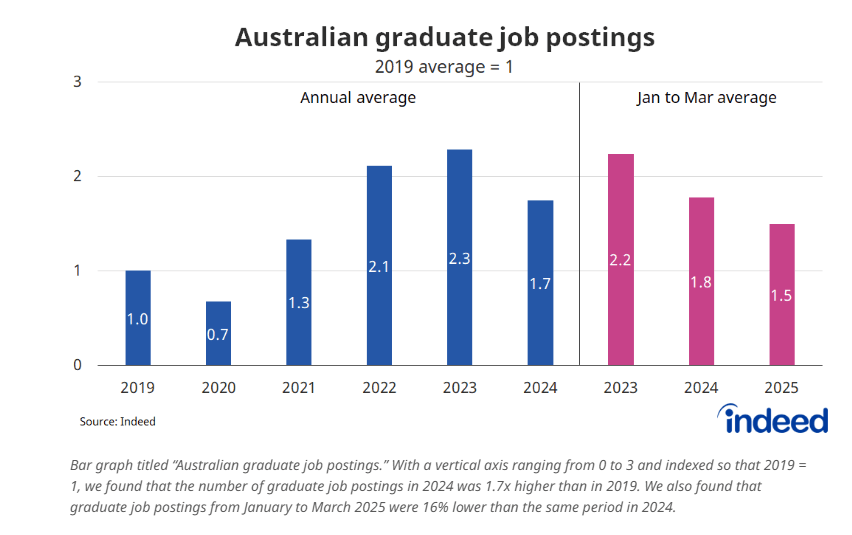
In May 2025, Callam Pickering looked at online job ads for graduates. He found that ads mentioning graduates declined in 2024 compared to 2023 – although they still exceeded 2019 levels. At least to March, ads for graduates in 2025 were tracking below the same months in 2024.

Fewer job ads targeting graduates cannot be good news, but I am not sure how important these are to the overall graduate labour market. There would be jobs typically taken by recent graduates that are not part of graduate programs or exclusively marketed to graduates. As work-integrated learning becomes more common, are firms increasingly hiring people they already know, recruiting graduates but not using advertising to find them? In analysis based on the 2023 GOS, but only graduates from institutions that had paid extra for WIL questions, 19% of people with new undergraduate qualifications said they had secured employment with a WIL employer and another 10% through a network contact made during their WIL experience.

Read More »

Why is demand for mature-age undergraduate education shrinking?

I have an article in The Conversation this morning on why demand for undergraduate higher education has been weak in recent years. I looked at school leavers in this July 2025 post. This post expands on the issue of mature age demand.

Applications

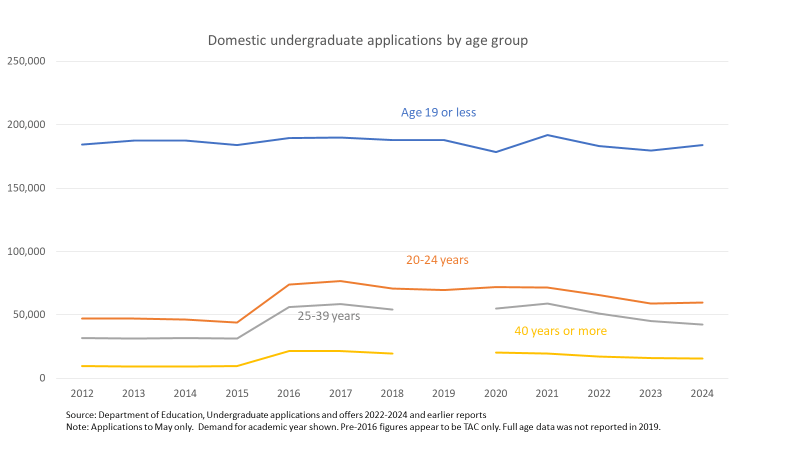
Demand from school leavers is soft but in 2024 was down only 3% on its 2017 peak. But demand from 20-24 year olds is down over the same period by 22% and for the 25 years + age group it is down by 27%. In absolute numbers, demand from school leavers fell by 6,057 applications compared to 44,545 fewer applications from mature age applicants.

Commencing enrolments

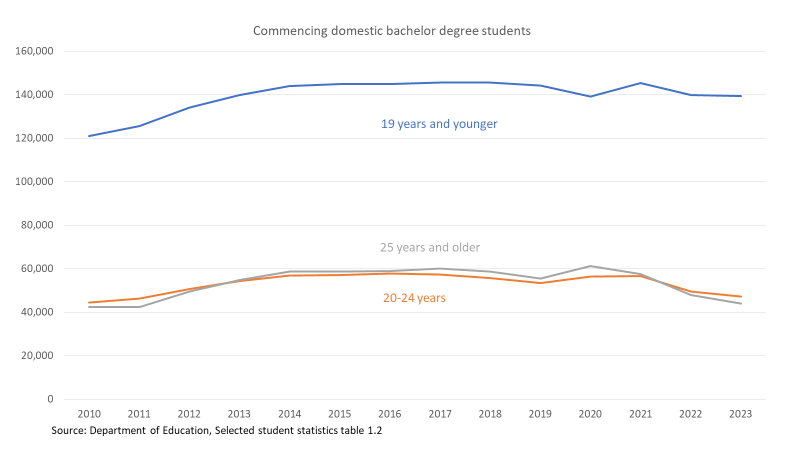
For commencing bachelor degree enrolments 2017 to 2023, unsurprisingly given the applications data, demand has also fallen by the most in the older demographics.

School leaver commencing enrolments are down 4% while the figures are 18% for the 20-24 years group and 27% for the 25+ group. Overall 6,216 fewer school leavers but 26,276 fewer mature age students.

Counter-cyclical enrolment patterns

An applications/enrolment spike in the COVID lockdown years provided evidence for one side of the counter-cyclical theory of enrolments – that more people study when jobs are hard to find. Weak labour markets reduce the ‘opportunity cost’ of education, such as forgone work and wages.

Conversely strong labour markets increase the opportunity cost of study. On average this is especially so for older people, due to their wage premium from previous labour market experience. With a strong labour market since 2022 economic theory predicts that, all other things being equal, enrolments will decline.

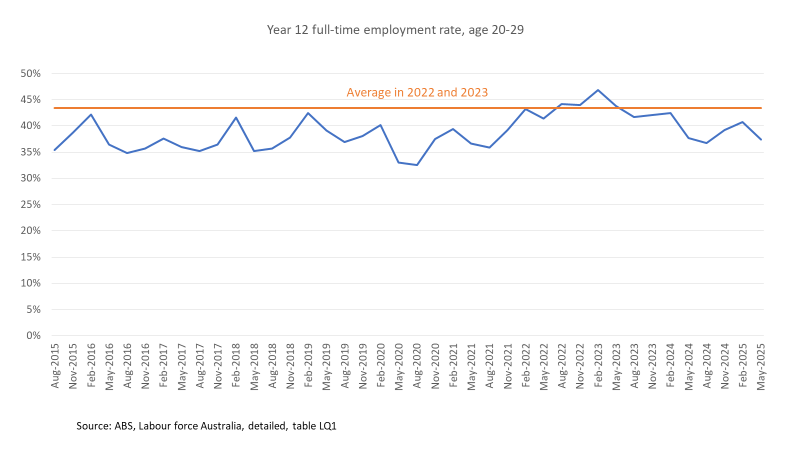
In the chart below we can see full-time employment for 20-29 year olds who have completed Year 12 but have no degree was at its lowest level in 2020, in the 2015-2025 period for which we have education levels in the labour force survey. In the initial post-COVID lockdown period, however, we can see that it was much easier than it had been in the 2010s to get a full-time job with a Year 12 qualification only.

The 2020s has provided evidence in favour of the counter-cyclical theory of higher education enrolments.

But does a cyclical theory of enrolments fully explain declining mature-age commencements?

Read More »

University funding systems and what graduates see as important in a job

For a side-project I’ve recently engaged with the subject of whether higher education funding systems shape the educational and career choices of students and graduates.

On one theory, where fees are charged students focus more on courses and jobs with high pay. Courses that satisfy intrinsic interests but do not offer good salary prospects would be less popular in countries with fees or after fee increases. Focus-group research on the views of students in European countries provides some support for this view (I have not cross-checked this against enrolments).

Under fee systems, depending on loan arrangements, taking courses with good job prospects may be necessary to reduce the risk of default on student debt repayments.

On another theory, also with some evidence from the European focus-group research, students in fee-paying countries may be more interested in courses that lead to personal financial rewards than courses that serve some broader public purpose. There are echoes of this argument in the local complaint that Australian higher education in the ‘neoliberal’ fee-charging era has lost sight of the ‘public good’.

I’ve discussed the role of interests in course choices before. In this post I look at the attitudes of graduates. My data source is survey evidence from the International Social Survey Programme. Unfortunately Australia only occasionally participates in these multi-nation comparative studies, but the ISSP’s 2015 work orientation questionnaire has Australian data.

What Australian graduates see as important in a job

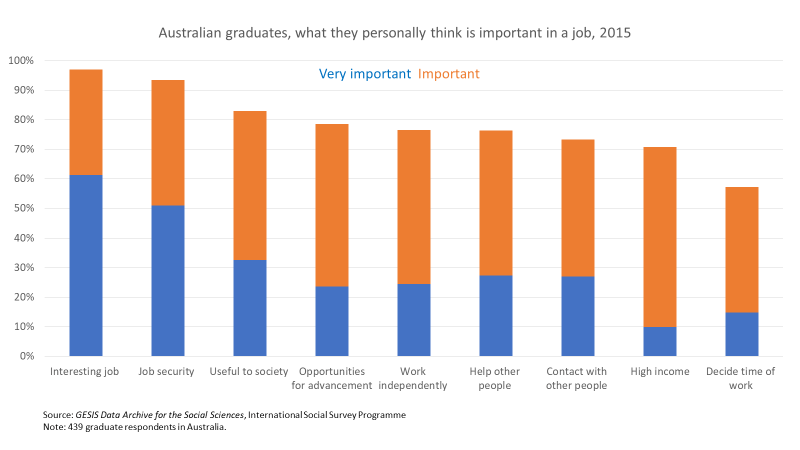
In the ISSP respondents are asked what job attributes they personally see as important.

A job being interesting is the single-most desirable attribute of a job for Australian graduates. This is consistent with interests being the dominant factor in course choice.

The ISSP question has two other-regarding options, being useful to society and helping other people. I presume helping others is a hands-on form of being useful, such as a teacher or nurse, while a policymaker, engineer or executive can produce useful-to-society structures and systems without directly helping specific individuals.

Perhaps because being useful to society is more general it is rated above helping others, and is the third mostly highly rated attribute overall.

Only 10% of graduates rate a high income as very important, the lowest of any attribute and the overall importance of money is the second-lowest of the options given. Money is nice to have but other job attributes are more important.

Read More »

Graduate income fluctuations and HELP repayment

Last week I raised concerns about the new HELP repayment system increasing the number of HELP debtors who face very long repayment times or lifetimes of student debt.

The calculations in that post assumed that people maintained their relative income position through their careers – for example that someone who earned the median income at age 25 would still do so at age 35, 45 etc. We know, however, that relative income fluctuates. Family commitments drive movements in and out of full-time work. Careers go better or worse than expected.

Without solving the problems involved in estimating how these changes affect HELP repayments, this post outlines findings on graduate income mobility and labour force status changes.

Movements between income quintiles

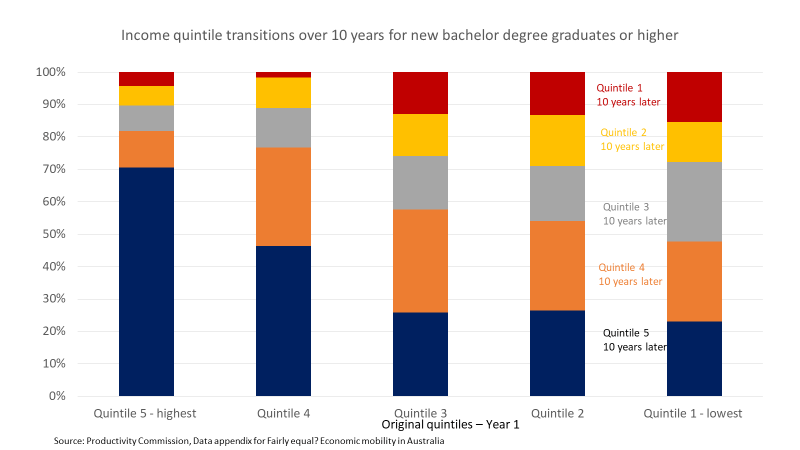
The chart below uses data from a Productivity Commission report on economic mobility. It shows changes in relative income, between five economic quintiles, over a decade since degree completion. The data source is HILDA.

Quintile 5, the highest, shows strong stability. More than 80% of graduates in quintile 5 were still there or in quintile 4 a decade later. The high starting point and following stability may be due to people already doing well in their careers acquiring postgraduate qualifications.

The other quintiles all show significant movement in relative income. Upward movement is expected as we know graduate incomes increase in the years after course completion. Almost half of graduates in the lowest quintile in year one are in the top two quintiles a decade later.

Bu there is also some stability at the lower end. In the two lowest quintiles, 1 and 2, over a quarter remain in those quintiles a decade later. In quintile 3 we see a similar share falling back to quintiles 1 and 2. While some of this is career stagnation, ten years out takes into the ages when women start leaving full-time work to meet family responsibilities.

Read More »

The Prac Payment that will go to Services Australia and the ATO, as well as students

Last year I was critical of how I thought the Commonwealth Prac Payments were going to work. These were to provide Austudy level payments, currently equivalent to $331.65 a week, for nursing, midwifery, social work and teacher education students while undertaking compulsory work placements. The payment starts on 1 July 2025 for students on income support and some working students.

Rather late in the day, the legal paperwork for its higher education version was completed last week. The vocational education diploma of nursing version paperwork was already available. The higher education version is administered by universities and funded through the ‘other grants’ provisions of the Higher Education Support Act 2003. The VET Prac Payment is administered by the Department of Employment and Workplace Relations, although the funding is authorised under the Social Security Act 1991.

Things I was concerned about that have not happened

Some of my Prac Payment concerns from last year were not realised in the policy as enacted. The Prac Payment has a means test but it is based solely on the student’s income, not family income. However family income has an indirect effect through eligibility for income support.

A policy goal is reduce the number of students who defer or withdraw from their course due to placement obligations, but students won’t need to prove that they are considering either of those things.

But in the Australian way of public policy, the Prac Payment is an underwhelming half-measure. The payment is low and will be further reduced by tax and by social security income tests. Many students won’t be eligible at all.

Read More »

Mapping Australian higher education 2023 – data update March 2025

Update 20/12/2025: More recent data here.

—————————————————————————————————

I won’t have the capacity to produce another edition of my Mapping Australian higher education report in the foreseeable future, but I am extending the life of the October 2023 edition by updating the data behind the charts.

Mapping‘s chart data is the only publicly-available source of long-term time series data on many higher education topics, especially on financial matters.

I had been waiting on the 2023 university finances report before releasing another chart data update. That finally happened yesterday. Despite a record 27 universities reporting deficits, in the aggregate there was a small surplus, after a loss overall in 2022.

2023 had some weak numbers for the two main Commonwealth student programs, the Commonwealth Grant Scheme and HELP. Several factors were behind this: temporary COVID places coming out of the system, Job-ready Graduates reductions in total funding rates for some courses, and weak domestic demand. These programs trended up in 2024 and 2025, as seen in the chart below, although high CPI-driven indexation was a significant factor.

The updated chart data is available here.

Reducing the number of ‘permanently temporary’ former international students

While I agree with the goals of today’s big migration policy changes, they will make life more difficult for universities relying on migration-motivated international students. In most cases, former international students will be able to stay in Australia on temporary graduate visas for less time than now. Other options for remaining in Australia, such as returning to a student visa, will become more difficult.

These policy changes aim to reduce temporary migrant numbers. The pressure temporary migrants place on accommodation and other services made this an urgent policy and political issue. But prior to this there were also significant concerns about temporary migrants themselves, in their vulnerability to labour market exploitation and prolonging their time in Australia in the often false hope of eventual permanent residence, as ‘permanently temporary’ migrants. The Parkinson migration review, released in March this year, set out an agenda for change.

Future policy on permanent residence is still under development, with some signals discussed below. Whether the number of former international students getting PR will go down remains to be seen. But clearer rules will mean PR aspirants can cut their losses at an earlier point. Fewer will delay important career and family events and decisions due to uncertainty about their long-term country of residence.

Shorter-stay temporary graduate visas

In September 2022 the government announced its decision to add two years to the sub-class 485 temporary graduate visa for graduates with degrees in areas of ‘verified skill shortages’. In the critique I wrote at the time I was ‘far from convinced that a 485 time extension is a good or ethical policy’, and so I am glad that this policy will be abolished.

As the chart below from the migration plan shows, they will also cut the base time period for a masters by coursework from three years to two years, and for a PhD from four years to three years. The regional extension, however, will remain.

Read More »