Graduate employment prospects during the COVID-19 recession

This post looks at the history of economic downturns and graduate employment since the early 1980s – specifically the early 1980s recession, the early 1990s recession and the end of the mining boom in 2013 – to draw out potential implications for the COVID-19 recession.

Historically, each downturn peaks at worse graduate employment outcomes than the previous one. The COVID-19 recession is likely to fit this pattern and deliver record high graduate unemployment. Not only is it likely to be the most severe recession in living memory, but it has already caused massive job losses in industries that are significant graduate employers.

Past recessions

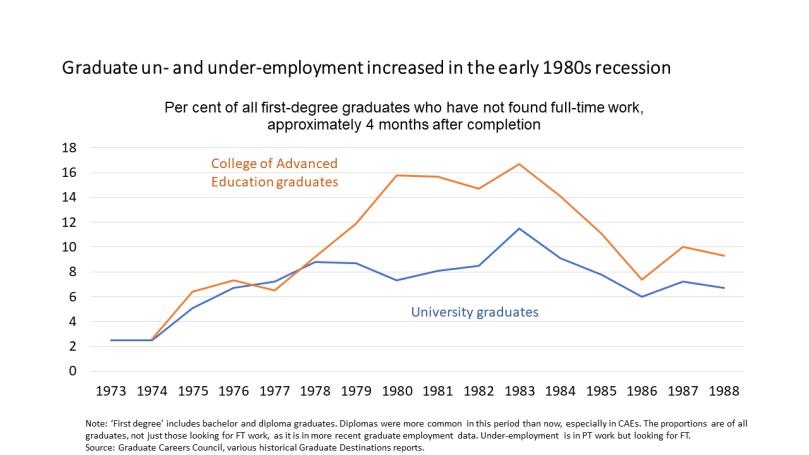
Thanks to old graduate destination survey reports being put online (scroll down here),  the employment effects of past recessions are easier to examine. The early 1980s recession triggered a four percentage point increase, on the best recent outcome in 1980, in university graduates still looking for full-time work four months after completion. But the negative effects were short-lived. By the mid-1980s employment outcomes were better than they had been in the late 1970s (chart below). Graduates of Colleges of Advanced Education had higher proportions looking for full-time work, but this appears to be mostly due to trends that started before the recession. Their results also recovered quickly.

1980s recessions

Read More »

Will the COVID-19 recession increase mature-age applications for higher education?

In an earlier post, I looked at how the COVID-19 recession might affect school-leaver applications for undergraduate education. I concluded that although the lack of job opportunities would favour continued education over unemployment, the scope for applications growth was lower now than during the early 1990s recession.

School retention is much higher now than 30 years ago, and a much larger proportion of the cohort with a potential interest in university already attends. With the age cohort’s size not changing much in the short term there is less room to move.

Interpreting historical application numbers from older university applicants is complicated. It includes relatively young people, did not until the last decade count direct applications to universities (which are mostly from older applicants), and does not distinguish between applicants who are already students but hoping to change courses and those seeking to enter higher education.

With these caveats, the chart below shows a large increase in applications from non-school leavers in the early 1990s. In percentage terms it is larger than the school leaver increase. It is consistent with the recessions drive up higher education demand hypothesis. The scope for growth is high because it is not constrained by the size of recent Year 12 classes.Read More »

Will the COVID-19 recession increase school-leaver applications for higher education?

Due to COVID-19 Australia faces the worst recession in living memory. This post is the first of a series looking at how this might influence demand for higher education. But to pre-empt future posts, applications are just one of several factors affecting how many students end up enrolled. Acceptance rates, deferrals, and attrition rates could all change, affecting student numbers.

I will start with the school leaver market. As I have noted previously, in recent years higher education applicant numbers have softened. For school leavers, demography will continue to cap numbers. But within the constraints of age cohort size, could the recession affect applicant numbers?

Recessions change the economics of choosing between higher education and work. If there are no jobs a university student does not forgo pay and work experience. Higher education’s opportunity cost falls. Further study might be the second-best option, but it is better than unemployment.Read More »

The student workforce and COVID-19

According to ABS statistics, about 60 per cent of students in full-time tertiary education have jobs (this includes vocational and higher education). Their major occupations put them at elevated risk of catching infectious diseases and of losing hours or jobs due to the COVID-19 recession.

Exposure to disease

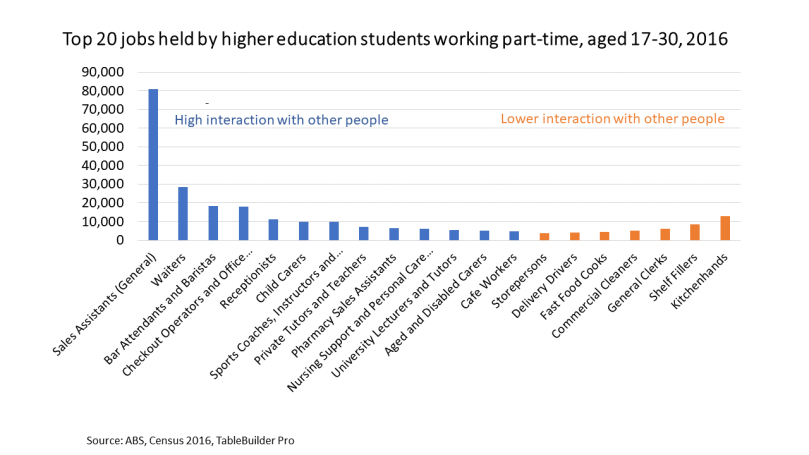
Because the census has detailed occupational information I am using it as my data source for jobs, even though it is now nearly four years old. The chart below shows the top 20 jobs for higher education students aged 30 or less who work part-time. The top 20 includes just over two-thirds of all employed students in this group.

As expected, student employment has a strong skew to occupations with large amounts of routine interaction with other people. Sales assistants are by far the largest single group. Waiters, bar attendants and baristas make up the next two largest groups. People in these occupations are all relatively likely to interact with someone with COVID-19, although if self-quarantine works not while that person is showing symptoms. job interaction with public

Read More »

Do 75 per cent of the fastest growing jobs require STEM skills?

In promoting the government’s international women’s day STEM announcement, science minister Karen Andrews is reported as stressing that ’75 per cent of the jobs in the fastest-growing industries need STEM skills’. This is a variant on a common claim. In the same article, it also appears as 75 per cent of all occupations, as it has here, here, here, here, here and in many other places. The industries version is less common but still a regular claim, for example here, here, and here.

The original source of this 75 per cent claim has always been hard to find. Some government documents cite this 2015 PwC report. But it does not have any data supporting this number, giving this 2011 article in the Journal of STEM Education as its source. Unfortunately the article does not substantiate the claim either, other than by pointing to this 2007 US Department of Education report. But the report does not mention the 75 per cent statistic at all, and so the trail goes cold.*

Even without checking the claim’s provenance it sounds suspect. How do we define fastest? Top 10, top 20, top half? It would be easy to manipulate the list to produce the desired result. And then there is the distinction between fastest growing (as a percentage of previous levels) and greatest growth (absolute numbers of jobs). Occupations can easily have very high percentage growth rates if they start from a low base, while in absolute terms adding many fewer jobs than larger occupations growing by a smaller annual percentage. Read More »

The changing nature of work training: further evidence and puzzles

In August, although I only noticed it yesterday, the OECD published a report on work-related training in Australia relevant to my recent blog posts. It has a couple of data sources I had missed that confirm the declining use of some forms of training.

The HILDA survey has a question about whether employed respondents have undertaken any education or training. Based on the questionnaire, it could have been higher education, vocational education or unaccredited training but it has to be ‘structured’. So it would not include short online self-education.

As the chart below from the OECD report shows, the proportion of workers undertaking any type of training has declined. From peak to trough, the proportion participating in structured learning for work over the previous 12 months has declined by about 5 percentage points.

HILDA work related training

I don’t have access to HILDA data, but it has several questions related to the purpose of the training that could help us understand what is going on (recalling that NCVER data suggests that training for the respondent’s current job is declining more than for a new job or promotion).Read More »

The popularity of online self-education

A couple of weeks ago I posted on the surprising apparent decline of reskilling and retraining. Mature-age undergraduate, postgraduate, vocational qualification, ABS work-related training, and ATO self-education expenses have all trended down in recent years. These trends did not seem consistent with the oft-repeated claims of workplace change and the need to reskill and retrain.

Especially on LinkedIn, much of the reaction to the post suggested that this was due to online self-education as a substitute for credentialed and uncredentialed courses and training. While I haven’t found any time series data on how online self-education  has grown, I am persuaded that this must be a significant part of the explanation.

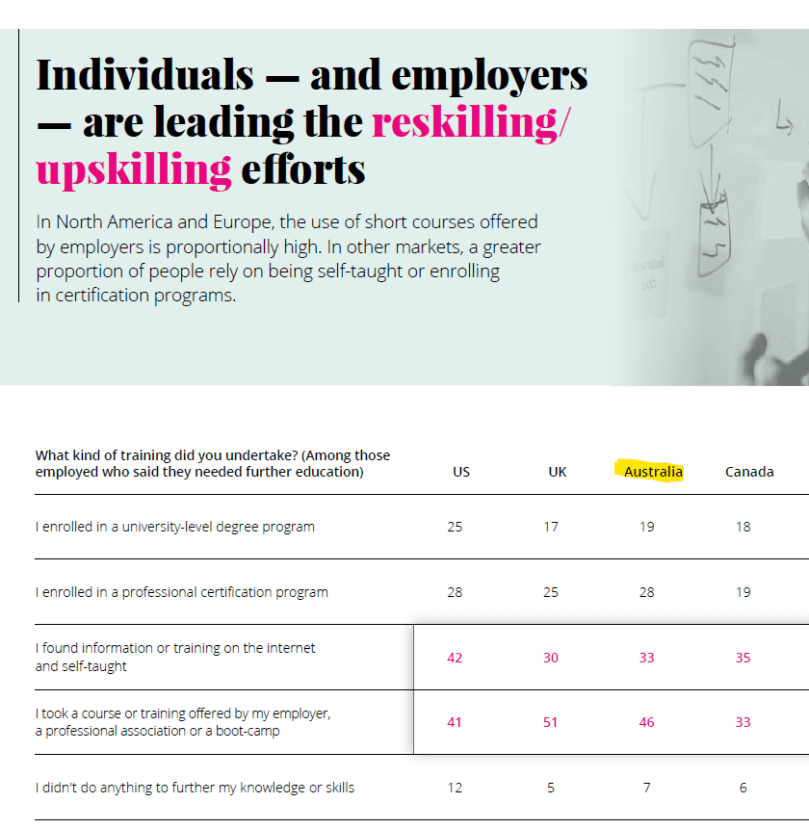
In a recent Pearson global survey of learners, employed respondents who required further training were asked how they did it. In Australia, organised courses or training are still more widely used than online self-education. But a third of the sample had used this method (chart below).

use Pearson

Read More »

Contrary to expectations, reskilling and retraining seem to be in decline

We are regularly being told that in an era of technology-driven labour market change we will need to reskill and retrain much more than we did in the past. Perhaps we will. But it is hard to find evidence for this in the available data.

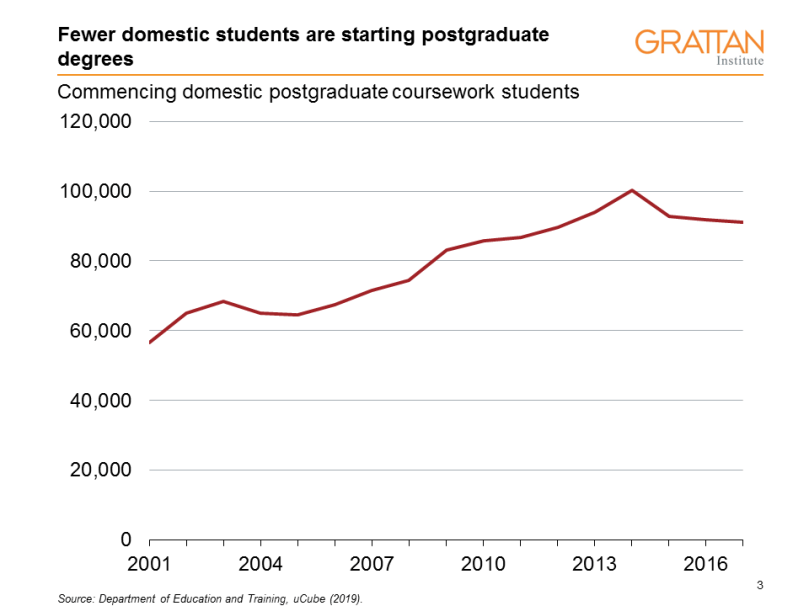
Let’s start in higher education. As I have noted before, mature-age undergraduate education is trending down. But domestic postgraduate coursework commencing student numbers are also down on their 2014 peak, as seen in the chart below. Education and business courses are driving the decline. Only health and IT courses have enjoyed enrolment increases since 2014.

Total student numbers are still high by historical standards. But with record numbers of eligible students (people who already have degrees), and undergraduate initial professional entry courses being converted into postgraduate qualifications, we would expect strong growth in this type of qualification. It is not happening.

postgraduate commencers

In vocational education too enrolments are trending down, including for people who already have a Certificate III or above qualification (taking the Certificate III as more clearly a career qualification than Certificates I or II). Read More »

Higher education inequality: do graduate outcomes differ by socioeconomic status?

In earlier posts in this series on inequality and higher education, I have suggested that the SES participation differences are largely driven by prior academic performance and that different SES groups seem to experience higher education in much the same way, but low SES students are less likely to complete their degrees. In this post, I will look at outcomes for the students who do complete their degrees.

First, are there differences in rates of getting a job? The 2017 Graduate Outcomes Survey finds that there are small differences. About four months after completing their bachelor degree, 73.6 per cent of high SES graduates who were looking for full-time work had found it, compared to 70.3 per cent of low SES graduates. However, of those who were working full time low SES students were slightly less likely to report not fully using their skills at work than high SES graduates (27.1 per cent compared to 28.9 per cent). It is difficult to say whether there is any direct SES effect in these results, as employment outcomes differ substantially by field of education, and SES differences in discipline choices could explain the results.

The Graduate Outcomes Survey also looks at starting salaries in the first full-time job after completing an undergraduate degree. Again, we find a small SES difference: the median starting salary for high-SES graduates in 2017 was $61,000, and for low SES graduates it was $60,000. This does not tell us whether there is any direct SES effect (such as not being able to access social networks to find professional jobs) or whether other factors such as discipline explain the result. A study using an earlier first year out survey had a limited control for discipline, as well as controls for weighted average marks, gender, and various other factors. It found no negative salary effect for low SES students, using a geographic measure of SES.

One possible cause of SES differences is that low SES students tend to attend the less prestigious universities, reflecting the school results issues reported in an earlier post. For example, 7.5 per cent of the University of Sydney’s students are low SES on a geographic measure, compared to 26.2 per cent of Western Sydney University students.

In theory, university attended should affect starting salaries. There are well-known differences in entry requirements between universities, which employers may take as a more reliable measure of ability than university marks, and employers may assume that the more prestigious universities have better teaching (can attract better staff, have more to spend – although student satisfaction surveys don’t support this conclusion). The first full-time job is when employers have to make greatest use of proxy indicators of potential, since most new graduates lack a track record in full-time skilled employment. Consistent with this, nearly 40 per cent of graduate employers say they have preferred institutions, mostly Group of Eight universities.

In practice, however, many studies have found no or small starting salary differences by university or university grouping (eg here, here, here, here and here). What course you take matters much more to your income than what university you attend. Read More »
Is the graduate labour market recovering?

Last week’s Graduate Outcome Survey, which looks at employment rates about four months after course completion, showed that full-time employment rates continue to improve. However, the proportion of new graduates looking for full-time work at this time is still high by historical standards, as the chart below shows (many of them have part-time jobs; this is not necessarily unemployment).

grad-FT-search

At the margins, there are things universities can do to make their graduates more employable. They can offer courses in fields likely to be in labour market demand, and they can offer work-integrated learning to improve graduate employability. Both were happening under the demand driven system.

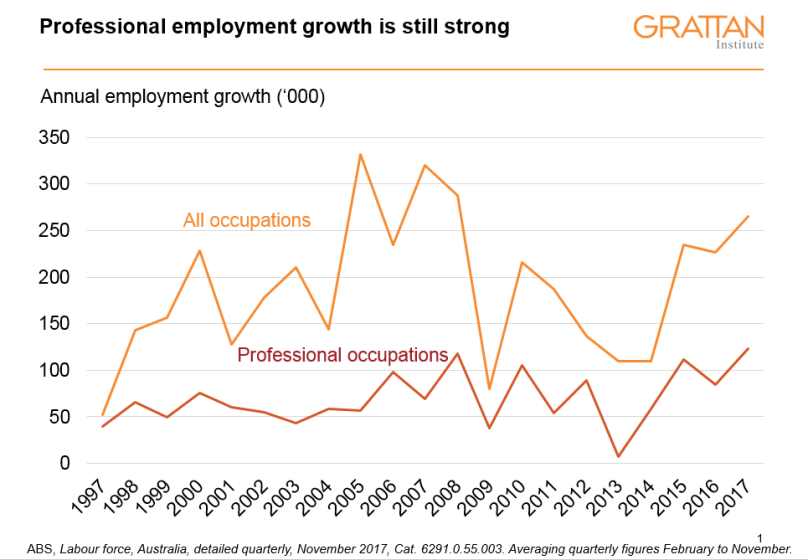
But unless there is overall job growth graduate employment is unlikely to improve. When the labour market is tight the first thing to go is new entry-level positions, and so this disproportionately affects recent graduates. The effects of downturns are visible in the chart on annual growth in professional occupations and the labour market overall.

The good news is that growth in the professional labour market has fully recovered from the post-GFC crash and the second crash that started in mid-2012.

profess-employ-2

Read More »