Why is demand for mature-age undergraduate education shrinking?

I have an article in The Conversation this morning on why demand for undergraduate higher education has been weak in recent years. I looked at school leavers in this July 2025 post. This post expands on the issue of mature age demand.

Applications

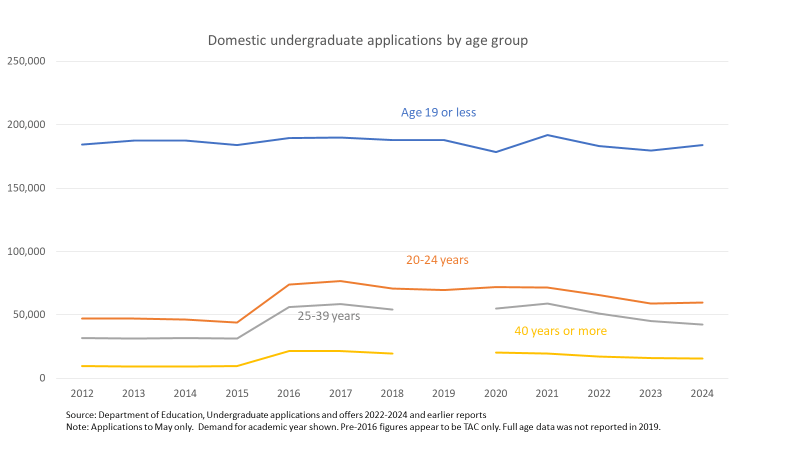
Demand from school leavers is soft but in 2024 was down only 3% on its 2017 peak. But demand from 20-24 year olds is down over the same period by 22% and for the 25 years + age group it is down by 27%. In absolute numbers, demand from school leavers fell by 6,057 applications compared to 44,545 fewer applications from mature age applicants.
Commencing enrolments

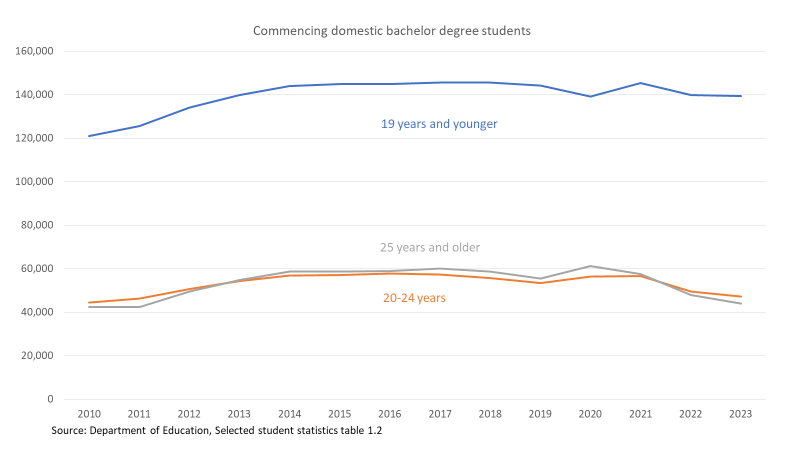
For commencing bachelor degree enrolments 2017 to 2023, unsurprisingly given the applications data, demand has also fallen by the most in the older demographics.

School leaver commencing enrolments are down 4% while the figures are 18% for the 20-24 years group and 27% for the 25+ group. Overall 6,216 fewer school leavers but 26,276 fewer mature age students.
Counter-cyclical enrolment patterns

An applications/enrolment spike in the COVID lockdown years provided evidence for one side of the counter-cyclical theory of enrolments – that more people study when jobs are hard to find. Weak labour markets reduce the ‘opportunity cost’ of education, such as forgone work and wages.

Conversely strong labour markets increase the opportunity cost of study. On average this is especially so for older people, due to their wage premium from previous labour market experience. With a strong labour market since 2022 economic theory predicts that, all other things being equal, enrolments will decline.

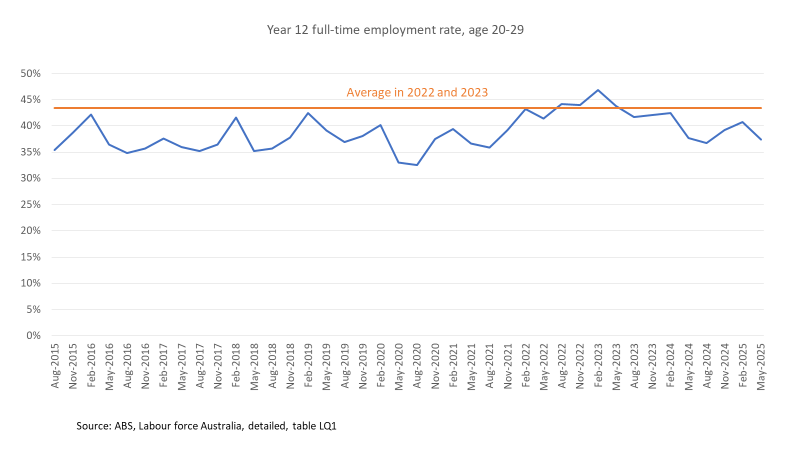
In the chart below we can see full-time employment for 20-29 year olds who have completed Year 12 but have no degree was at its lowest level in 2020, in the 2015-2025 period for which we have education levels in the labour force survey. In the initial post-COVID lockdown period, however, we can see that it was much easier than it had been in the 2010s to get a full-time job with a Year 12 qualification only.

The 2020s has provided evidence in favour of the counter-cyclical theory of higher education enrolments.
But does a cyclical theory of enrolments fully explain declining mature-age commencements?

Read More »

Job-ready Graduates price effects?: An update with 2022 enrolment data

The official release yesterday of the CPI-indexed Job-ready Graduates student contributions for 2025 has prompted questions about what impact the JRG price increases have had on enrolments.

With arts, business and law student contributions to hit nearly $17,000 a year in 2025 – with our bout of inflation having increased them from $14,500 in 2021 – students would be wise to think about whether this is a sensible investment. That’s $50,000 for a basic 3 year degree or $85,000 for common combinations like arts/law or business/law.

On the other hand, as I have argued, students follow their interests while keeping an eye on which courses within their cluster of interests would have the best employment and salary outcomes.

The most sophisticated work to date, using NSW data to 2021, found small effects in the expected directions.

Using simple trends in subjects taken, this post will look at domestic commencing EFTSL by discipline in the 2010-2022 period, drawing on the annual commencing load spreadsheet produced by the Department of Education. This does not distinguish between CSP and domestic full-fee students, but it is the best I can do with publicly available data.

Because I am comparing fields with very different absolute enrolments, I have converted them to an index, with 2010=1. So an index of 1.1 in a subsequent year would mean 10% more EFTSL, and an index of .9 would mean 10% fewer EFTSL.

Read More »

A cap-and-trade system for international student places

In an earlier post I argued that the government’s plans to cap international student numbers, including by education provider and course, would cause actual enrolments to fall well below the official maximum number.

This is due to the inherent weaknesses of bureaucratic systems of student place allocation. Even when meeting demand is a goal the limited information held by central planners, and the long time lags between allocations and enrolments, will cause student places to remain unused.

This post proposes a partial remedy to this problem, a cap-and-trade system for international student places.

Read More »

The competitive education market for workers updating their skills

In 2019 I wrote a series of posts on declining participation in formal education and training by people already in employment. Falling enrolments ran counter to claims that technology-driven disruptions to work would make further education more necessary than in the past.

The 2019 blog posts identified nine sources of survey and administrative data that should be trending up if the workforce disruption analysis was right. All seven data sources on individuals were instead trending down, while two employer surveys respectively showed a small increase in informal training and a larger increase in online training.

Informal training is not or is poorly measured in the individual person surveys. If it is increasing while structured learning is decreasing then this may signal a change in how people educate themselves after their initial formal education.

Prompted by this week’s release of new data on one of my trend indicators – ATO self-education expense claims – this post updates my 2019 analysis. Most indicators show signs of recovery but on the latest available data three are still trending down.

Postgraduate education

Postgraduate coursework education returned to growth in 2019. Commencing on-campus numbers continued to decline but were offset by online commencements. People moving straight from undergraduate to postgraduate study complicate my analysis, as they are trying to start rather than advance their careers. On the publicly available data I cannot distinguish the two groups.

Postgraduate numbers for 2019 remain below their earlier peak, but I expect 2020 and especially 2021 to be growth years. This is partly because I see postgraduate education as counter-cyclical, with COVID labour market disruptions in 2020 encouraging further study. If this hypothesis is right data noise complicates analysis of longer-term trends, but convenient online postgraduate options are attracting students.

Read More »

Key differences between Australian and British higher education: regional versus national markets and institutions

In two previous posts on higher education parallels between Britain and Australia, prompted by reading Peter Mandler’s book on Britain, I also noted that there were some important differences, which this post explores.

National versus regional systems

Mandler argues that in Britain a national higher education system emerged out of a ‘patchwork of institutions dating back to the middle ages’. Although local funding has been part of higher education finance in Britain, national funding was more significant early in the 20th century, and dominated the post-WW2 expansion of higher education. Universities were linked in a common funding system.

As a recent book by Gwil Croucher and James Waghorne explains, in Australia state governments were significant funders of higher education until the national government took over in 1974. Laws regulating the foundation of universities were state-based until 2011, although agreements between the states created a high degree of uniformity from 2000.

In Britain, free higher education from 1962 and a means-tested maintenance (income support) grant helped universities recruit nationally. Britain had a national applications and admissions system from 1961. However, devolution in the UK means that there are now differences in higher education finance between jurisdictions.

Free or consistently-priced undergraduate education across Australia since 1974, along with means-tested student income support, has not fundamentally changed the largely regional nature of Australian higher education. Most students attend universities in their state, and usually in their home city. Australia’s admission systems remain state-based.

Read More »

Funding incentives for students and universities in the Tehan reforms: some are aligned, others contradict each other

The higher education reforms Dan Tehan announced last month make the idea of ‘national priority’ courses, which are often but not always linked to employment prospects, a central feature.

This is a significant conceptual shift in the funding system. Historically, deliberately steering the system by course has been a marginal aspect of policy. It has occasionally been done by allocating new places to preferred fields, especially in the mid-to-late 2000s. In the same period, some changes to relative student contributions, particularly in the case of science, were designed to boost demand. But universities, influenced by student preferences, largely decided how student places were divided between courses.

In the Tehan proposal, universities will remain the main decision makers. The government will not directly allocate money to national priority fields. Instead, the government will send price signals to students across all fields of education, with low student contributions indicating national priorities, and high student contributions discouraging non-priority fields. Altered student preferences will, if the policy goes to plan, cause universities to shift student places to priority areas.

Student contribution effects

To date, most discussion has centred on what effect the new student contributions will have. My own position on this is mid-debate.

Read More »

Sitting out the recession at university: postgraduate courses

In previous posts, I looked at whether demand for undergraduate education would increase during the COVID-19 recession. In this post, I examine potential demand for postgraduate education.

As with initial undergraduate qualifications, theory suggests that a recession is a good time for postgraduate study. The opportunity cost of time spent out of the workforce is lower or non-existent. Studying is a relatively productive and interesting way of sitting out a recession.

In examining what happened in previous recessions I have been helped by a project that has put all the old graduate destination surveys online (scroll down to the bottom of the page here). Recessions aside, the trends are interesting.Read More »

The popularity of online self-education

A couple of weeks ago I posted on the surprising apparent decline of reskilling and retraining. Mature-age undergraduate, postgraduate, vocational qualification, ABS work-related training, and ATO self-education expenses have all trended down in recent years. These trends did not seem consistent with the oft-repeated claims of workplace change and the need to reskill and retrain.

Especially on LinkedIn, much of the reaction to the post suggested that this was due to online self-education as a substitute for credentialed and uncredentialed courses and training. While I haven’t found any time series data on how online self-education  has grown, I am persuaded that this must be a significant part of the explanation.

In a recent Pearson global survey of learners, employed respondents who required further training were asked how they did it. In Australia, organised courses or training are still more widely used than online self-education. But a third of the sample had used this method (chart below).

use Pearson

Read More »

Current higher education policies are the unsatisfactory result of political misjudgements in 2017. There are better ways of balancing the interests of students, universities and taxpayers.

Higher education is one of the sectors most affected by Saturday’s surprise election result. Labor’s biggest promise, restoring demand driven funding from 2020, would have delivered universities funding for all bachelor-degree students, with Commonwealth  contribution rates 5.3% higher than they were were in 2017. This did not require legislation; the current funding freeze was imposed through university funding agreements and could have been ended the same way.

By contrast, if the Coalition’s current policies stay in place there will be no demand driven funding and most universities face limited nominal increases in total Commonwealth Grant Scheme funding for bachelor-degree students (a few unis have special deals that will deliver larger increases). The best-case scenario for most universities is an annual total CGS funding increase linked to growth in the 18-64 year old population, if they meet yet-to-be-announced performance criteria.

The mention of population gives the impression that the policy will respond to demographics, but this is not correct. As the chart below shows, the projected increase in the 18-64 year old population is below even recent low CPI increases. In real terms total funding for bachelor-degree students will continue to decline.

population funding

If universities decide to maintain per student funding they would provide fewer student places each year (the logic is explained in this submission). It’s not clear to what extent this will happen. Commencements were down in 2018, but quite possibly due to weak demand for student places rather than a reluctance to supply them.  Existing enrolment projections, based on numbers universities give to the Department, suggest modest growth to 2022. But whether this would be sustained long-term with annual real funding cuts is unclear.Read More »

The VETification of higher education is a precedent that should not be set

In The Australian this morning an article points out that publicly-funded language diplomas may be not be available to new students from next year. In my view, that is a correct implication of both general policy statements on funding diplomas and associate degrees made by the government, and the specific consultation paper on sub-bachelor courses.

Unfortunately, this is a case in which the government, in attempting to fix one problem, would create several new problems.

The original problem here is that diplomas and associate degrees were, at the last minute in 2011, excluded from the demand driven system. That means that the total number of government-funded sub-bachelor places remains set by the government, the allocation of places between universities reflects largely historical decisions, and new places (when available) are distributed according to regularly changing criteria. The distribution of places does not strongly align with the preferences of students, the strategies of universities, or the needs of employers. In the review of the demand driven system I did with David Kemp, we recommended putting sub-bachelor places into the demand driven system.

On the surface, the government’s proposal looks like it is responding positively to this recommendation. Constraints on the number of funded sub-bachelor places will be lifted in two ways. First, sub-bachelor courses approved by the minister will enter the demand driven system. Second, sub-bachelor courses not approved by the minister will be given an exception on the general ban on undergraduate full-fee places at public universities.

Language courses are in trouble because they typically fail to meet both the announced criteria for sub-bachelor demand driven funding – that they articulate into a related bachelor degree program, and that they have been developed with a focus on industry needs. Read More »